DropleX: Liquid sensing on tablet touchscreens
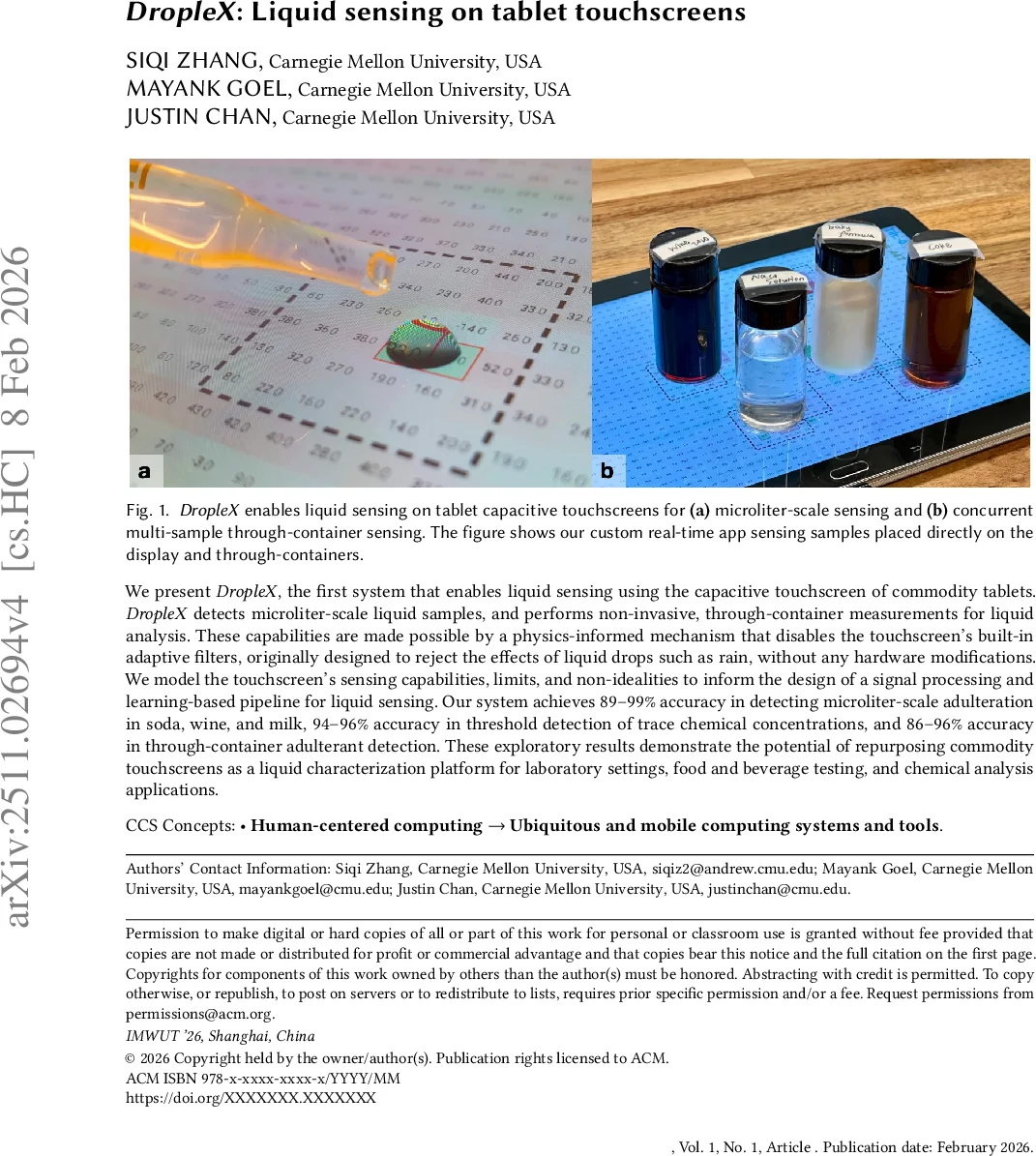
We present DropleX, the first system that enables liquid sensing using the capacitive touchscreen of commodity tablets. DropleX detects microliter-scale liquid samples, and performs non-invasive, through-container measurements for liquid analysis. These capabilities are made possible by a physics-informed mechanism that disables the touchscreen’s built-in adaptive filters, originally designed to reject the effects of liquid drops such as rain, without any hardware modifications. We model the touchscreen’s sensing capabilities, limits, and non-idealities to inform the design of a signal processing and learning-based pipeline for liquid sensing. Our system achieves 89-99% accuracy in detecting microliter-scale adulteration in soda, wine, and milk, 94-96% accuracy in threshold detection of trace chemical concentrations, and 86-96% accuracy in through-container adulterant detection. These exploratory results demonstrate the potential of repurposing commodity touchscreens as a liquid characterization platform for laboratory settings, food and beverage testing, and chemical analysis applications.
💡 Research Summary
DropleX introduces a novel method for turning the capacitive touchscreen of off‑the‑shelf tablets into a liquid‑sensing platform without any hardware modifications. Commercial touchscreens are designed to reject transient liquid events (e.g., rain) by employing an adaptive filter that continuously recalibrates the baseline capacitance. The authors discovered that this filter is automatically disabled whenever a finger touch is detected, because the system must maintain a stable signal for a valid touch. Exploiting this behavior, they devised a physics‑informed “priming” procedure: a small water droplet is deposited on the screen, leaving a thin conductive film that mimics a permanent finger contact. This simple step—performed with an eye‑dropper, a fingertip, or a tissue—temporarily disables the adaptive filter, allowing the touchscreen controller to continuously report the capacitance changes caused by any liquid placed on or above the screen.
With the filter disabled, the tablet’s mutual‑capacitance sensor provides a spatial “heatmap” of capacitance values at a frame rate of about 1.67 Hz. Because raw scalar capacitance values for different liquids often overlap, the authors leverage the spatial distribution of the electric field, including fringing fields that extend beyond the liquid’s physical boundary. They first perform a one‑time multi‑point calibration to generate a sensitivity‑compensation map that corrects for spatial non‑uniformities across the electrode grid, and they apply temporal averaging to suppress noise. The resulting heatmaps are fed into a convolutional neural network (CNN) that learns discriminative features for liquid classification.
Experimental evaluation covers three major use cases. (1) Microliter‑scale adulteration detection: soda, wine, and milk samples spiked with 10‑100 µL of contaminants are identified with 89‑99 % accuracy. (2) Trace chemical detection: DNA, NaCl, and ethanol at low concentrations are detected with 94‑96 % accuracy, demonstrating the system’s sensitivity to subtle permittivity changes. (3) Through‑container sensing: liquids placed inside plastic, glass, or metal containers are sensed from above the screen, achieving 86‑96 % accuracy across different container materials and thicknesses. Additional studies examine the impact of temperature (20 °C‑40 °C) and sample volume (10 µL‑1 mL), confirming robustness under varied laboratory conditions.
Compared with prior work, DropleX stands out in three respects. First, it requires no external display, dedicated electrode arrays, or protective polymer coatings; the existing tablet hardware suffices. Second, it moves beyond reporting raw capacitance values by employing spatial pattern analysis and machine learning to achieve reliable classification of both liquid type and concentration. Third, it demonstrates non‑invasive through‑container measurements, a capability absent from earlier touchscreen‑based approaches that either used standalone screens or required direct contact with the liquid.
Limitations include dependence on Android tablets and specific touchscreen controller implementations; extending the technique to iOS devices or other manufacturers will require additional validation. The fixed electrode pitch (~1 mm) limits spatial resolution, and continuous high‑frequency sampling may increase power consumption and device heating. Future work could explore optimized electrode designs, low‑power data acquisition, and cloud‑based real‑time analytics to broaden applicability to field diagnostics, food safety testing, and educational kits.
In summary, DropleX provides a low‑cost, software‑only solution that repurposes ubiquitous tablet touchscreens into versatile liquid analysis tools, opening new avenues for accessible laboratory instrumentation and on‑site chemical testing.
Comments & Academic Discussion
Loading comments...
Leave a Comment