What Makes LLM Agent Simulations Useful for Policy Practice? An Iterative Design Study in Emergency Preparedness
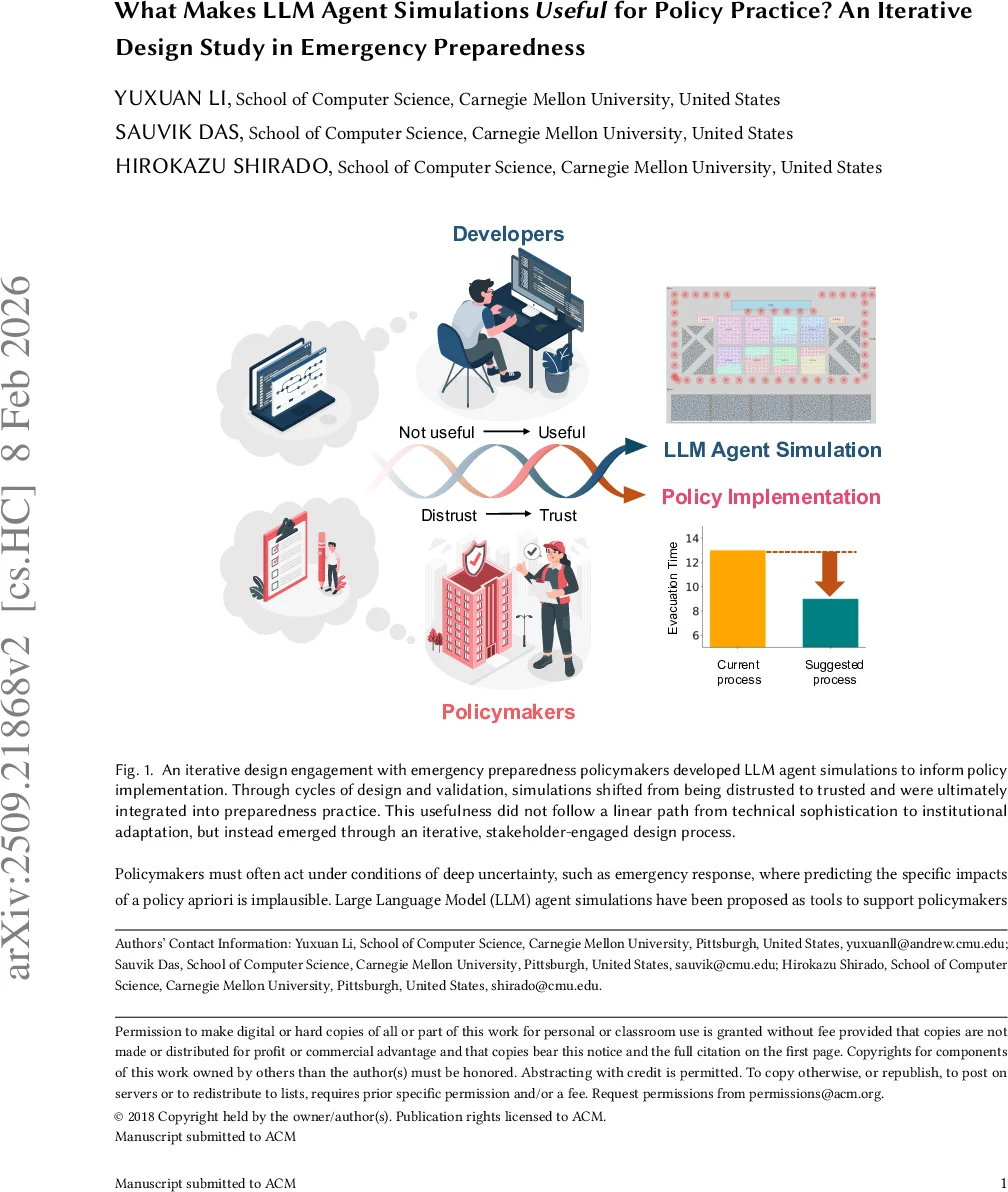
Policymakers must often act under conditions of deep uncertainty, such as emergency response, where predicting the specific impacts of a policy apriori is implausible. Large Language Model (LLM) agent simulations have been proposed as tools to support policymakers under these conditions, yet little is known about how such simulations become useful for real-world policy practice. To address this gap, we conducted a year-long, stakeholder-engaged design process with a university emergency preparedness team. Through iterative design cycles, we developed and refined an LLM agent simulation of a large-scale campus gathering, ultimately scaling to 13,000 agents that modeled crowd movement and communication under various emergency scenarios. Rather than producing predictive forecasts, these simulations supported policy practice by shaping volunteer training, evacuation procedures, and infrastructure planning. Analyzing these findings, we identify three design process implications for making LLM agent simulations that are useful for policy practice: start from verifiable scenarios to bootstrap trust, use preliminary simulations to elicit tacit domain knowledge, and treat simulation capabilities and policy implementation as co-evolving.
💡 Research Summary
This paper investigates how large‑language‑model (LLM) agent simulations can become genuinely useful tools for real‑world policy practice, focusing on emergency preparedness at a university campus. The authors conducted a year‑long, stakeholder‑engaged design study with the institution’s emergency preparedness team. Their goal was not to build a predictive model but to create an interactive simulation that could inform training, evacuation procedures, and infrastructure planning.
The study begins by identifying the limitations of traditional physics‑based evacuation models, which ignore the social, communicative, and institutional dimensions that dominate crisis response. LLM agents, by generating behavior from natural‑language prompts, can model semantic reasoning, role negotiation, and information propagation—capabilities that rule‑based agents lack.
The design process unfolded in five iterative phases: (1) requirements exploration through interviews and observations; (2) definition of concrete, high‑stakes scenarios (e.g., a graduation ceremony with thousands of attendees); (3) prototype development, scaling from a few hundred to 13,000 agents that simulate both movement and communication; (4) empirical validation against campus CCTV, crowd‑flow data, and radio logs; and (5) policy integration, where simulation outputs guided volunteer allocation, announcement scripts, and exit‑route prioritization.
Through this longitudinal collaboration the authors derived three design implications for making LLM agent simulations useful for policy practice:
-
Start from verifiable scenarios to bootstrap trust. By grounding the simulation in a real event that can be measured, policymakers can directly compare outputs to observed data, building confidence in the model’s fidelity and limits.
-
Use preliminary simulations as technology probes to elicit tacit domain knowledge. Even imperfect early prototypes surface hidden assumptions about role expectations, communication norms, and trust mechanisms that are otherwise invisible to designers.
-
Treat simulation capabilities and policy implementation as co‑evolving. As the simulation becomes more sophisticated, it reshapes policymakers’ questions and expectations; conversely, shifting institutional priorities prompt revisions to the simulation’s parameters and architecture.
The authors also acknowledge risks inherent to LLM‑driven simulations, such as bias amplification, opacity, and difficulty of causal explanation. They mitigate these risks through continuous stakeholder feedback loops, transparent validation procedures, and by positioning the simulation as an “in‑silico rehearsal” rather than a decision‑making oracle.
Ultimately, the LLM agent simulation proved valuable not as a forecasting engine but as a sandbox for policy rehearsal. It informed volunteer training curricula, suggested modifications to evacuation signage, and helped the university refine its emergency communication protocols. The paper’s contribution lies in demonstrating that the usefulness of AI‑driven social simulations hinges more on participatory, iterative design processes than on raw model performance, offering a roadmap for researchers aiming to embed LLM simulations within institutional decision‑making contexts.
Comments & Academic Discussion
Loading comments...
Leave a Comment