Uniformly S-projective relative to a module and its dual
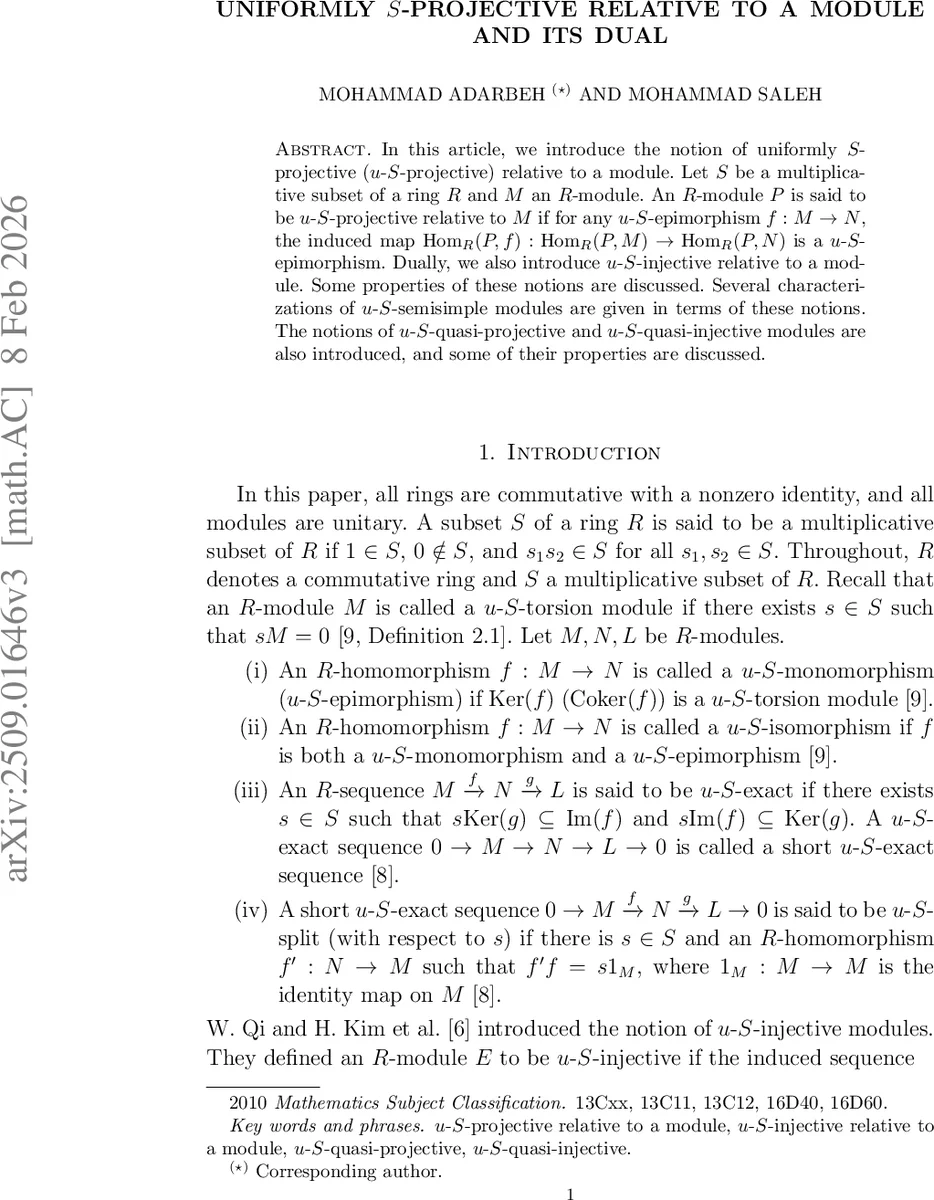
In this article, we introduce the notion of uniformly S-projective (u-S-projective) relative to a module. Let S be a multiplicative subset of a ring R and M an R-module. An R-module P is said to be u-S-projective relative to M if for any u-S-epimorphism f : M \to N, the induced map HomR(P, f ): HomR(P, M ) \to HomR(P, N ) is a u-S-epimorphism. Dually, we also introduce u-S-injective relative to a module. Some properties of these notions are discussed. Several characterizations of u-S-semisimple modules are given in terms of these notions. The notions of u-S-quasi-projective and u-S-quasi-injective modules are also introduced, and some of their properties are discussed.
💡 Research Summary
The paper introduces a uniform version of relative projectivity and injectivity with respect to a fixed multiplicative subset S of a commutative ring R. For an R‑module M, an R‑module P is called u‑S‑projective relative to M if for every u‑S‑epimorphism f : M → N (i.e., Coker f is S‑torsion), the induced map Hom_R(P,f) : Hom_R(P,M) → Hom_R(P,N) is again a u‑S‑epimorphism. Dually, u‑S‑injective relative to M requires that for every u‑S‑monomorphism g : K → M (i.e., Ker g is S‑torsion) the map Hom_R(g,E) : Hom_R(M,E) → Hom_R(K,E) is a u‑S‑epimorphism.
The authors first show that these definitions are equivalent to more concrete conditions involving natural quotient maps. Theorem 2.3 (and its dual Theorem 2.4) proves that P is u‑S‑projective relative to M iff for every submodule K ⊆ M the map Hom_R(P,η_K) (where η_K : M → M/K) is a u‑S‑epimorphism. This mirrors the classical characterization of relative projectivity but replaces exactness by the weaker “uniform S‑exactness” condition.
Subsequent results establish stability under direct sums (Theorem 2.7), under passage to submodules and quotients (Theorem 2.11 and 2.12), and under u‑S‑isomorphisms (Proposition 2.9). In particular, if M is u‑S‑projective relative to a module B, then it is also u‑S‑projective relative to any submodule A ⊆ B and the corresponding quotient B/A. The same holds for u‑S‑injectivity.
A central part of the paper is devoted to u‑S‑semisimple modules. Theorem 2.16 and Theorem 2.17 give several equivalent characterizations: a module M is u‑S‑semisimple iff every R‑module is u‑S‑injective relative to M, iff every R‑module is u‑S‑projective relative to M, and also via conditions on kernels of endomorphisms of injective modules and cokernels of endomorphisms of projective modules. These statements generalize the classical semisimple notion by inserting the uniform S‑torsion condition.
Section 3 introduces u‑S‑quasi‑projective and u‑S‑quasi‑injective modules: a module is quasi‑projective (resp. quasi‑injective) when it is u‑S‑projective (resp. u‑S‑injective) relative to itself. The authors note that the implications u‑S‑projective ⇒ u‑S‑quasi‑projective and u‑S‑injective ⇒ u‑S‑quasi‑injective are strict; examples demonstrate that the converse fails in general. Proposition 3.4 provides a local characterization: a module is u‑S‑quasi‑projective (resp. quasi‑injective) iff every finitely generated submodule enjoys the same property.
Finally, Theorem 3.11 characterizes u‑S‑semisimple rings: a ring R is u‑S‑semisimple iff every left R‑module is u‑S‑quasi‑injective, equivalently iff every right R‑module is u‑S‑quasi‑projective. This mirrors the classical Wedderburn‑Artin theorem but within the uniform S‑framework.
Overall, the paper systematically extends the classical relative projectivity/injectivity theory by incorporating a uniform S‑torsion condition. It shows that most familiar properties (stability under direct sums, passage to submodules/quotients, behavior under isomorphisms) survive this generalization, and it provides new characterizations of semisimple structures that blend S‑localization with module-theoretic concepts. The work therefore offers a coherent bridge between S‑torsion techniques and relative homological algebra, opening avenues for further exploration in contexts where a distinguished multiplicative set plays a central role.
Comments & Academic Discussion
Loading comments...
Leave a Comment