Choi-Wang inequality for affine connections
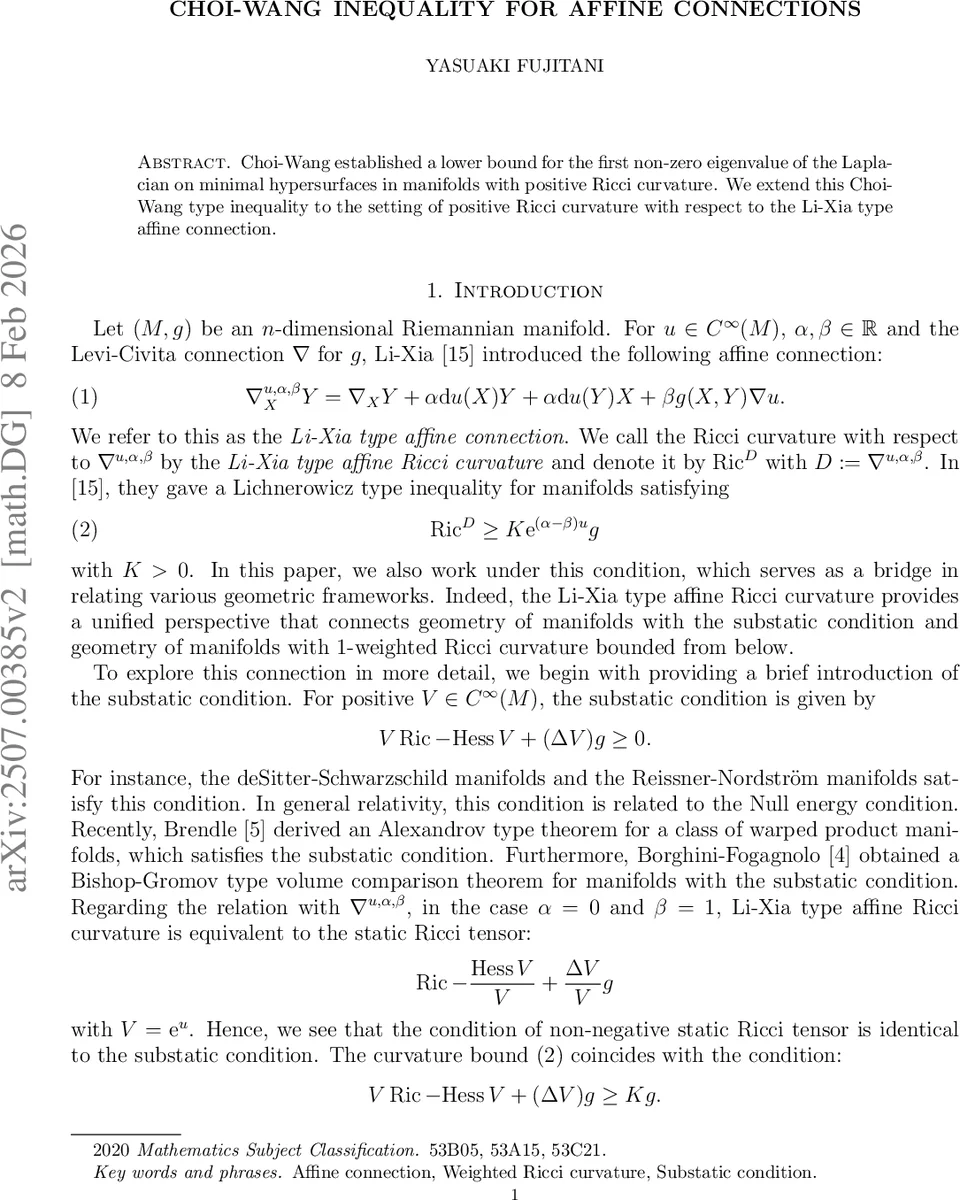
Choi-Wang established a lower bound for the first non-zero eigenvalue of the Laplacian on minimal hypersurfaces in manifolds with positive Ricci curvature. We extend this Choi-Wang type inequality to the setting of positive Ricci curvature with respect to the Li-Xia type affine connection.
💡 Research Summary
The paper investigates a natural extension of the classical Choi‑Wang eigenvalue estimate to the setting of affine connections introduced by Li and Xia. Let (M,g) be an n‑dimensional compact orientable Riemannian manifold and let u∈C∞(M) together with real parameters α,β define the Li‑Xia affine connection
∇_{u,α,β}X Y = ∇_X Y + α du(X) Y + α du(Y) X + β g(X,Y)∇u.
The associated Ricci curvature Ric_D is called the Li‑Xia affine Ricci curvature. The authors assume a positive lower bound of the form
Ric_D ≥ K e^{(α−β)u} g, K>0,
which generalizes the usual Ric ≥ Kg condition and also encompasses the static Ricci tensor and the sub‑static condition appearing in general relativity.
The first major contribution is the observation that (M, e^{(α−β)u}g, ∇_{u,α,β}) is a statistical manifold: the Amari‑Chentsov tensor (D_X g)(Y,Z) is symmetric, and the dual connection D* can be written explicitly. Using this statistical structure, the authors apply a Bochner‑type theorem due to Opozda to obtain a first Betti‑number estimate: if Ric_D ≥ 0 then b₁(M)≤n, and if Ric_D is positive somewhere then b₁(M)=0. This result recovers known estimates for weighted manifolds (Lott) while covering the new affine‑connection case.
Next, the paper develops a Reilly‑type formula adapted to the affine connection. They define the D‑gradient, D‑Hessian, and D‑Laplacian by
∇_D φ = V^{β−α}∇φ, V=e^{u},
Hess_D φ = V^{β−α}(Hess φ + β du⊗dφ + β dφ⊗du + α g(∇u,∇φ)g),
Δ_D φ = tr(Hess_D φ) = V^{β−α}
Comments & Academic Discussion
Loading comments...
Leave a Comment