OpticalAging: Real-time Presbyopia Simulation for Inclusive Design via Tunable Lenses
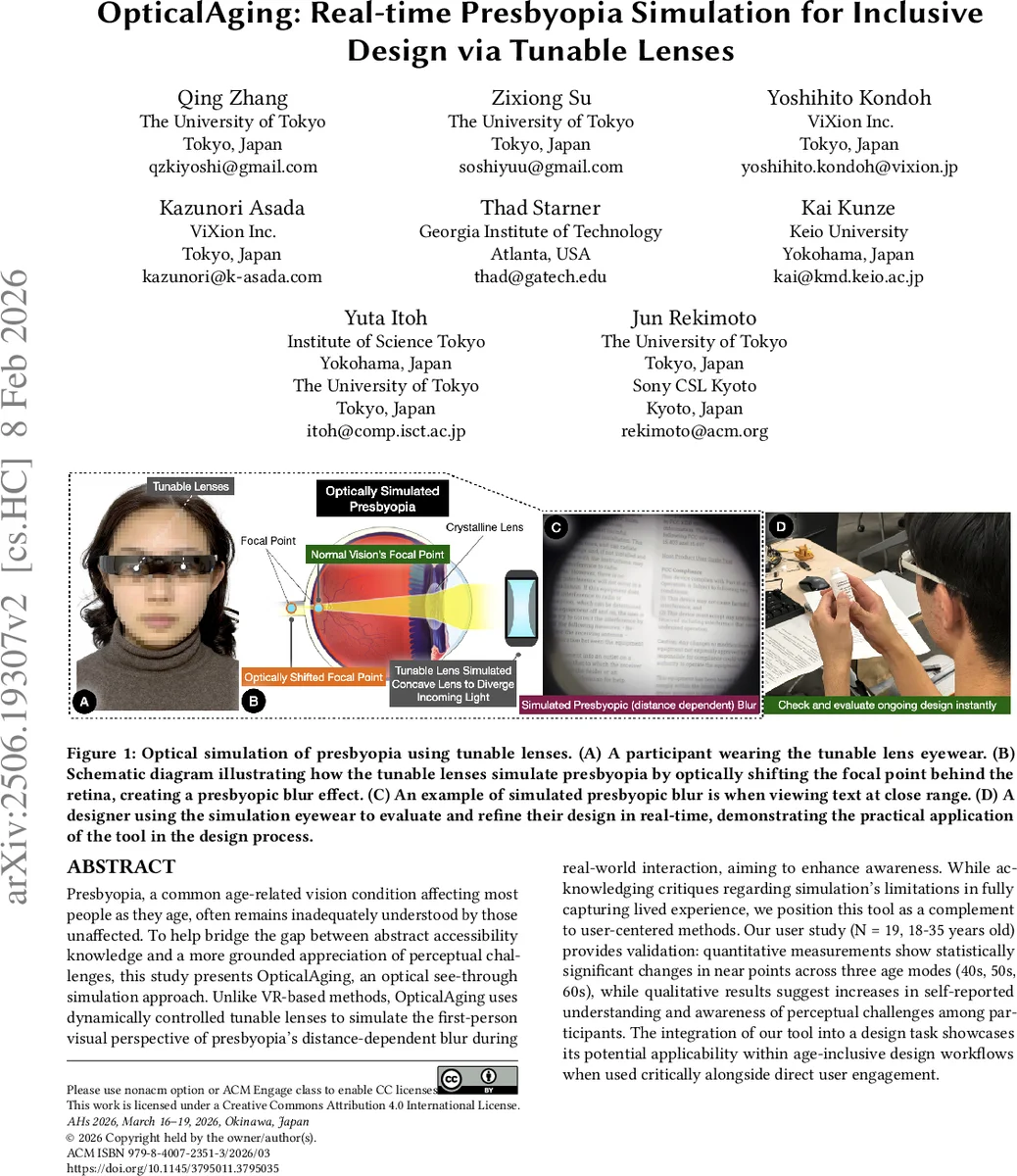
Presbyopia, a common age-related vision condition affecting most people as they age, often remains inadequately understood by those unaffected. To help bridge the gap between abstract accessibility knowledge and a more grounded appreciation of perceptual challenges, this study presents OpticalAging, an optical see-through simulation approach. Unlike VR-based methods, OpticalAging uses dynamically controlled tunable lenses to simulate the first-person visual perspective of presbyopia’s distance-dependent blur during real-world interaction, aiming to enhance awareness. While acknowledging critiques regarding simulation’s limitations in fully capturing lived experience, we position this tool as a complement to user-centered methods. Our user study (N = 19, 18-35 years old) provides validation: quantitative measurements show statistically significant changes in near points across three age modes (40s, 50s, 60s), while qualitative results suggest increases in self-reported understanding and awareness of perceptual challenges among participants. The integration of our tool into a design task showcases its potential applicability within age-inclusive design workflows when used critically alongside direct user engagement.
💡 Research Summary
The paper introduces OpticalAging, a novel optical‑see‑through system that uses commercially available tunable lenses (ViXion01) and a built‑in time‑of‑flight (TOF) distance sensor to simulate presbyopia—the age‑related loss of near‑vision accommodation—in real time. Unlike virtual‑reality (VR) approaches that isolate the user from the physical world, OpticalAging operates directly in the user’s environment, allowing designers and other stakeholders to experience distance‑dependent blur while handling real objects, mock‑ups, or packaging.
The core algorithm works in reverse of an autofocus correction system. When the sensor detects that the viewed surface is closer than a preset threshold for a given “age mode” (40s, 50s, or 60s), the lenses are driven to a negative diopter value that reduces the wearer’s overall accommodation. The specific diopter offsets (e.g., –5.8 D for a 20‑year‑old in the 40s mode) are derived from classic accommodation amplitude data (Duane, Schwartz). By shifting the focal point behind the retina, the system creates the characteristic near‑point blur of presbyopia while preserving clear vision for distant objects.
A three‑part user study with 19 participants aged 18‑35 was conducted. (1) Quantitative measurements of near point showed statistically significant increases for each simulated age: average near point moved back by roughly 30 % (40s), 45 % (50s), and 60 % (60s) compared with baseline (p < 0.01). (2) Post‑experience questionnaires revealed heightened awareness of challenges such as the need to hold reading material farther away, reduced legibility of small text, and the impact of blur on ergonomics. Participants reported that the simulation gave them a “first‑hand sense” of presbyopic vision that abstract guidelines cannot convey. (3) An exploratory design task involved a professional designer and a design‑student using the system while evaluating a product label and button layout. Both participants adjusted font size, contrast, and spacing more aggressively when wearing the simulation, demonstrating that the tool can inform concrete design decisions in situ.
The authors explicitly acknowledge that simulation cannot fully capture the lived experience of visual impairment, citing disability studies that warn against “experience‑based” design without direct user involvement. Consequently, OpticalAging is positioned as a complementary probe—useful for rapid empathy building, hypothesis generation, and early‑stage design evaluation, but not a substitute for user testing with actual presbyopic individuals.
Limitations are discussed: the tunable‑lens headset has a relatively narrow field of view (~30°), which may restrict tasks requiring peripheral vision; latency in lens adjustment and sensor noise can produce slight mismatches between distance and blur; and individual variations in interpupillary distance, baseline refractive error, and pupil size require manual calibration. Future work will explore multi‑focal lens arrays, wider FOV optics, and longitudinal studies comparing simulated responses with those of real presbyopic participants.
In summary, the contributions of the paper are: (1) the first real‑time, distance‑dependent presbyopia simulation using programmable optics in an optical‑see‑through form factor; (2) rigorous mixed‑methods validation showing both measurable changes in accommodation and self‑reported empathy gains; (3) a demonstration of how such a tool can be embedded into professional design workflows to produce tangible design refinements; and (4) a thoughtful framing of simulation as an ethical, supplemental method rather than a replacement for inclusive, user‑centered design practices.
Comments & Academic Discussion
Loading comments...
Leave a Comment