Correspondence among congruence families for generalized Frobenius partitions via modular permutations
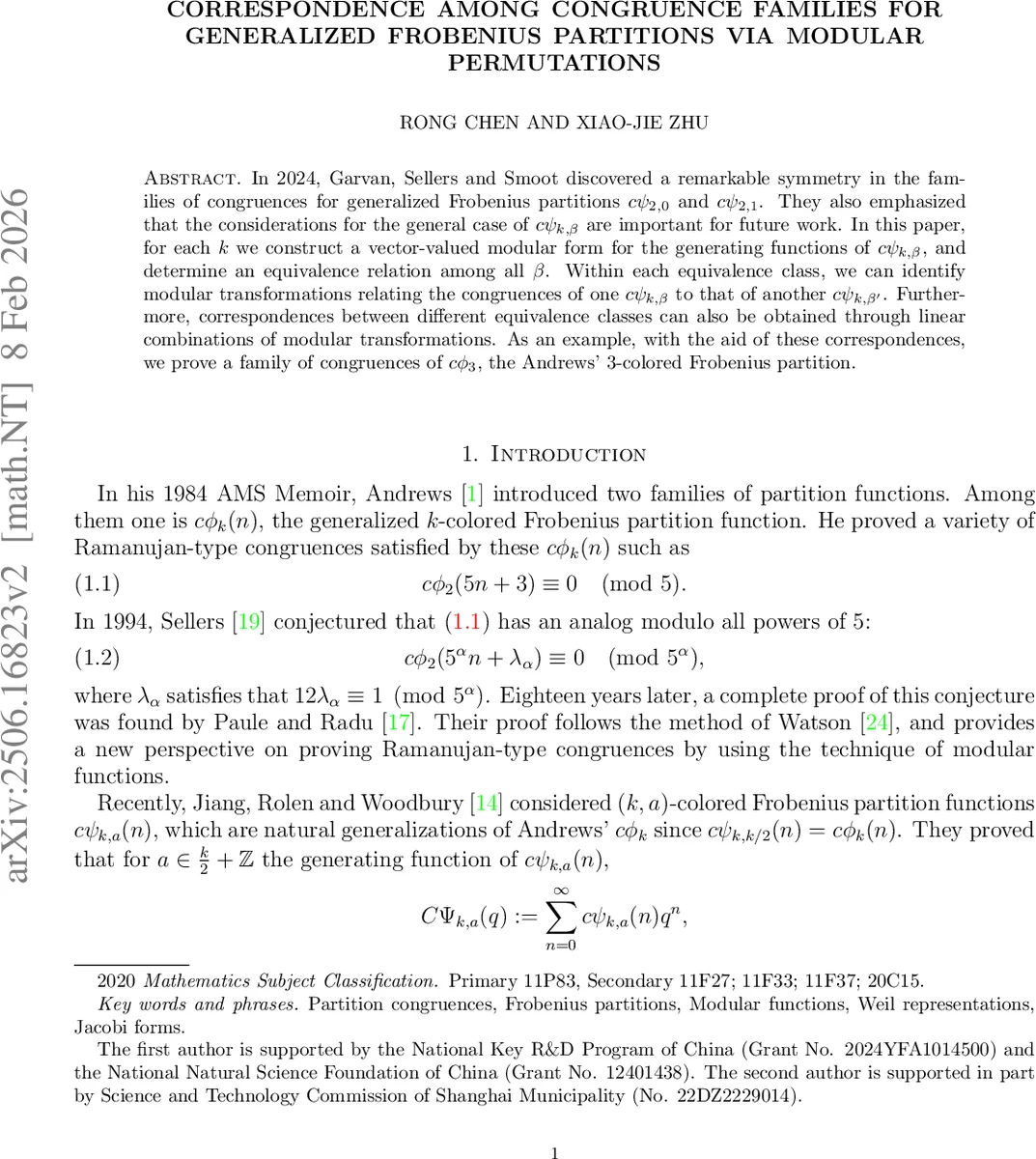
In 2024, Garvan, Sellers and Smoot discovered a remarkable symmetry in the families of congruences for generalized Frobenius partitions $cψ_{2,0}$ and $cψ_{2,1}$. They also emphasized that the considerations for the general case of $cψ_{k,β}$ are important for future work. In this paper, for each $k$ we construct a vector-valued modular form for the generating functions of $cψ_{k,β}$, and determine an equivalence relation among all $β$. Within each equivalence class, we can identify modular transformations relating the congruences of one $cψ_{k,β}$ to that of another $cψ_{k,β’}$. Furthermore, correspondences between different equivalence classes can also be obtained through linear combinations of modular transformations. As an example, with the aid of these correspondences, we prove a family of congruences of $cϕ_{3}$, the Andrews’ $3$-colored Frobenius partition.
💡 Research Summary
The paper investigates congruence families for the generalized Frobenius partition functions (c\psi_{k,\beta}(n)). Building on the symmetry observed by Garvan, Sellers and Smoot for the case ((k,\beta)=(2,0)) and ((2,1)), the authors develop a unified modular‑theoretic framework that works for every positive integer (k).
First, the generating function (C\Psi_{k,\beta}(q)=\sum_{n\ge0}c\psi_{k,\beta}(n)q^{n}) is normalized to
\
Comments & Academic Discussion
Loading comments...
Leave a Comment