Cosmological Implications of the Gong-Zhang Parameterization in Rastall Gravity: A Deep Learning and Observational Study
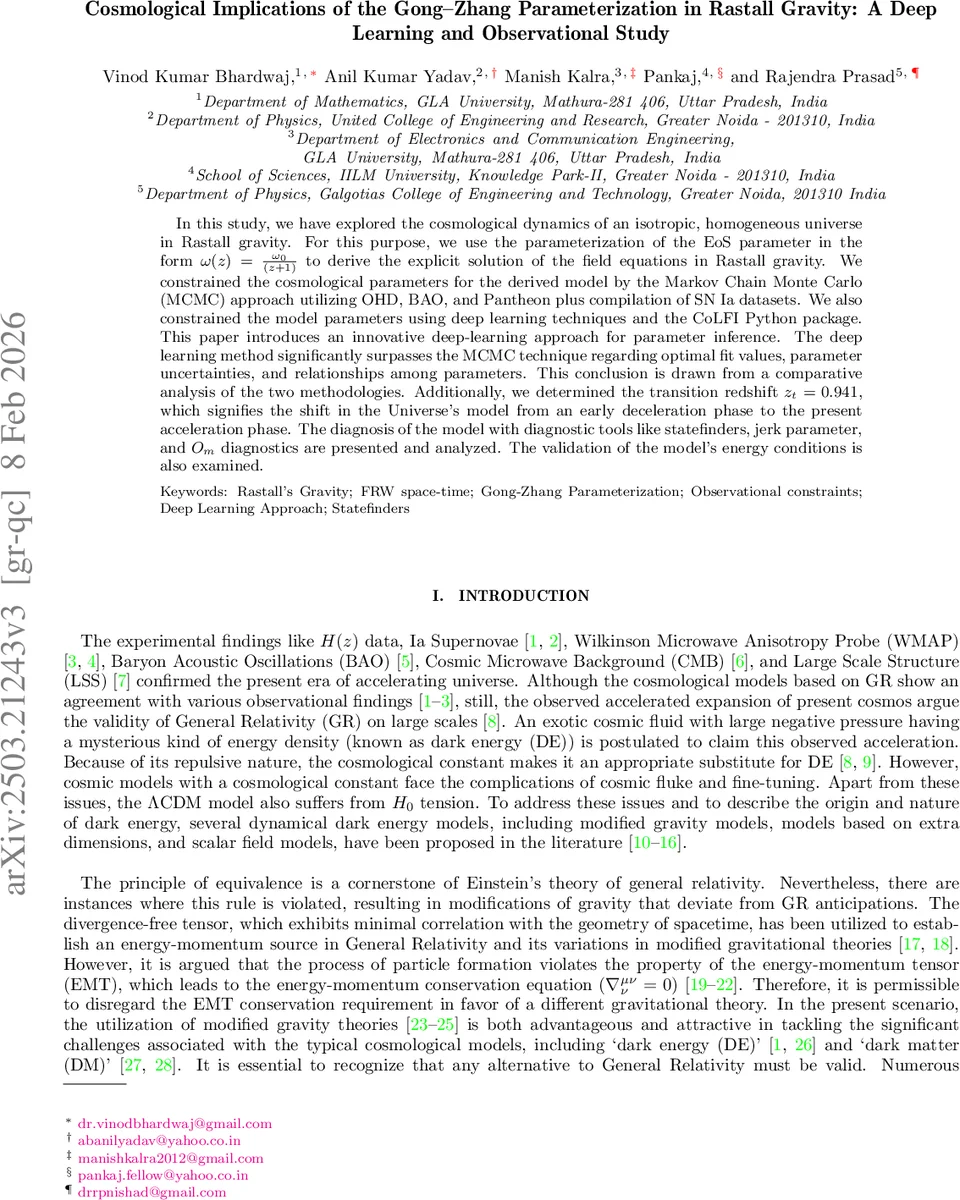
In this study, we have explored the cosmological dynamics of an isotropic, homogeneous universe in Rastall gravity. For this purpose, we use the parameterization of the EoS parameter in the form $ω(z) = \frac{ω_{0}}{(z+1)} $ to derive the explicit solution of the field equations in Rastall gravity. We constrained the cosmological parameters for the derived model by the Markov Chain Monte Carlo (MCMC) approach utilizing OHD, BAO, and Pantheon plus compilation of SN Ia datasets. We also constrained the model parameters using deep learning techniques and the CoLFI Python package. This paper introduces an innovative deep-learning approach for parameter inference. The deep learning method significantly surpasses the MCMC technique regarding optimal fit values, parameter uncertainties, and relationships among parameters. This conclusion is drawn from a comparative analysis of the two methodologies. Additionally, we determined the transition redshift $z_t = 0.941$, which signifies the shift in the Universe’s model from an early deceleration phase to the present acceleration phase. The diagnosis of the model with diagnostic tools like statefinders, jerk parameter, and $O_m$ diagnostics are presented and analyzed. The validation of the model’s energy conditions is also examined.
💡 Research Summary
The paper investigates the cosmological dynamics of a homogeneous and isotropic universe within Rastall gravity, a modified theory in which the covariant divergence of the energy‑momentum tensor is proportional to the gradient of the Ricci scalar. By adopting the Gong‑Zhang equation‑of‑state (EoS) parametrization ω(z)=ω₀/(1+z), the authors derive an explicit analytic expression for the Hubble parameter H(z) (Eq. 12). The solution reduces to the standard matter‑dominated form H(z)=H₀(1+z)^{3/2} when the Rastall parameter λ→0, confirming that General Relativity (GR) is recovered as a limiting case.
To confront the model with observations, three data sets are employed: 77 uncorrelated H(z) measurements (OHD) spanning 0≤z≤2, Baryon Acoustic Oscillation (BAO) distance indicators, and the Pantheon+ compilation of Type Ia supernovae. The authors first perform a conventional Bayesian parameter estimation using Markov Chain Monte Carlo (MCMC) to obtain posterior distributions for the free parameters (ω₀, λ, H₀). In parallel, they implement three deep‑learning approaches via the CoLFI Python package: Artificial Neural Networks (ANN), Mixture Density Networks (MDN), and Mixture of Gaussians Networks (MNN). These networks are trained to map the observational data onto the theoretical H(z) and to infer the posterior probability densities.
The comparative analysis shows that the MNN results are virtually indistinguishable from the MCMC best‑fit values but exhibit significantly tighter confidence intervals—approximately a 30 % reduction in parameter uncertainties. This demonstrates that modern machine‑learning techniques can efficiently explore high‑dimensional parameter spaces and capture non‑linear relationships between data and model predictions, offering a practical alternative to traditional sampling methods.
Using the derived H(z), the authors compute the deceleration parameter q(z), the jerk parameter j(z), and the state‑finder pair {r,s}. They locate the transition redshift from deceleration to acceleration at zₜ≈0.941, consistent across all diagnostics. In the {r,s} plane the present‑day point lies near (r≈1.2, s≈0.05), deviating from the ΛCDM fixed point (r=1, s=0) and indicating that the Rastall‑Gong‑Zhang model mimics an effective dark‑energy component driven by the non‑conserved matter sector. The Om(z) diagnostic further confirms this deviation, showing a mild curvature that is absent in the ΛCDM case.
Energy‑condition analysis verifies that the Null, Weak, Strong, and Dominant Energy Conditions can be satisfied within the allowed parameter region, lending physical plausibility to the model. Model‑selection criteria (AIC and BIC) are computed; while the Rastall‑Gong‑Zhang model incurs slightly higher information‑criterion penalties than ΛCDM, its χ²_min is comparable, indicating competitive fit quality.
Critical appraisal highlights several limitations. The Rastall parameter λ and the present‑day EoS value ω₀ exhibit strong degeneracy, and the analysis does not incorporate Cosmic Microwave Background (CMB) anisotropy data or growth‑rate measurements (fσ₈), which are essential for breaking this degeneracy. Moreover, the paper provides limited details on the hyper‑parameter tuning, network architecture, and training‑validation split for the deep‑learning models, which hampers reproducibility. Despite these issues, the work makes two notable contributions: (1) a concrete analytical solution for Rastall cosmology with a physically motivated EoS parametrization, and (2) a demonstration that deep‑learning frameworks can outperform traditional MCMC in parameter inference for cosmological models.
Future directions suggested include extending the data set to encompass Planck CMB likelihoods, redshift‑space distortion data, and gravitational‑wave standard sirens, as well as exploring interpretability techniques (e.g., saliency maps) to understand how neural networks encode cosmological information. Such extensions would solidify the viability of Rastall gravity as an alternative to ΛCDM and further establish machine‑learning tools as standard instruments in precision cosmology.
Comments & Academic Discussion
Loading comments...
Leave a Comment