Moser's twist theorem revisited
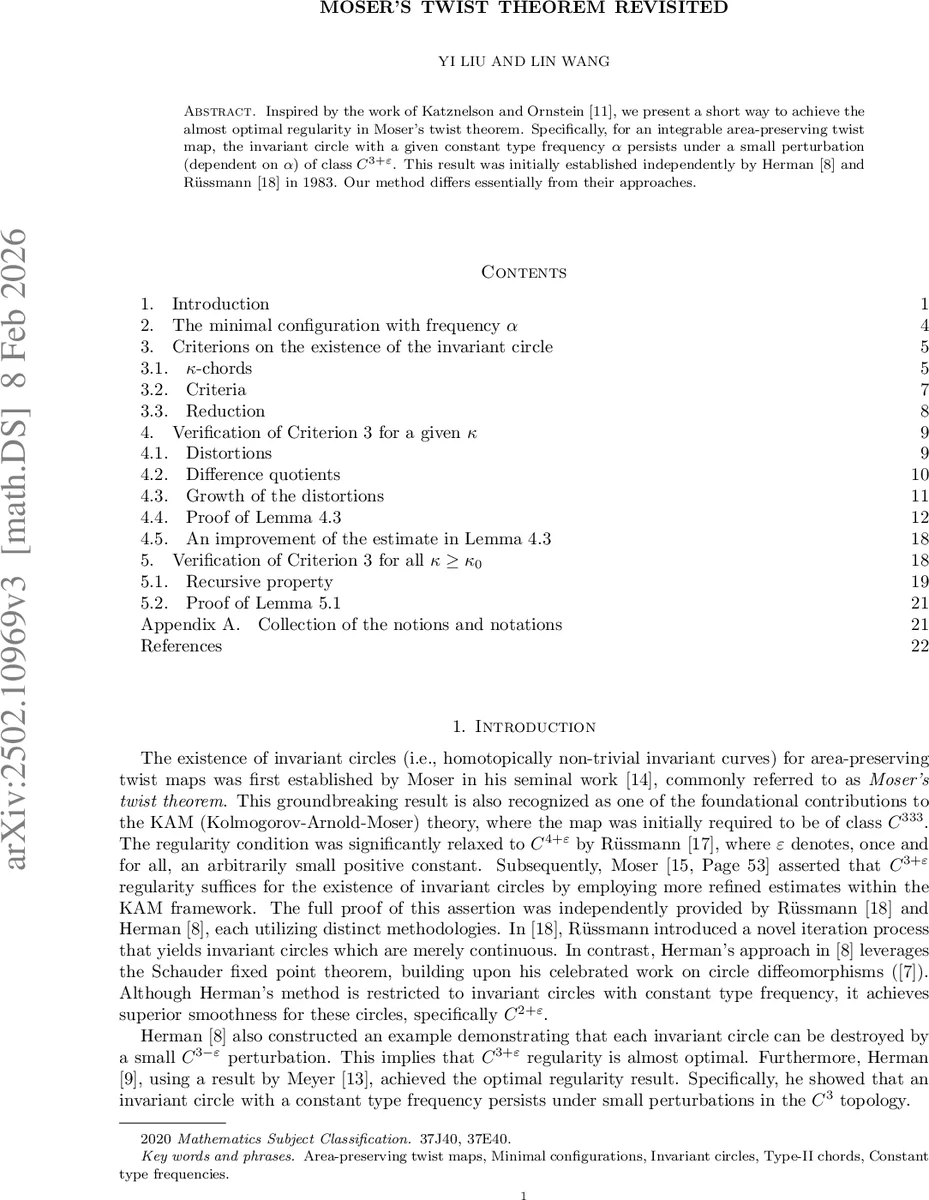
Inspired by the work of Katznelson and Ornstein, we present a short way to achieve the almost optimal regularity in Moser’s twist theorem. Specifically, for an integrable area-preserving twist map, the invariant circle with a given constant type frequency $α$ persists under a small perturbation (dependent on $α$) of class $C^{3+ε}$. This result was initially established independently by Herman and Rüssmann in 1983. Our method differs essentially from their approaches.
💡 Research Summary
**
The paper “Moser’s Twist Theorem Revisited” offers a concise and conceptually new proof that the regularity requirement for the persistence of invariant circles in area‑preserving twist maps can be lowered to almost the optimal level, namely C^{3+ε}. The authors build on the ideas of Katznelson and Ornstein, but they introduce a refined class of chords—called “Type‑II chords”—and a series of criteria that translate the geometric problem into a problem about boundedness of a multiplicative cocycle.
The setting is a standard exact area‑preserving twist map F on the cylinder T×ℝ. For an irrational rotation number α of constant type (i.e., the coefficients of its continued fraction expansion are uniformly bounded), the authors consider a family of generating functions
Gₙ(x,x′)=½(x−x′)²+qₙ^{−4−ε} V(qₙx′),
where V∈C^{4+ε}(T) and qₙ is the denominator of the n‑th convergent of α. The associated maps Fₙ converge to the integrable twist T(x,y)=(x+y,y) in the C^{3+ε′} norm for any ε′<ε.
The main result (Theorem 1) states that for each constant‑type α there exists a sufficiently large n such that Fₙ possesses an invariant circle of frequency α, and this circle can be represented as the graph of a function of class C^{2+ε′} for any ε′<ε. This matches the lower bound proved by Herman (a C^{3−ε} perturbation can destroy an invariant circle) and therefore is essentially optimal.
To achieve this, the authors develop three equivalent criteria:
- Criterion 1 (Katznelson‑Ornstein) – expressed in terms of λ‑lengths of chords (vectors whose endpoints lie on orbit segments).
- Criterion 2 – a refined version that uses Type‑II chords, which impose an additional constraint on the index distance |i−j| relative to the convergent denominator qₙ.
- Criterion 3 – a boundedness condition on a cocycle e_{K₀} defined from the chords.
The equivalence of Criteria 1 and 2 is proved in Lemma 3.6, while Lemma 3.7 relates the size of the perturbation to the scale κ₀ at which Criterion 3 must be verified.
A central technical achievement is the exponential decay of a distortion quantity e_{K₁}. The authors introduce first‑ and second‑order difference quotients ∇₁ and ∇₂ of the minimal configuration (the Aubry–Mather set). Under suitable bounds (inequalities (27) and (28)), they show that ∇₁ is monotone (Lemma 4.4) and that e_{K₁} decays exponentially on short orbit segments (Lemma 4.6). Using the control on ∇₂ they extend this decay to longer segments (Lemma 4.8) and finally obtain a sharp decay estimate (Proposition 4.9).
The next step is a recursive scale argument (Section 5). Lemma 5.1 proves the existence of a scale κ₀ such that for all finer scales the conditions on ∇₁ and ∇₂ are automatically satisfied. Lemma 5.4 controls the growth of ∇₁ relative to ∇₂, while the refined estimate for ∇₂ (derived from Katznelson‑Ornstein’s Corollary 3.1) completes the induction. Consequently, e_{K₀} remains bounded, Criterion 3 holds, and by the chain of equivalences the invariant circle exists.
The authors also point out that the same argument applies to two‑degree‑of‑freedom Hamiltonian systems. Corollary 1.1 states that for any constant‑type Diophantine frequency vector ω, there is a sequence of C^{4+ε} Hamiltonians Hₙ converging to the integrable kinetic energy H₀, each admitting an invariant torus of frequency ω that is a C^{2+ε′} graph. This recovers known results but via a completely different “chord‑based” approach.
Limitations are acknowledged: the method currently works only for constant‑type frequencies and does not reach the exact C³ regularity (ε=0). Extending the Type‑II chord framework to general Diophantine conditions and achieving the optimal C³ threshold are left as future work.
In summary, the paper provides a streamlined proof that invariant circles of constant‑type rotation numbers persist under C^{3+ε} perturbations, introduces novel geometric tools (Type‑II chords and refined difference‑quotient estimates), and connects the problem to boundedness of a multiplicative cocycle. It clarifies the near‑optimal nature of Herman’s and Rüssmann’s earlier results and opens a new avenue for further regularity improvements in KAM‑type theorems.
Comments & Academic Discussion
Loading comments...
Leave a Comment