Tensor products of Leibniz bimodules and Grothendieck rings
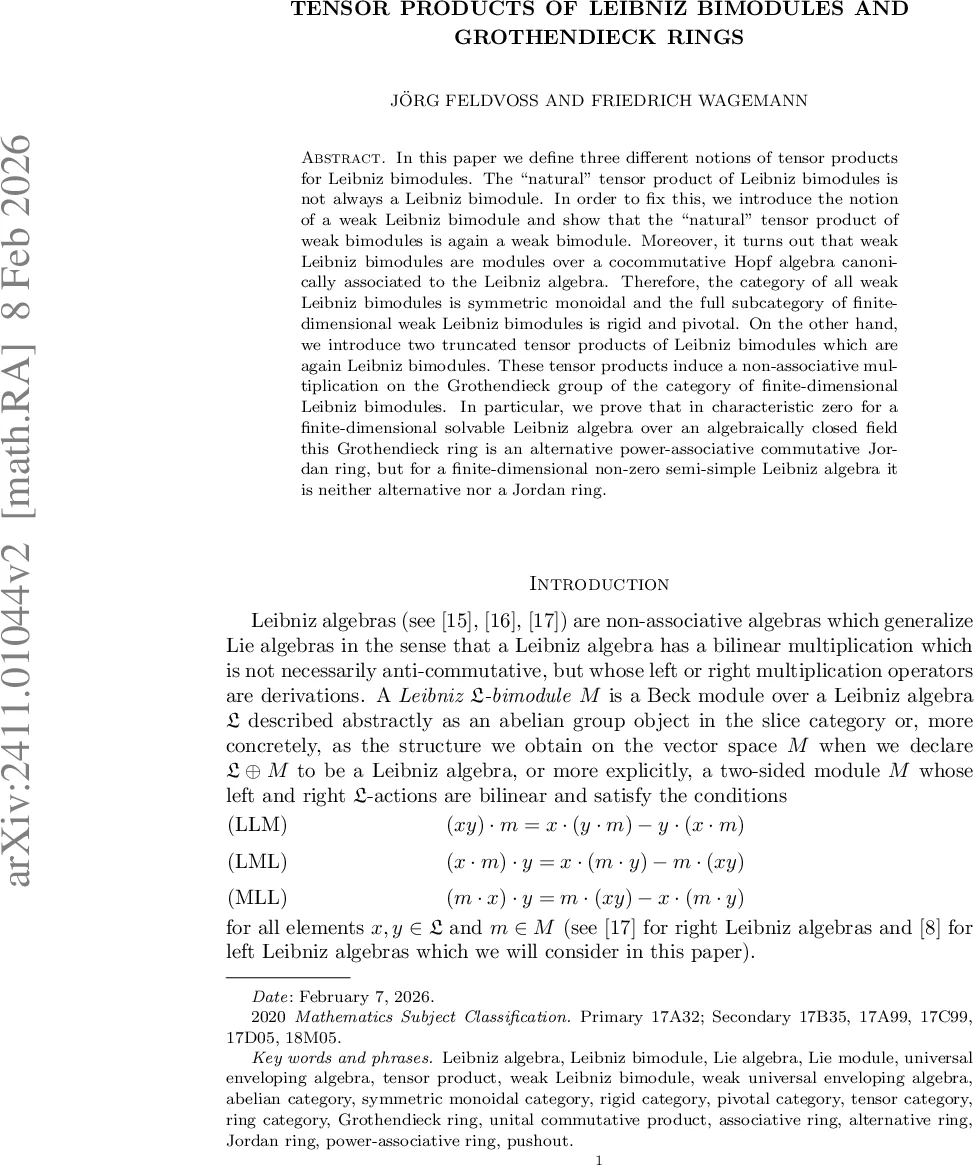
In this paper we define three different notions of tensor products for Leibniz bimodules. The natural" tensor product of Leibniz bimodules is not always a Leibniz bimodule. In order to fix this, we introduce the notion of a weak Leibniz bimodule and show that the natural" tensor product of weak bimodules is again a weak bimodule. Moreover, it turns out that weak Leibniz bimodules are modules over a cocommutative Hopf algebra canonically associated to the Leibniz algebra. Therefore, the category of all weak Leibniz bimodules is symmetric monoidal and the full subcategory of finite-dimensional weak Leibniz bimodules is rigid and pivotal. On the other hand, we introduce two truncated tensor products of Leibniz bimodules which are again Leibniz bimodules. These tensor products induce a non-associative multiplication on the Grothendieck group of the category of finite-dimensional Leibniz bimodules. In particular, we prove that in characteristic zero for a finite-dimensional solvable Leibniz algebra this Grothendieck ring is an alternative power-associative commutative Jordan ring, but for a finite-dimensional non-zero semi-simple Leibniz algebra it is neither alternative nor a Jordan ring.
💡 Research Summary
The paper tackles the problem of defining a tensor product for bimodules over a Leibniz algebra (L). While for Lie algebras the category of modules carries a natural tensor product over the ground field, the same construction fails for Leibniz bimodules: the naïve tensor product (M\otimes N) equipped with the obvious left and right actions satisfies the Leibniz compatibility conditions (LLM) and (LML) but generally violates (MLL). This obstruction is demonstrated in Proposition 2.1 and Example 2.9.
To overcome the difficulty the authors introduce weak Leibniz bimodules, which are required only to satisfy (LLM) and (LML). They prove (Theorem 2.11) that weak bimodules are precisely left modules over a certain cocommutative Hopf algebra (U_{w}(L)) canonically associated to (L). The Hopf algebra is built from the universal enveloping algebra (U(L)) using two algebra maps (d_{0},d_{1}:U(L)\to U(L_{\mathrm{Lie}})) and an embedding (s_{0}:U(L_{\mathrm{Lie}})\to U(L)). Consequently the category (\mathrm{Mod}{\mathrm{weak}}(L)) becomes a symmetric monoidal category (Theorem 2.14). Its full subcategory of finite‑dimensional objects, (\mathrm{mod}{\mathrm{weak}}(L)), is shown to be rigid and pivotal (Theorem 2.23) and even a ring category in the sense of Bruguières–Virelizier (Theorem 2.25). Partial classification results for irreducible weak bimodules are given (Proposition 2.8) and the relationship with ordinary Leibniz bimodules is explored (Proposition 2.16).
The second line of development concerns truncated tensor products. By quotienting the naïve tensor product by a carefully chosen subspace, the authors obtain two products, denoted (\otimes) and (\boxtimes), which do satisfy all three Leibniz compatibility conditions and therefore yield genuine Leibniz bimodules. Theorem 3.6 shows that when one factor is symmetric or anti‑symmetric the two truncated products coincide; Corollary 3.7 proves that if both factors are symmetric (or both anti‑symmetric) the truncated product agrees with the naïve one. However, the truncated products are generally non‑associative, a fact reflected in the Grothendieck group.
Section 4 studies the Grothendieck ring (Gr_{bi}(L)) associated with the category of finite‑dimensional Leibniz bimodules equipped with either truncated product. Proposition 4.1 establishes that (Gr_{bi}(L)) is a commutative unital ring, but not necessarily associative. The central structural result (Theorem 4.4) identifies (Gr_{bi}(L)) as a unital commutative product of two copies of the Grothendieck ring of the canonical Lie algebra (L_{\mathrm{Lie}}). One copy corresponds to classes of symmetric irreducible bimodules, the other to anti‑symmetric irreducibles, each constructed from irreducible (L_{\mathrm{Lie}})-modules.
Using this description the authors completely determine the ring for solvable Leibniz algebras over an algebraically closed field of characteristic 0 (Corollary 4.8). In this setting the Grothendieck ring is shown to be alternative, power‑associative, and Jordan (Theorem 4.12, Corollary 4.16). An example (4.13) shows that the characteristic‑zero hypothesis is essential. Conversely, for non‑zero semisimple Leibniz algebras the Grothendieck ring fails to be alternative or Jordan (Theorem 4.18), illustrating that associativity can break down dramatically. Proposition 4.10 further proves non‑associativity whenever the canonical Lie algebra is finite‑dimensional.
The paper concludes with several open problems: a full classification of irreducible weak bimodules, a precise comparison between the categories (\mathrm{Mod}{\mathrm{weak}}(L)) and (\mathrm{Mod}{bi}(L)), and the behavior of the Grothendieck ring for non‑solvable Leibniz algebras or over fields of positive characteristic. The work thus opens a new avenue in the representation theory of Leibniz algebras, providing both categorical and ring‑theoretic tools that extend beyond the classical Lie‑algebra framework.
Comments & Academic Discussion
Loading comments...
Leave a Comment