The behavior of higher proof theory I: Case $Σ^1_2$
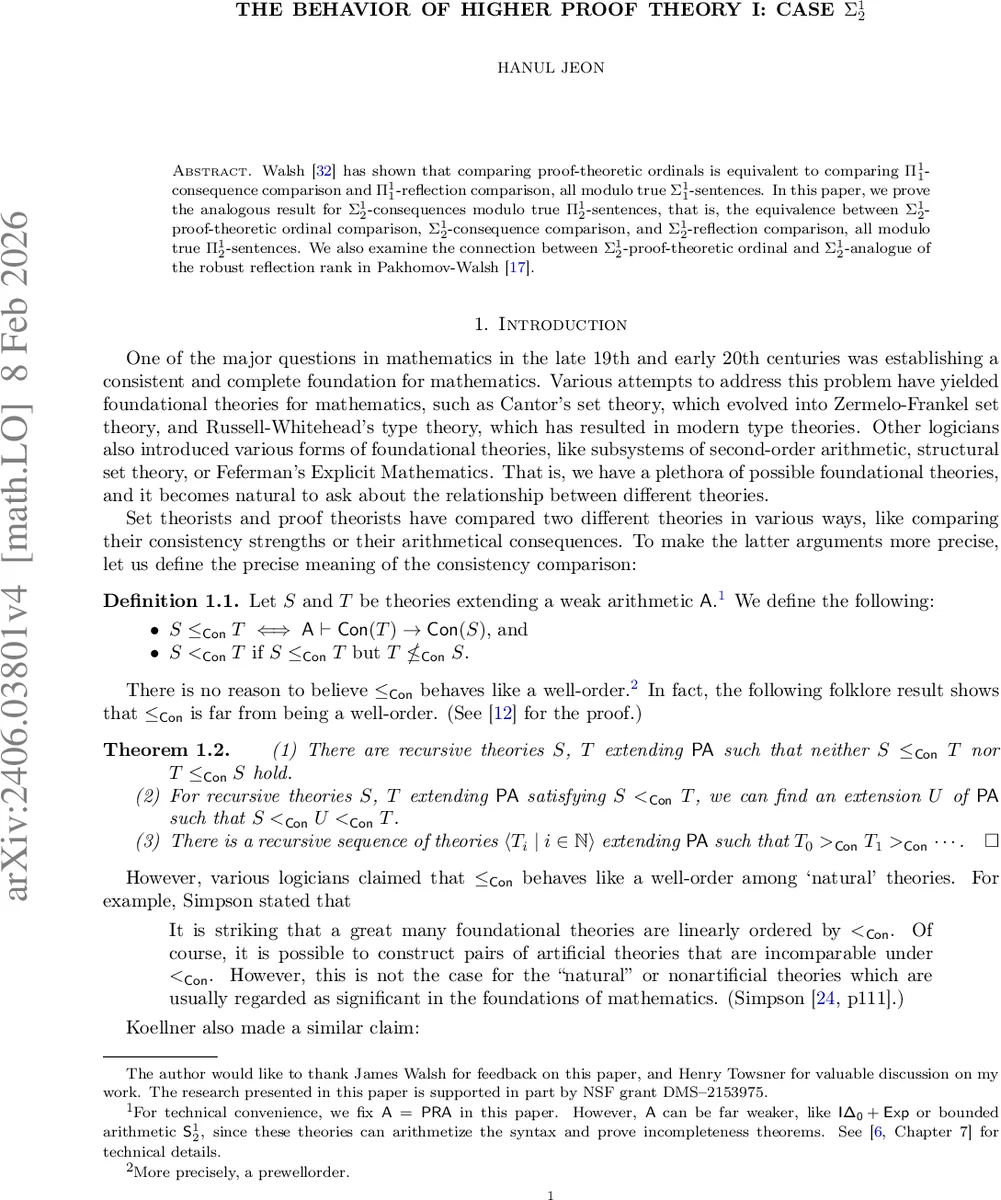
Walsh [MR4525964, Zbl 1569.03151] has shown that comparing proof-theoretic ordinals is equivalent to comparing $Π^1_1$-consequence comparison and $Π^1_1$-reflection comparison, all modulo true $Σ^1_1$-sentences. In this paper, we prove the analogous result for $Σ^1_2$-consequences modulo true $Π^1_2$-sentences, that is, the equivalence between $Σ^1_2$-proof-theoretic ordinal comparison, $Σ^1_2$-consequence comparison, and $Σ^1_2$-reflection comparison, all modulo true $Π^1_2$-sentences. We also examine the connection between $Σ^1_2$-proof-theoretic ordinal and $Σ^1_2$-analogue of the robust reflection rank in Pakhomov-Walsh [MR4362917, Zbl 1511.03018]
💡 Research Summary
The paper “The behavior of higher proof theory I: Case Σ¹₂” extends a recent line of work by Walsh, who showed that for Π¹₁‑sound extensions of ACA₀ three notions of strength—proof‑theoretic ordinal comparison, Π¹₁‑consequence comparison (modulo true Σ¹₁ sentences), and Π¹₁‑reflection comparison—are equivalent. The author, Hanul Jeon, lifts this equivalence to the next level of the analytical hierarchy, namely Σ¹₂.
The central objects are Σ¹₂‑sound theories (i.e., any Σ¹₂‑sentence provable in the theory is true). For such a theory T a new ordinal invariant |T|{Σ¹₂} is defined via “pseudo‑dilators”. A pseudo‑dilator is a computable functional F that maps each ordinal α to a linear order F(α). For a given Σ¹₂‑sentence φ one can effectively produce a pseudo‑dilator F_φ such that the least α for which F_φ(α) becomes ill‑founded (the “climax” Clim(F_φ)) measures the ordinal complexity of φ. The Σ¹₂‑ordinal of a theory is then
s{Σ¹₂}(T) = sup{Clim(F) | T ⊢ “F is a pseudo‑dilator”}.
This construction mirrors Kleene’s normal‑form theorem for Π¹₁‑formulas, but works at the Σ¹₂ level.
The main technical results are:
-
Proposition 5.1: For Σ¹₂‑sound S and T, S ⊆{Π¹₂}^{Σ¹₂} T (i.e., every Σ¹₂‑consequence of S is a Π¹₂‑consequence of T) iff s{Σ¹₂}(S) ≤ s_{Σ¹₂}(T). Thus Σ¹₂‑consequence inclusion exactly tracks the Σ¹₂‑ordinal ordering.
-
Propositions 5.4 and 5.5: If S and T are arithmetically definable Σ¹₂‑sound extensions of Σ¹₂‑ACA₀, then s_{Σ¹₂}(S) ≤ s_{Σ¹₂}(T) iff Σ¹₂‑ACA₀ proves Π¹₂‑RFN(T) → Π¹₂‑RFN(S). Here Π¹₂‑RFN(T) is the Σ¹₂‑analogue of uniform reflection: “every Π¹₂‑sentence provable in T is true”. Hence the Σ¹₂‑ordinal comparison is equivalent to Π¹₂‑reflection comparison.
-
Theorem 5.9: Under the same hypotheses, a strict inequality s_{Σ¹₂}(S) < s_{Σ¹₂}(T) holds exactly when T proves Π¹₂‑RFN(S). This gives a precise correspondence between strict Σ¹₂‑ordinal strength and the ability of one theory to reflect Π¹₂‑sentences of another.
These three statements together constitute the Σ¹₂‑analogue of Walsh’s Π¹₁ result: proof‑theoretic ordinal comparison, Σ¹₂‑consequence comparison (modulo true Π¹₂ sentences), and Σ¹₂‑reflection comparison are interchangeable for natural theories.
The paper also generalises the “robust reflection rank” introduced by Pakhomov and Walsh. The Σ¹₂‑reflection rank of a theory measures how far up the Π¹₂‑reflection hierarchy the theory sits. Jeon shows that this rank coincides with the Σ¹₂‑ordinal s_{Σ¹₂}(T), establishing a tight link between ordinal analysis and reflection hierarchies at the Σ¹₂ level.
A recurring theme is the restriction to “natural” theories—those extending RCA₀, ACA₀, or Σ¹₂‑ACA₀ and arising in ordinary mathematical practice. For such theories the three notions form a well‑ordering, whereas for artificially constructed theories the ≤Con relation can be highly non‑linear. The results explain why, in practice, consistency comparisons among natural theories behave as if they were well‑ordered: logicians are in fact proving a stronger Π¹₂‑reflection statement, which is already known to be a pre‑well‑order.
Technically, the construction of pseudo‑dilators proceeds by normalising a Σ¹₂‑formula into ∃X∀Y φ(X,Y), interpreting the existential set X as a search tree, and turning each stage of the search into a linear order. The climax is the least ordinal at which the induced tree acquires an ill‑founded branch. The paper verifies that this process is effective, that the resulting ordinals are recursive, and that the supremum over all such dilators yields a robust invariant.
In conclusion, Jeon’s work provides a comprehensive framework for comparing the strength of Σ¹₂‑sound theories, unifying ordinal analysis, consequence inclusion, and reflection principles. It opens the way for further extensions to higher levels Σ¹ₙ (n≥3) and suggests that the pattern observed at Π¹₁ and Σ¹₂ may persist throughout the analytical hierarchy, offering a powerful tool for the meta‑theoretic study of higher‑order arithmetic and set theory.
Comments & Academic Discussion
Loading comments...
Leave a Comment