Deep Neural Network Architectures for Electrocardiogram Classification: A Comprehensive Evaluation
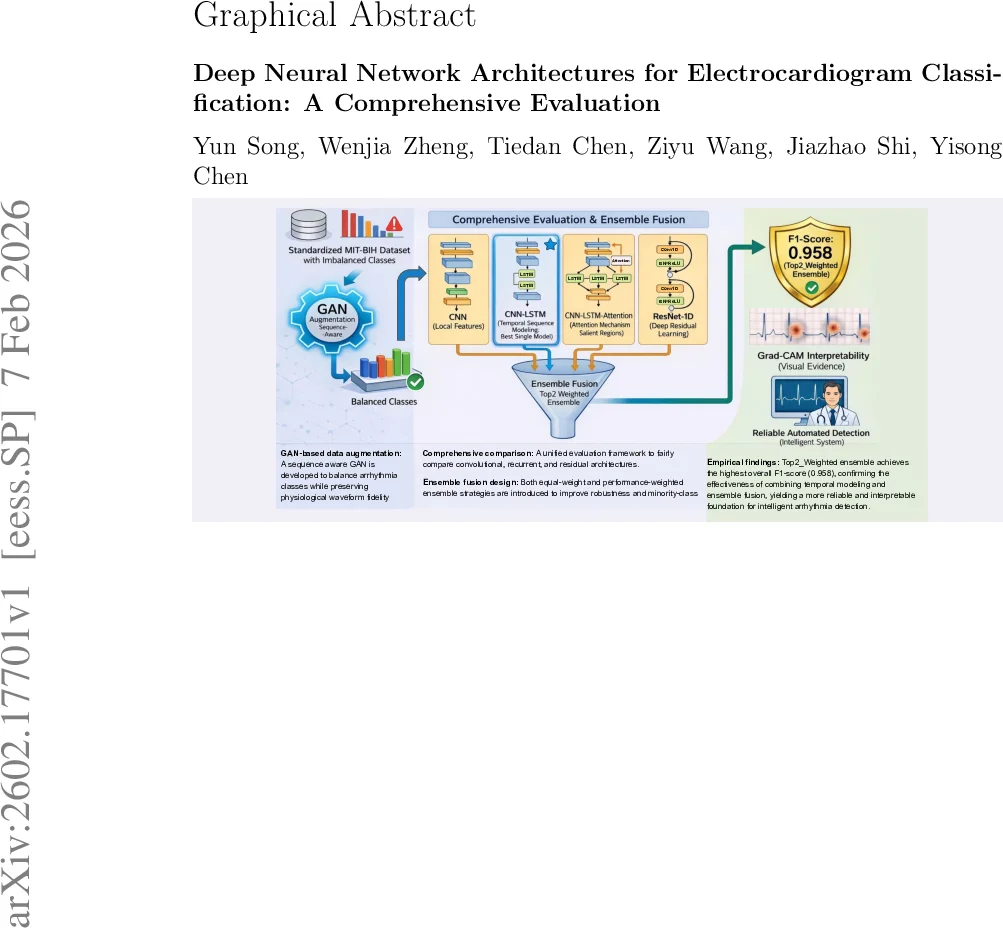
With the rising prevalence of cardiovascular diseases, electrocardiograms (ECG) remain essential for the non-invasive detection of cardiac abnormalities. This study presents a comprehensive evaluation of deep neural network architectures for automated arrhythmia classification, integrating temporal modeling, attention mechanisms, and ensemble strategies. To address data scarcity in minority classes, the MIT-BIH Arrhythmia dataset was augmented using a Generative Adversarial Network (GAN). We developed and compared four distinct architectures, including Convolutional Neural Networks (CNN), CNN combined with Long Short-Term Memory (CNN-LSTM), CNN-LSTM with Attention, and 1D Residual Networks (ResNet-1D), to capture both local morphological features and long-term temporal dependencies. Performance was rigorously evaluated using accuracy, F1-score, and Area Under the Curve (AUC) with 95% confidence intervals to ensure statistical robustness, while Gradient-weighted Class Activation Mapping (Grad-CAM) was employed to validate model interpretability. Experimental results indicate that the CNN-LSTM model achieved the optimal stand-alone balance between sensitivity and specificity, yielding an F1-score of 0.951. Conversely, the CNN-LSTM-Attention and ResNet-1D models exhibited higher sensitivity to class imbalance. To mitigate this, a dynamic ensemble fusion strategy was introduced; specifically, the Top2-Weighted ensemble achieved the highest overall performance with an F1-score of 0.958. These findings demonstrate that leveraging complementary deep architectures significantly enhances classification reliability, providing a robust and interpretable foundation for intelligent arrhythmia detection systems.
💡 Research Summary
This paper presents a thorough comparative study of deep learning architectures for automated electrocardiogram (ECG) arrhythmia classification, addressing the persistent challenge of class imbalance in the widely used MIT‑BIH Arrhythmia Database. The authors first apply a sequence‑aware Generative Adversarial Network (GAN) to synthesize realistic ECG segments for minority classes (premature ventricular contractions, paced‑fusion beats, etc.), thereby augmenting the training set while preserving physiological waveform characteristics. Four representative models are then built and trained under identical preprocessing, normalization, and stratified train‑validation splits: a conventional Convolutional Neural Network (CNN), a CNN‑LSTM hybrid that adds two layers of Long Short‑Term Memory units to capture temporal dependencies, a CNN‑LSTM with a self‑attention module that dynamically weights each time step, and a one‑dimensional Residual Network (ResNet‑1D) employing residual blocks to enable deeper feature extraction.
Training uses the Adam optimizer with early stopping, and performance is evaluated via accuracy, F1‑score, and Area Under the ROC Curve (AUC), each reported with 95 % confidence intervals obtained by bootstrapping. Gradient‑weighted Class Activation Mapping (Grad‑CAM) visualizations confirm that all models focus on clinically relevant regions such as the QRS complex and T‑wave, while the attention‑enhanced model additionally highlights abnormal P‑wave segments.
Results show that the CNN‑LSTM achieves the best single‑model trade‑off, attaining an F1‑score of 0.951 and the highest AUC (0.967), indicating that incorporating temporal modeling substantially improves overall balance between sensitivity and specificity. The attention‑augmented CNN‑LSTM and the ResNet‑1D exhibit higher sensitivity to minority classes but suffer slight drops in overall precision, suggesting that attention can over‑focus on rare patterns and that very deep residual structures may overfit scarce classes.
To further boost robustness, the authors explore ensemble strategies. An equal‑weight average of all four models yields modest gains, whereas a performance‑weighted scheme that emphasizes the two strongest models (CNN‑LSTM and CNN‑LSTM‑Attention) – termed the Top2‑Weighted ensemble – delivers the highest overall performance with an F1‑score of 0.958 and AUC of 0.972. This demonstrates that complementary strengths across architectures can be synergistically combined to mitigate individual weaknesses, especially for under‑represented arrhythmia types.
The study also discusses practical deployment considerations, noting the computational demands of deep models for real‑time or edge‑device scenarios and suggesting model pruning, quantization, or hardware acceleration (e.g., Edge TPU, FPGA) as future directions.
In conclusion, the paper provides a systematic benchmark that highlights the importance of (1) GAN‑based data augmentation for class balance, (2) temporal modeling via LSTM for stable single‑model performance, (3) attention mechanisms for enhanced minority‑class sensitivity, and (4) weighted ensemble fusion for maximal overall accuracy and interpretability. These findings offer a concrete roadmap for developing reliable, interpretable, and clinically viable AI‑driven ECG diagnostic tools.
Comments & Academic Discussion
Loading comments...
Leave a Comment