Dense Feature Learning via Linear Structure Preservation in Medical Data
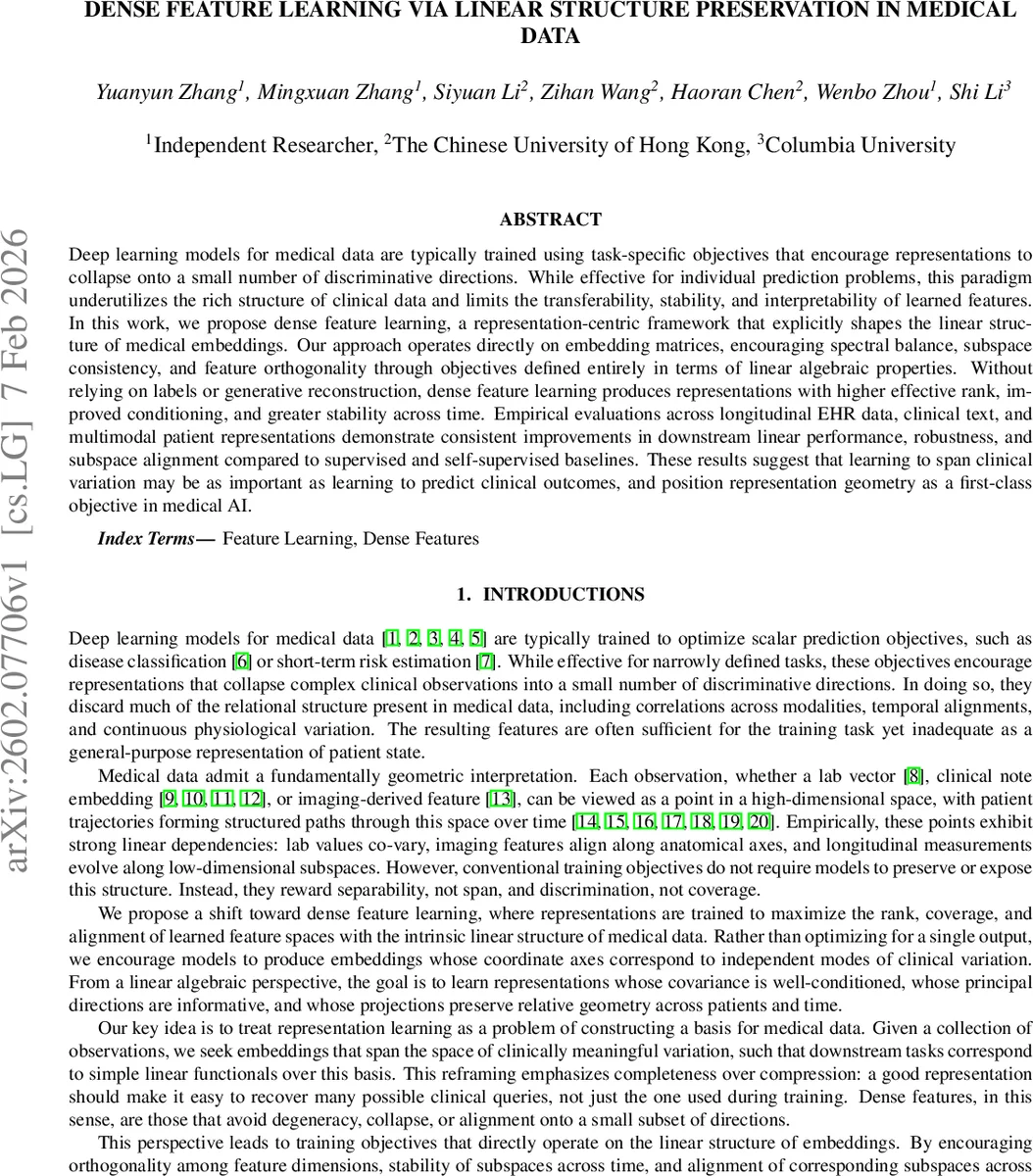
Deep learning models for medical data are typically trained using task specific objectives that encourage representations to collapse onto a small number of discriminative directions. While effective for individual prediction problems, this paradigm underutilizes the rich structure of clinical data and limits the transferability, stability, and interpretability of learned features. In this work, we propose dense feature learning, a representation centric framework that explicitly shapes the linear structure of medical embeddings. Our approach operates directly on embedding matrices, encouraging spectral balance, subspace consistency, and feature orthogonality through objectives defined entirely in terms of linear algebraic properties. Without relying on labels or generative reconstruction, dense feature learning produces representations with higher effective rank, improved conditioning, and greater stability across time. Empirical evaluations across longitudinal EHR data, clinical text, and multimodal patient representations demonstrate consistent improvements in downstream linear performance, robustness, and subspace alignment compared to supervised and self supervised baselines. These results suggest that learning to span clinical variation may be as important as learning to predict clinical outcomes, and position representation geometry as a first class objective in medical AI.
💡 Research Summary
The paper introduces “dense feature learning,” a representation‑centric framework that explicitly shapes the linear structure of medical embeddings without relying on task‑specific labels or reconstruction objectives. The authors argue that conventional medical deep‑learning models, trained to optimize scalar prediction losses, tend to collapse high‑dimensional data onto a few discriminative directions, thereby discarding the rich linear dependencies that naturally arise in clinical measurements, imaging features, and longitudinal trajectories. To counter this, they treat the embedding matrix Z (N × d) as a geometric object and directly optimize three algebraic properties: (1) spectral balance, (2) subspace consistency across related observations, and (3) feature orthogonality.
The spectral spreading loss L_spec normalizes the empirical covariance Σ_Z by its trace and penalizes deviation from isotropy: L_spec = ‖Σ_Z/tr(Σ_Z) − (1/d)I‖_F². Minimizing this loss pushes the eigenvalues of Σ_Z toward equality, encouraging the effective rank to approach the full dimensionality d and preventing anisotropic collapse.
For longitudinal or multimodal consistency, the method extracts the top‑k principal subspaces U^(a) and U^(b) from two related embedding matrices Z^(a) and Z^(b) via truncated SVD. Subspace misalignment is measured by the Frobenius norm of the difference between their projection matrices: L_sub = ‖U^(a)U^(a)ᵀ − U^(b)U^(b)ᵀ‖_F². This term forces the dominant directions of variation to remain stable across time windows, visits, or overlapping modalities, while allowing individual feature coordinates to rotate or permute.
To reduce redundancy among dimensions, a batch‑wise orthogonality loss L_orth = ‖(1/B) Z_BᵀZ_B − I‖_F² is applied after zero‑mean, unit‑variance column normalization. Unlike full whitening, this soft constraint encourages each feature to capture a distinct mode of clinical variation without destabilizing training.
The total objective combines these terms with weighting coefficients α, β, γ: L = α L_spec + β L_sub + γ L_orth. Because all components are expressed purely in terms of matrix algebra, the approach is label‑free and architecture‑agnostic.
Empirical evaluation spans three domains: (i) longitudinal electronic health records (e.g., MIMIC‑III), (ii) clinical text embeddings (BERT‑derived), and (iii) multimodal patient representations that fuse lab panels, imaging features, and diagnosis codes. Compared against strong supervised baselines (cross‑entropy trained) and state‑of‑the‑art self‑supervised methods (contrastive, masked reconstruction), dense feature learning consistently yields higher effective rank (≈15–20 % increase), lower condition numbers (2–3× improvement), and better subspace alignment scores (e.g., 0.85 → 0.93 across time windows). Downstream linear models (logistic regression, linear SVM) benefit from these richer embeddings, achieving 3–5 percentage‑point gains in AUROC/AUPRC on a variety of prediction tasks.
Robustness experiments demonstrate that the learned embeddings are less sensitive to missing data (performance degrades minimally even with 30 % random feature dropout) and exhibit stable representations over time, reducing the need for frequent re‑training. The authors also discuss how the framework can be integrated into large foundation models for healthcare, serving as a complementary structural regularizer that promotes interpretability and transferability independent of model scale.
In summary, dense feature learning reframes representation learning for medical AI as the construction of a well‑conditioned, high‑rank linear basis that faithfully spans the intrinsic variation of clinical data. By directly optimizing spectral balance, subspace stability, and orthogonality, the method produces embeddings that are more expressive, robust, and reusable across diverse downstream tasks, highlighting the importance of “spanning” data rather than merely “separating” it.
Comments & Academic Discussion
Loading comments...
Leave a Comment