Aura Topological Spaces and Generalized Open Sets with Applications to Rough Sets, Sensor Networks, and Epidemic Modelling
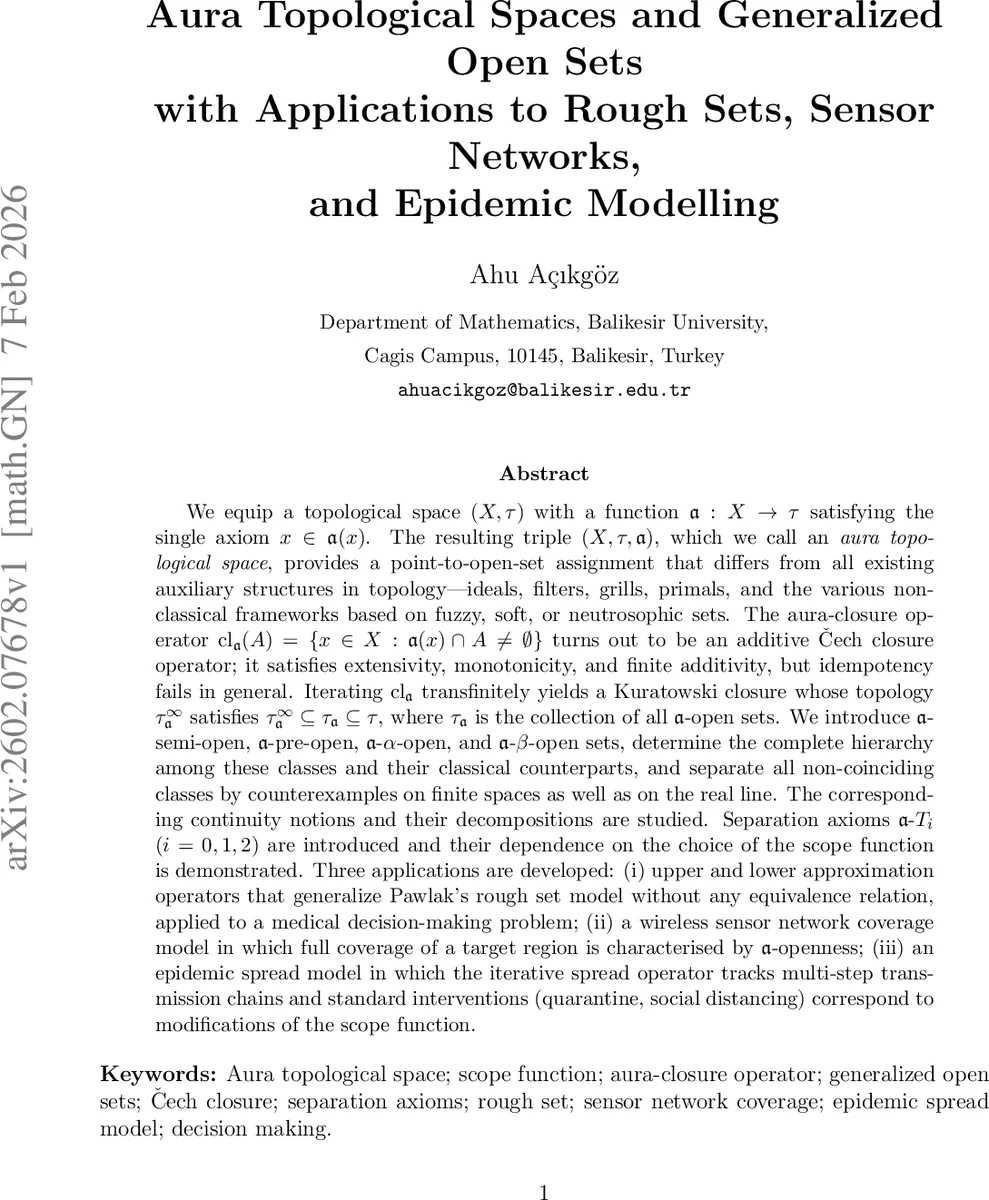
We equip a topological space $(X,τ)$ with a function $\mathfrak{a}: X \to τ$ satisfying the single axiom $x \in \mathfrak{a}(x)$. The resulting triple $(X, τ, \mathfrak{a})$, which we call an aura topological space, provides a point-to-open-set assignment that differs from all existing auxiliary structures in topology. The aura-closure operator $\text{cl}{\mathfrak{a}}(A) = {x \in X : \mathfrak{a}(x) \cap A \neq \emptyset}$ turns out to be an additive Cech closure operator; it satisfies extensivity, monotonicity, and finite additivity, but idempotency fails in general. Iterating $\text{cl}{\mathfrak{a}}$ transfinitely yields a Kuratowski closure whose topology $τ_{\mathfrak{a}}^{\infty}$ satisfies $τ_{\mathfrak{a}}^{\infty} \subseteq τ_{\mathfrak{a}} \subseteq τ$. We introduce five classes of generalized open sets, determine their complete hierarchy, and separate all non-coinciding classes by counterexamples. Continuity notions, decomposition theorems, and separation axioms are studied. Three applications are developed: rough set approximations generalizing Pawlak’s model, wireless sensor network coverage analysis, and epidemic spread modelling.
💡 Research Summary
The paper introduces a novel augmentation of a topological space (X, τ) by means of a “scope function” a : X → τ satisfying the single axiom x ∈ a(x) for every point x. The resulting triple (X, τ, a) is called an aura topological space (or a‑space). This construction differs fundamentally from previously studied auxiliary structures such as ideals, filters, grills, primals, fuzzy/soft/neutrosophic sets, or equivalence‑based rough set frameworks, because it assigns a fixed open neighbourhood to each point rather than a family of neighbourhoods or a secondary topology.
Aura‑closure operator.
For any subset A⊆X the aura‑closure is defined by
clₐ(A) = { x ∈ X | a(x) ∩ A ≠ ∅ }.
The authors prove that clₐ satisfies the first four Kuratowski axioms: it preserves the empty set, is extensive, monotone, and finitely additive. Hence clₐ is an additive Čech closure operator. However, idempotency generally fails; a concrete three‑point counterexample shows clₐ(clₐ(A)) ≠ clₐ(A). The lack of idempotency is interpreted as a feature that models multi‑step propagation phenomena (e.g., signal relaying, disease transmission) where a single application of the operator does not capture the full effect.
Transitivity and idempotency.
If the scope function satisfies the transitivity condition (∀x ∀y∈a(x) ⇒ a(y)⊆a(x)), then each a(x) becomes a‑open, the family {a(x)} forms a base for the a‑open topology τₐ, and clₐ becomes idempotent, thus turning into a genuine Kuratowski closure. The paper highlights this special case but notes that transitivity is not automatic in most applications.
Iterated closure and τ∞ₐ.
Because clₐ is not idempotent in general, the authors define an ordinal‑indexed iteration: cl⁰ₐ(A)=A, clⁿ⁺¹ₐ(A)=clₐ(clⁿₐ(A)), and cl∞ₐ(A)=⋃ₙclⁿₐ(A). They prove that cl∞ₐ is a Kuratowski closure operator, generating a topology τ∞ₐ that sits between τₐ and the original τ (τ∞ₐ⊆τₐ⊆τ). This construction provides a canonical way to recover a genuine topological structure from any aura space.
Generalized open sets.
Beyond the basic a‑open sets (those satisfying a(x)⊆A for all x∈A), the paper defines five families of generalized open sets: a‑semi‑open, a‑pre‑open, a‑α‑open, a‑β‑open, and a‑open. It establishes a complete implication diagram showing all inclusion relations among these classes and the classical counterparts (semi‑open, pre‑open, α‑open, β‑open). Counterexamples on finite discrete spaces and on ℝ with the usual topology demonstrate that each inclusion is strict where claimed.
Continuity and decomposition.
A map f:(X,τ,a)→(Y,σ,b) is called a‑continuous if the preimage of every b‑open set is a‑open. The authors study several equivalent formulations, show how a‑continuity decomposes into combinations of a‑semi‑continuity and a‑pre‑continuity, and compare these notions with existing α‑ and β‑continuity concepts.
Separation axioms.
Analogues of T₀, T₁, and T₂ are introduced (a‑T₀, a‑T₁, a‑T₂) using a‑open sets. The paper demonstrates that the validity of these axioms depends on the chosen scope function; for instance, a‑T₁ coincides with the classical T₁ exactly when the space is transitive. The hierarchy of separation properties mirrors the hierarchy of generalized open sets.
Applications.
-
Rough set approximations without equivalence relations.
Using clₐ and intₐ, lower and upper approximations of a subset are defined as clₐ(Aᶜ)ᶜ and intₐ(A), respectively. This yields a Pawlak‑style decision‑theoretic model where the “indiscernibility” is replaced by the pointwise neighbourhood a(x). A medical decision‑making example illustrates how varying a can encode different diagnostic sensitivities. -
Wireless sensor network coverage.
Each sensor’s detection region is modeled by a(x). Full coverage of a target region R is equivalent to R being a‑open. The authors translate the classic set‑cover problem into finding a minimal subfamily of sensors whose a‑open union equals R, and discuss how adjusting a (e.g., by changing transmission power) corresponds to network reconfiguration. -
Epidemic spread modeling.
An infected individual’s transmission radius is represented by a(x). The iterative application of clₐ models successive infection waves. Public‑health interventions such as quarantine or social distancing are interpreted as modifications of a (shrinking neighbourhoods or breaking transitivity). The framework thus unifies spatial epidemic dynamics with topological closure theory.
Critical assessment and future directions.
The introduction of a fixed point‑to‑open‑set assignment is conceptually elegant and opens a new line of research linking topology with applied network and epidemiological models. However, the paper leaves several important issues open. First, the choice of the scope function a is largely arbitrary; the authors provide examples but no systematic method for selecting a in a data‑driven context. Second, the transitivity condition, while mathematically convenient, may be unrealistic for many physical systems, and the consequences of violating it are not fully explored. Third, computational aspects are only briefly mentioned; evaluating clₐ on large graphs or continuous domains could be costly, and algorithmic strategies are absent. Finally, the application sections are primarily illustrative; empirical validation, simulations, or real‑world case studies would strengthen the claim of practical relevance.
In summary, the paper proposes a fresh topological construct— aura spaces with a scope function— and develops a rich theory of closure, interior, generalized openness, continuity, and separation. It demonstrates the versatility of the framework through three diverse applications, while also highlighting the need for further work on function selection, algorithmic implementation, and empirical testing.
Comments & Academic Discussion
Loading comments...
Leave a Comment