Alteration of the Brains Microbiome and Neuroinflammation Associated with Ventricular Catheters
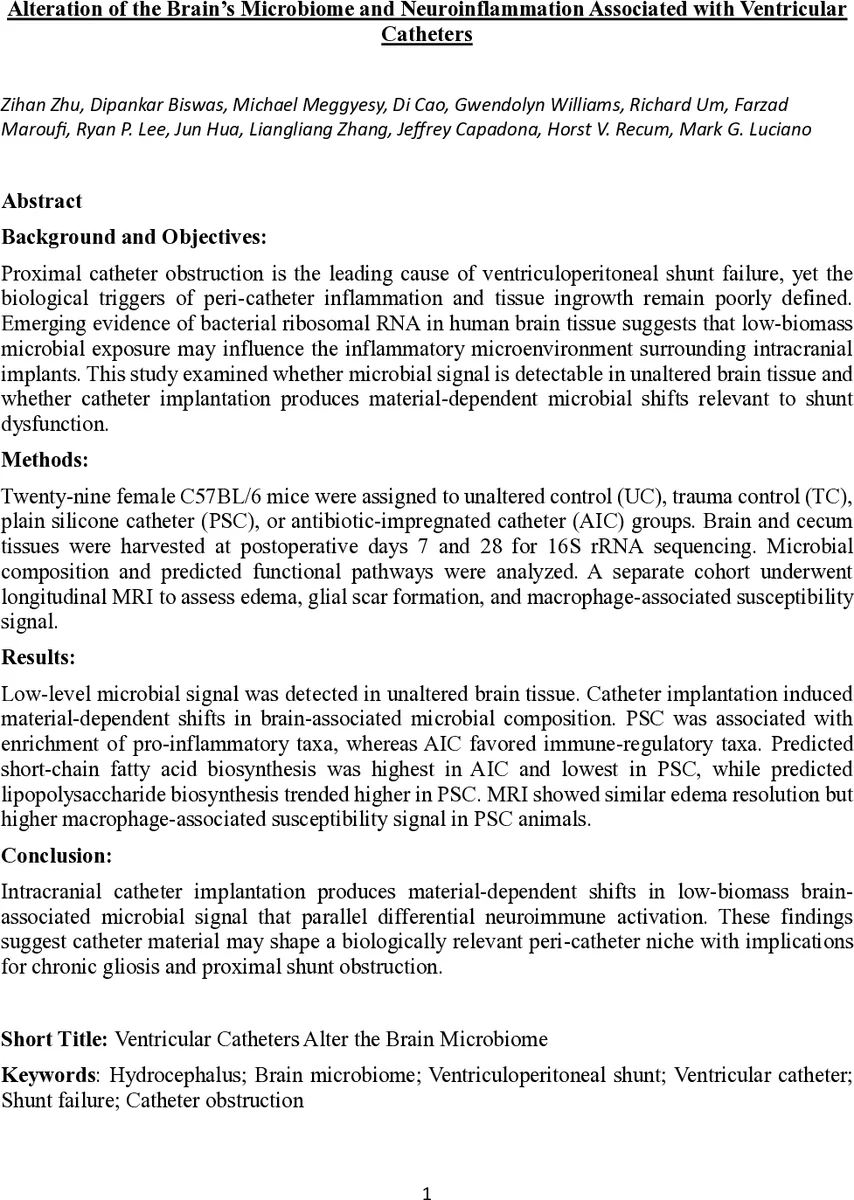
Background and Objectives: Proximal catheter obstruction is the leading cause of ventriculoperitoneal shunt failure, yet the biological triggers of peri-catheter inflammation and tissue ingrowth remain poorly defined. Evidence of bacterial ribosomal RNA in human brain tissue suggests that low-biomass microbial exposure may influence the inflammatory microenvironment surrounding implants. This study examined if microbial signal is detectable in unaltered brain tissue and if catheter implantation produces microbial shifts relevant to shunt dysfunction. Methods: Twenty-nine female mice were assigned to unaltered control (UC), trauma control (TC), plain silicone catheter (PSC), or antibiotic-impregnated catheter (AIC) groups. Brain and cecum tissues were harvested at postoperative days 7 and 28 for 16S rRNA sequencing. Microbial composition and predicted functional pathways were analyzed. A separate cohort underwent longitudinal MRI to assess edema, glial scar formation, and macrophage-associated susceptibility signal. Results: Low-level microbial signal was detected in unaltered brain tissue. Catheter implantation induced material-dependent shifts in brain-associated microbial composition. PSC was associated with enrichment of pro-inflammatory taxa, whereas AIC favored immune-regulatory taxa. Predicted short-chain fatty acid biosynthesis was highest in AIC and lowest in PSC, while predicted lipopolysaccharide biosynthesis trended higher in PSC. MRI showed similar edema resolution but higher macrophage-associated susceptibility signal in PSC animals. Conclusion: Intracranial catheter implantation produces material-dependent shifts in low-biomass brain-associated microbial signal that parallel differential neuroimmune activation. These findings suggest catheter material may shape a biologically relevant peri-catheter niche with implications for chronic gliosis and proximal shunt obstruction.
💡 Research Summary
This pilot study investigated two fundamental questions relevant to ventriculoperitoneal (VP) shunt failure: (1) whether a low‑biomass microbial signal can be detected in unaltered brain tissue, and (2) whether implantation of intracranial catheters induces material‑dependent shifts in that signal that might influence neuroinflammation and proximal shunt obstruction.
Twenty‑nine 5‑week‑old female C57BL/6 mice were divided into four groups: unaltered control (UC), trauma control (TC, burr‑hole placement without implantation), plain silicone catheter (PSC), and antibiotic‑impregnated catheter (AIC). Brain and cecum tissues were harvested at postoperative day 7 (acute) and day 28 (chronic) for 16S rRNA gene sequencing. A separate cohort of five mice underwent longitudinal MRI (T2‑weighted, FLAIR, and susceptibility‑weighted imaging with ferumoxytol) to monitor edema, glial scar formation, and macrophage‑associated susceptibility signals.
Sequencing data were processed with QIIME 2, host reads removed via Kraken2, and OTUs clustered at 99 % identity against SILVA. Alpha diversity (Shannon, Chao1) and beta diversity (weighted UniFrac) demonstrated that the brain harbored a markedly less rich but similarly even microbial community compared with the cecum (Chao1 p < 0.0001, Shannon p = 0.8). Low‑abundance but reproducible genera—including Cutibacterium, Flavobacterium, Pseudomonas, Muribaculaceae, and Herbaspirillum—were detected in all UC brain samples, confirming the presence of a resident low‑biomass brain microbiome.
When catheters were implanted, distinct material‑dependent microbial signatures emerged. PSC brains were enriched for Desulfovibrionaceae, Muribaculaceae, and Clostridia UCG‑014—taxa linked to lipopolysaccharide (LPS) production, intestinal barrier disruption, and pro‑inflammatory signaling. In contrast, AIC brains showed higher relative abundances of Akkermansiaceae (Akkermansia), Parabacteroides, and several unclassified Clostridiales, all associated with short‑chain fatty acid (SCFA) synthesis, epithelial barrier maintenance, and neuro‑immune modulation. Trauma controls displayed a mixed profile dominated by Providencia, Saccharimonadales, and Gammaproteobacteria, reflecting a generic surgical stress response. Differential abundance was assessed with LEfSe, and effect sizes were quantified using Cliff’s Δ.
Functional inference via PICRUSt2 focused on SCFA and LPS biosynthetic pathways. The AIC group exhibited the highest predicted SCFA pathway abundance (Δ = 0.76 vs. UC, p ≈ 0.05) and the lowest LPS potential, whereas PSC showed the opposite trend (Δ ≈ 0.4 higher LPS vs. UC). Although many comparisons did not reach conventional statistical significance due to limited sample size, the direction and magnitude of effect sizes support biologically meaningful differences.
MRI findings complemented the microbiome data. All implanted mice showed a peak in edema volume at week 1 that resolved by week 4, with no significant differences between PSC and AIC. Glial scar volume peaked at week 4 and persisted through week 16 in both groups. Susceptibility‑weighted imaging revealed that R2* values—an indicator of iron‑laden macrophage activity—were consistently higher in PSC‑implanted mice at weeks 4, 8, and 16, suggesting a more robust or prolonged macrophage response. Catheter volumes remained stable (< 1 mm³) across time points.
The authors conclude that (i) a low‑biomass microbial community is present in normal mouse brain tissue, (ii) intracranial catheter implantation reshapes this community in a material‑dependent manner, and (iii) these microbial shifts parallel distinct neuroimmune phenotypes, with plain silicone favoring pro‑inflammatory taxa and higher macrophage activation, whereas antibiotic‑impregnated catheters promote SCFA‑producing, immune‑regulatory taxa and attenuated macrophage signals.
Limitations include the small cohort size, reliance on 16S‑based functional predictions rather than metagenomics or metabolomics, and the translational gap between murine models and human shunt patients. Nonetheless, the study provides a novel mechanistic link between catheter material, the peri‑catheter microbiome, and neuroinflammation, suggesting that engineering catheter surfaces to modulate the local microbial niche could be a viable strategy to reduce chronic gliosis and proximal shunt obstruction in hydrocephalus patients.
Comments & Academic Discussion
Loading comments...
Leave a Comment