BiBiEQ: Bivariate Bicycle Codes on Erasure Qubits
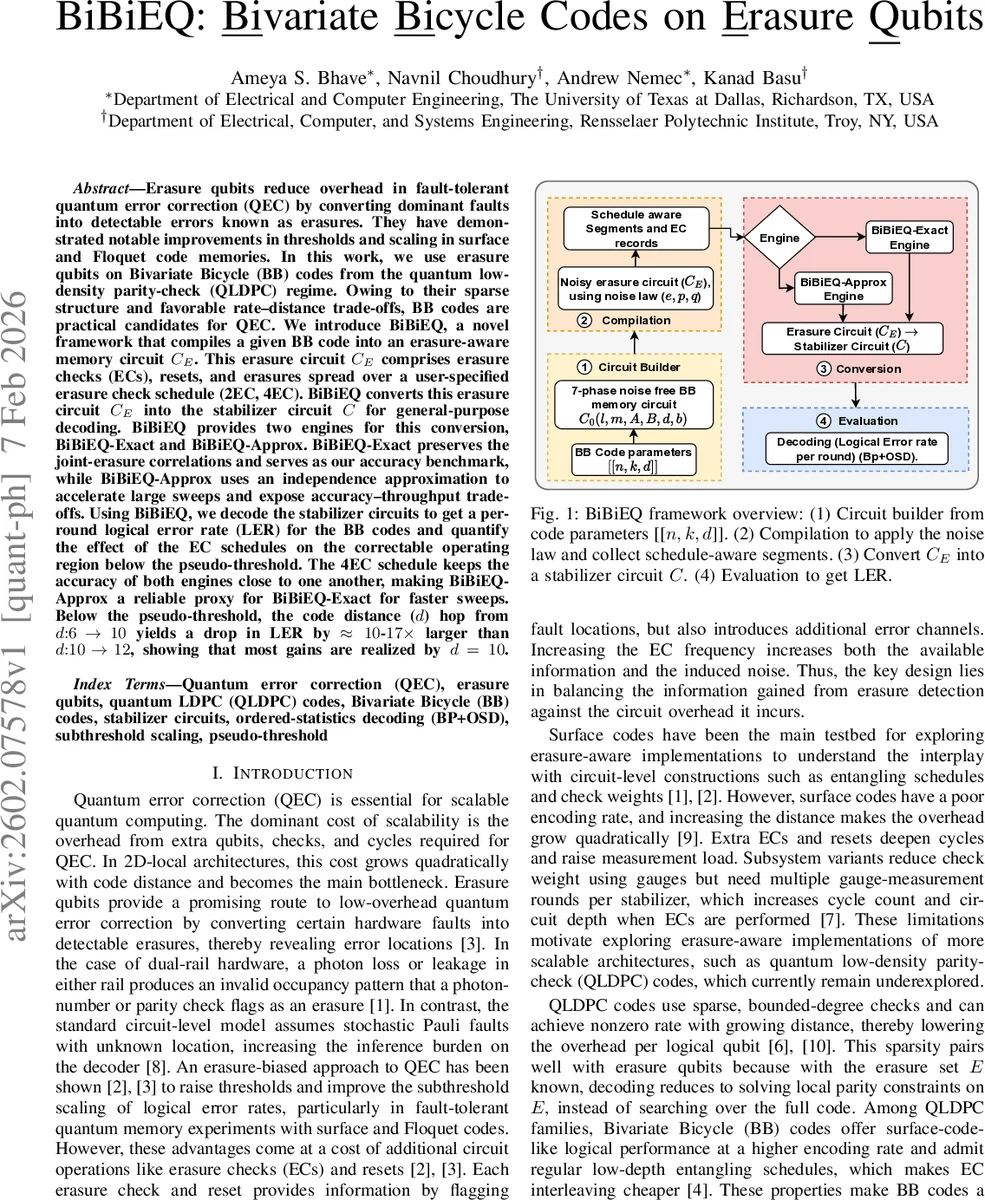
Erasure qubits reduce overhead in fault-tolerant quantum error correction (QEC) by converting dominant faults into detectable errors known as erasures. They have demonstrated notable improvements in thresholds and scaling in surface and Floquet code memories. In this work, we use erasure qubits on Bivariate Bicycle (BB) codes from the quantum low-density parity-check (QLDPC) regime. Owing to their sparse structure and favorable rate-distance trade-offs, BB codes are practical candidates for QEC. We introduce BiBiEQ, a novel framework that compiles a given BB code into an erasure-aware memory circuit C_E. This erasure circuit C_E comprises erasure checks (ECs), resets, and erasures spread over a user-specified erasure check schedule (2EC, 4EC). BiBiEQ converts this erasure circuit C_E into the stabilizer circuit C for general-purpose decoding. BiBiEQ provides two engines for this conversion, BiBiEQ-Exact and BiBiEQ-Approx. BiBiEQ-Exact preserves the joint-erasure correlations and serves as our accuracy benchmark, while BiBiEQ-Approx uses an independence approximation to accelerate large sweeps and expose accuracy-throughput trade-offs. Using BiBiEQ, we decode the stabilizer circuits to get a per-round logical error rate (LER) for the BB codes and quantify the effect of the EC schedules on the correctable operating region below the pseudo-threshold. The 4EC schedule keeps the accuracy of both engines close to one another, making BiBiEQ-Approx a reliable proxy for BiBiEQ-Exact for faster sweeps. Below the pseudo-threshold, the code distance (d) hop from distance (d) 6 to 10 yields a drop in LER by 10-17x larger than distance (d) 10 to 12, showing that most gains are realized by d=10.
💡 Research Summary
The paper introduces BiBiEQ, a comprehensive framework that enables the use of erasure‑biased qubits with Bivariate Bicycle (BB) quantum low‑density parity‑check (QLDPC) codes. Erasure qubits convert dominant physical faults into detectable erasures, providing precise spacetime locations for errors and thereby reducing the inference burden on decoders. While previous work demonstrated the benefits of erasure qubits for surface and Floquet codes, this work extends the approach to the QLDPC regime, where sparse, bounded‑degree checks allow non‑zero encoding rates and scalable overhead.
BB codes are defined by a pair of bivariate polynomials A(x,y) and B(x,y) over GF(2). The authors fix A(x,y)=x³+y+y² and B(x,y)=y³+x+x², and vary the toroidal lattice dimensions (l,m) = (6,6), (9,6), (12,6). This yields three codes:
Comments & Academic Discussion
Loading comments...
Leave a Comment