Graph Domain Adaptation via Homophily-Agnostic Reconstructing Structure
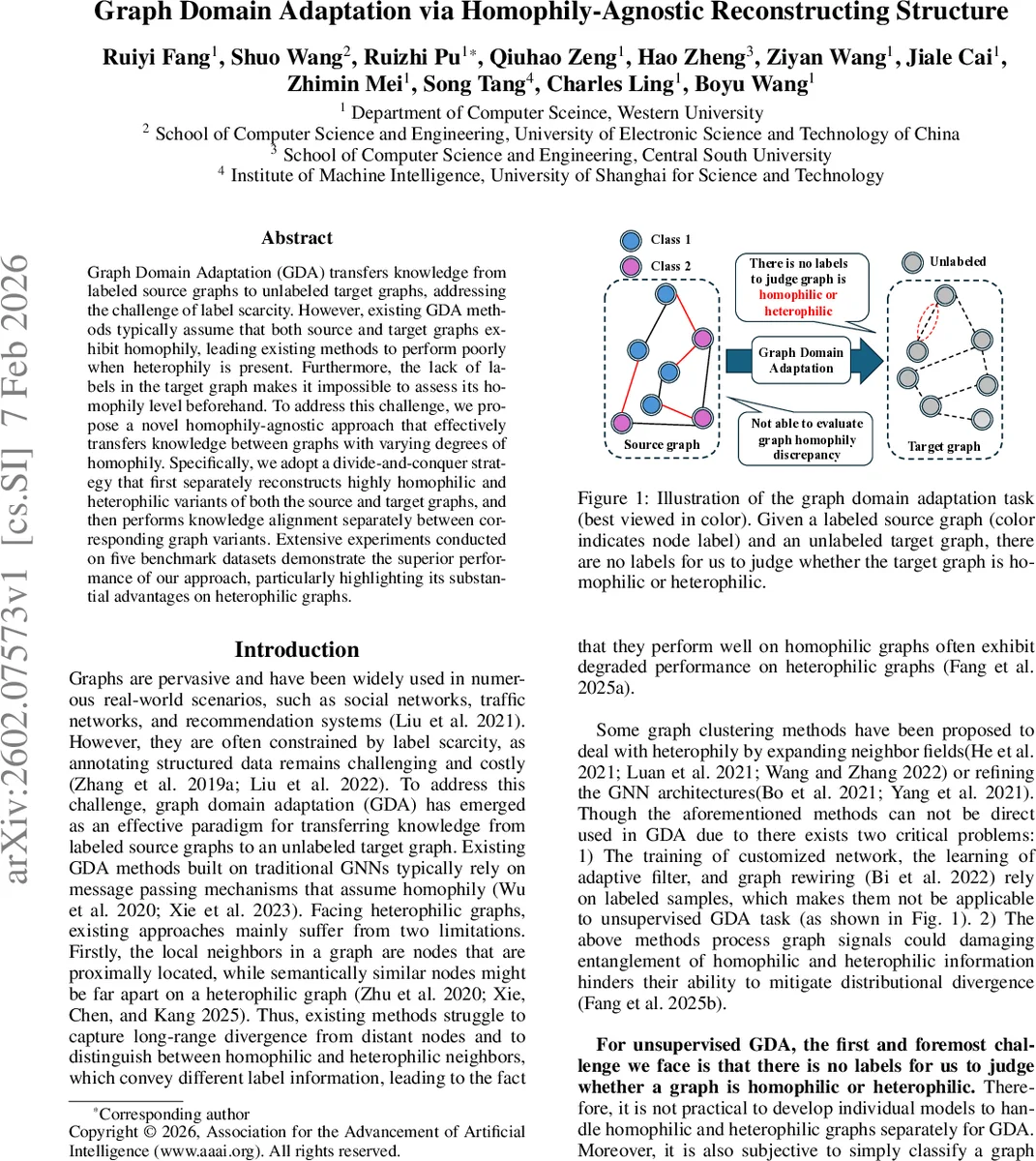
Graph Domain Adaptation (GDA) transfers knowledge from labeled source graphs to unlabeled target graphs, addressing the challenge of label scarcity. However, existing GDA methods typically assume that both source and target graphs exhibit homophily, leading existing methods to perform poorly when heterophily is present. Furthermore, the lack of labels in the target graph makes it impossible to assess its homophily level beforehand. To address this challenge, we propose a novel homophily-agnostic approach that effectively transfers knowledge between graphs with varying degrees of homophily. Specifically, we adopt a divide-and-conquer strategy that first separately reconstructs highly homophilic and heterophilic variants of both the source and target graphs, and then performs knowledge alignment separately between corresponding graph variants. Extensive experiments conducted on five benchmark datasets demonstrate the superior performance of our approach, particularly highlighting its substantial advantages on heterophilic graphs.
💡 Research Summary
Graph domain adaptation (GDA) aims to transfer knowledge from a labeled source graph to an unlabeled target graph, a task that becomes especially difficult when the target graph’s homophily level (the tendency of similar‑label nodes to connect) is unknown. Existing GDA methods largely assume homophily and therefore struggle on heterophilic graphs, where informative signals often reside in high‑frequency components rather than the smooth low‑frequency patterns that conventional graph neural networks (GNNs) capture. Moreover, the absence of target labels prevents any pre‑assessment of homophily, making it impossible to select a homophily‑specific model in advance.
The paper introduces RSGDA (Reconstruction Structure Graph Domain Adaptation), a homophily‑agnostic framework that sidesteps the need for prior homophily estimation. RSGDA follows a divide‑and‑conquer philosophy: it first reconstructs two complementary variants of each graph—a highly homophilic version and a highly heterophilic version—using fully unsupervised procedures, and then aligns the source and target representations separately for each variant. By treating the two variants independently, the method can exploit both low‑frequency (smooth) and high‑frequency (sharp) information without mixing them, thereby reducing domain shift more effectively.
1. Structure Reconstruction
Homophilic variant – The goal is to produce an adjacency matrix (\hat A) that encourages neighboring nodes to have similar feature vectors while satisfying row‑sum and non‑negativity constraints. The authors formulate a constrained optimization problem:
\
Comments & Academic Discussion
Loading comments...
Leave a Comment