Averaged Controllability of Time-Fractional Schrödinger Equations with Random Quantum Diffusivity
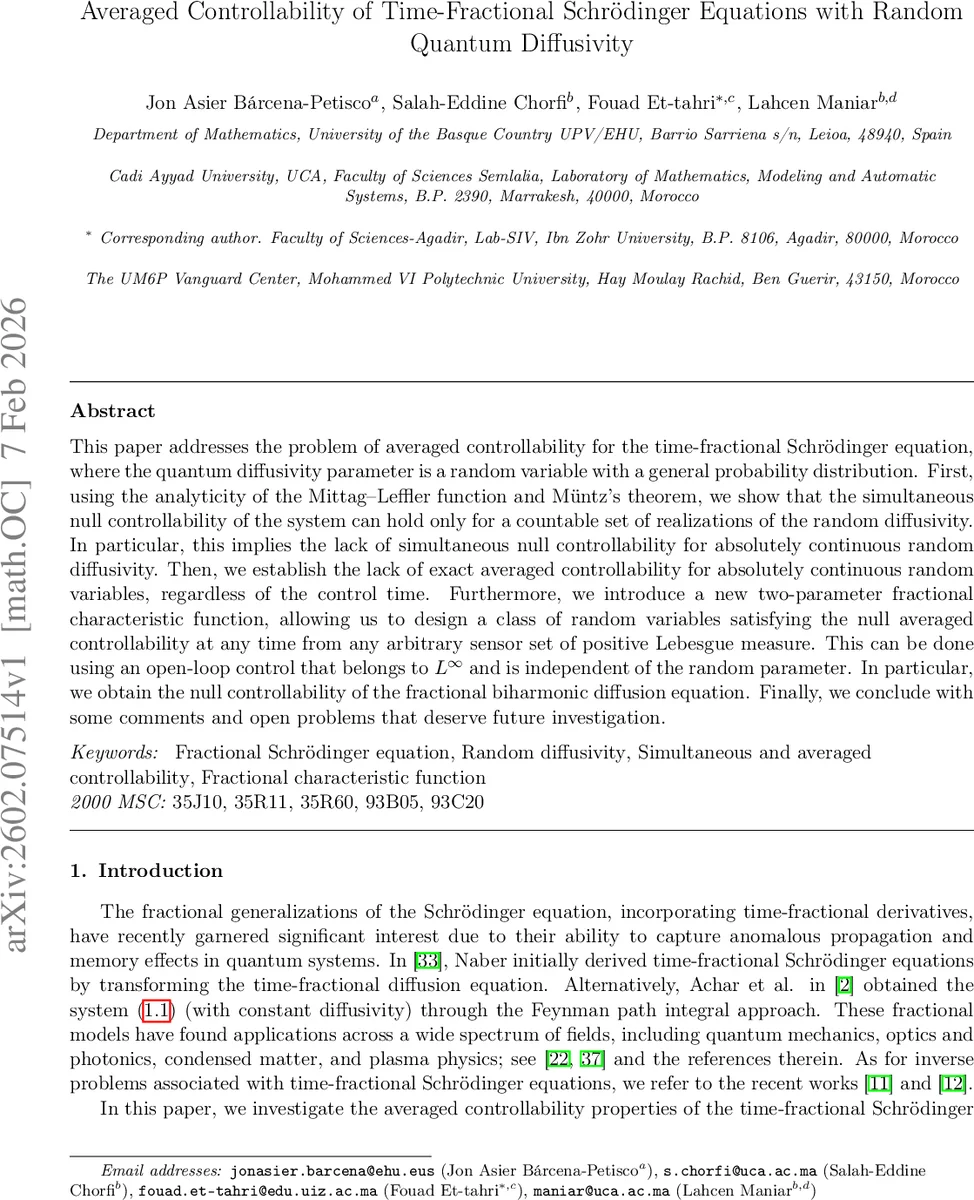
This paper addresses the problem of averaged controllability for the time-fractional Schrodinger equation, where the quantum diffusivity parameter is a random variable with a general probability distribution. First, by exploiting the analyticity of the Mittag-Leffler function and Muntz’s theorem, we show that the simultaneous null controllability of the system can occur only for a countable set of realizations of the random diffusivity. In particular, this implies the impossibility of simultaneous null controllability for absolutely continuous random diffusivity. Next, we prove the lack of exact averaged controllability for absolutely continuous random variables, irrespective of the control time. Furthermore, we introduce a new two-parameter fractional characteristic function, which allows us to construct a class of random variables satisfying null averaged controllability at any time from any arbitrary sensor set of positive Lebesgue measure. This is achieved using an open-loop control belonging to L^\infty and independent of the random parameter. In particular, we obtain the null controllability of the fractional biharmonic diffusion equation. Finally, we conclude with several remarks and open problems that merit future investigation.
💡 Research Summary
The paper investigates the controllability properties of a time‑fractional Schrödinger equation whose diffusion coefficient ξ is a random variable with a general probability distribution. The state equation is ∂α0,t y − i ξ Δy = 1G₀ u on (0,T)×G, with Dirichlet boundary conditions, where ∂α0,t denotes the Caputo derivative of order α∈(0,1). The control u belongs to L∞((0,T)×G₀) and is independent of the random parameter. The authors first exploit the analyticity of the Mittag‑Leffler function Eα,β(z) and Müntz’s theorem to prove that, for any non‑zero initial datum y₀ and any admissible control, the set of ξ‑realizations that drive the solution to zero at time T is at most countable. Consequently, when ξ has an absolutely continuous distribution, the probability of achieving simultaneous null controllability is zero. This extends known results for integer‑order Schrödinger equations to the fractional setting, where the presence of complex arguments i ξ λₙ tα in the Mittag‑Leffler functions introduces substantial technical difficulties.
Next, the authors study exact averaged controllability, i.e., the ability to steer the expectation E
Comments & Academic Discussion
Loading comments...
Leave a Comment