A Fubini Theorem for Grothendieck Functional Integrals
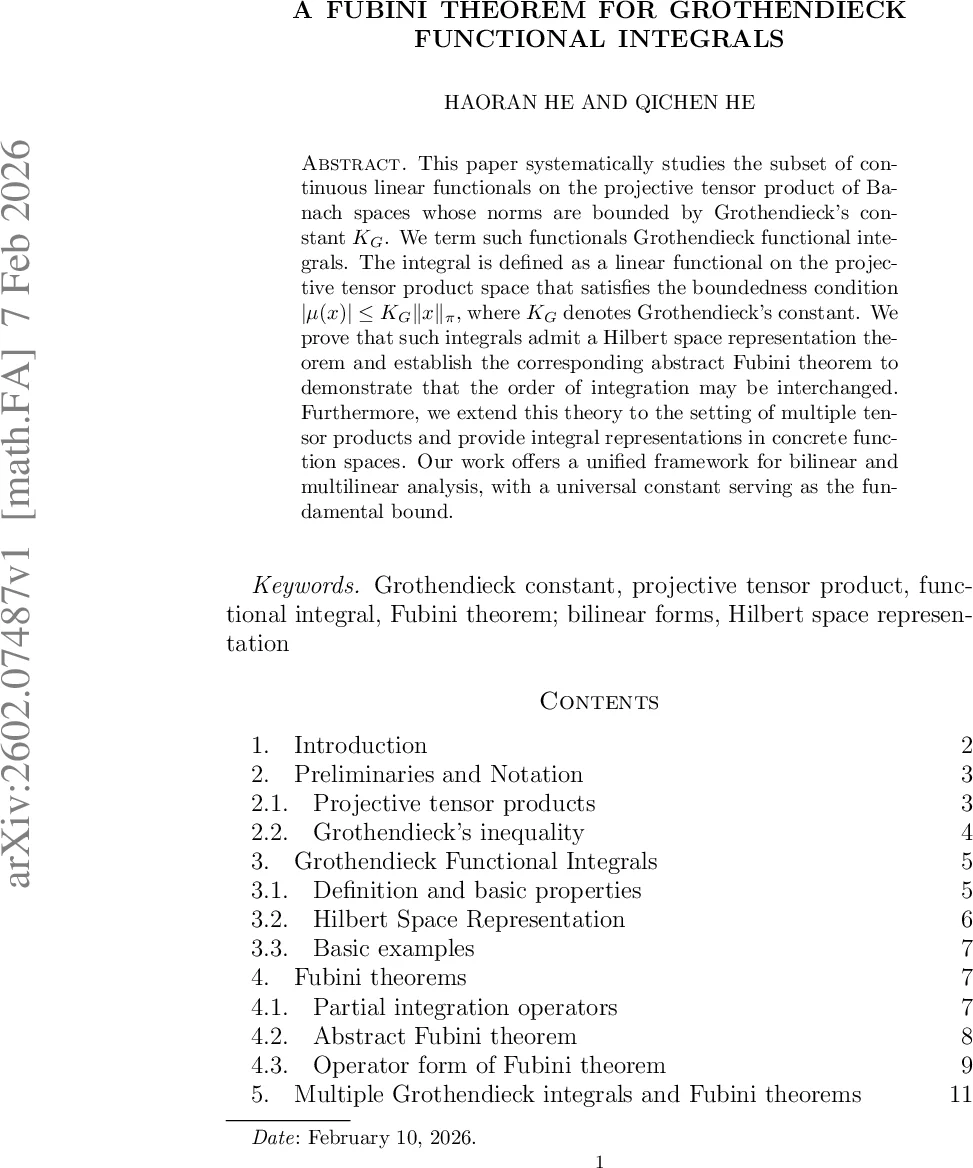
This paper systematically studies the subset of continuous linear functionals on the projective tensor product of Banach spaces whose norms are bounded by Grothendieck’s constant $K_G$. We term such functionals Grothendieck functional integrals. The integral is defined as a linear functional on the projective tensor product space that satisfies the boundedness condition $|μ(x)| \leq K_G |x|_π$, where $K_G$ denotes Grothendieck’s constant. We prove that such integrals admit a Hilbert space representation theorem and establish the corresponding abstract Fubini theorem to demonstrate that the order of integration may be interchanged. Furthermore, we extend this theory to the setting of multiple tensor products and provide integral representations in concrete function spaces. Our work offers a unified framework for bilinear and multilinear analysis, with a universal constant serving as the fundamental bound.
💡 Research Summary
The paper introduces a new class of linear functionals on the projective tensor product (E\otimes_{\pi}F) of Banach spaces, called Grothendieck functional integrals. A functional (\mu) belongs to this class if its operator norm does not exceed Grothendieck’s constant (K_G) (≈ 1.78 for real scalars, ≈ 1.34 for complex scalars). The authors deliberately avoid any measure‑theoretic construction; instead, the “integral” terminology is used metaphorically to stress the analogy with classical integration while the underlying bound is purely functional‑analytic.
The paper proceeds as follows. Section 2 reviews the projective tensor norm and Grothendieck’s inequality in the operator‑theoretic form: for any continuous bilinear form (\varphi:E\times F\to\mathbb K) there exist a Hilbert space (H) and bounded operators (A:E\to H), (B:F\to H) such that (\varphi(e,f)=\langle Ae,Bf\rangle_H) and (|A||B|\le K_G|\varphi|). This classical result is the backbone of the whole theory.
In Section 3 the authors define a Grothendieck functional integral (\mu) as a linear functional on the algebraic tensor product satisfying (|\mu(x)|\le K_G|x|{\pi}) for all (x). They show a one‑to‑one correspondence between such (\mu) and bilinear forms (\varphi{\mu}(e,f)=\mu(e\otimes f)) with (|\varphi_{\mu}|=|\mu|G). The main Hilbert‑space representation theorem (Theorem 3.3) follows immediately from Grothendieck’s inequality: every Grothendieck integral can be written as (\varphi{\mu}(e,f)=\langle Ae,Bf\rangle_H) with (|A||B|\le K_G^2). The authors remark that sharper estimates ((|A||B|\le K_G|\varphi|)) are available via the Grothendieck‑Pietsch factorisation, but they retain the simpler bound for readability.
Section 4 introduces partial integration operators. For fixed (e\in E) the map (f\mapsto\varphi(e,f)) defines an element (\mu_e\in F^); similarly (\mu_f\in E^). This yields bounded operators (T_{\mu}:E\to F^) and (S_{\mu}:F\to E^) with (|T_{\mu}|=|S_{\mu}|=|\mu|_G). The abstract Fubini theorem (Theorem 4.3) states that for any finite sum (x=\sum_i e_i\otimes f_i) one has \
Comments & Academic Discussion
Loading comments...
Leave a Comment