Are Reasoning LLMs Robust to Interventions on Their Chain-of-Thought?
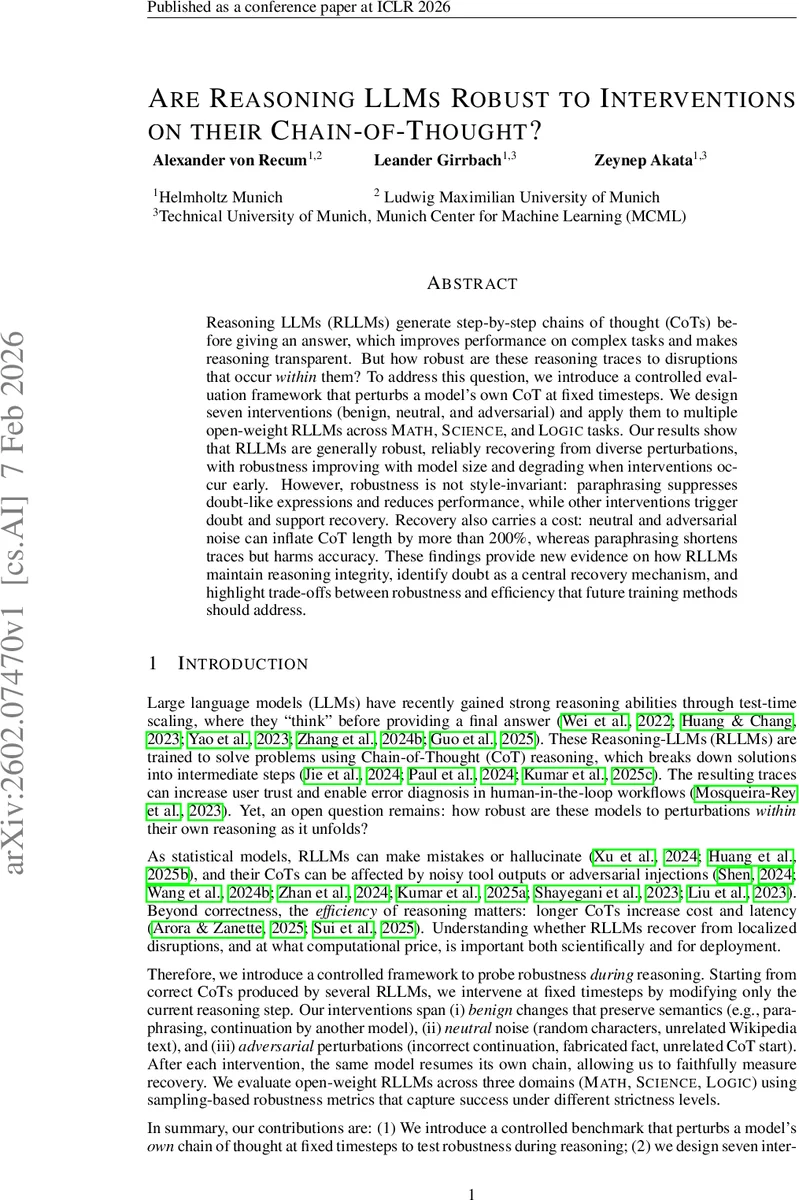
Reasoning LLMs (RLLMs) generate step-by-step chains of thought (CoTs) before giving an answer, which improves performance on complex tasks and makes reasoning more transparent. But how robust are these reasoning traces to disruptions that occur within them? To address this question, we introduce a controlled evaluation framework that perturbs a model’s own CoT at fixed timesteps. We design seven interventions (benign, neutral, and adversarial) and apply them to multiple open-weight RLLMs across Math, Science, and Logic tasks. Our results show that RLLMs are generally robust, reliably recovering from diverse perturbations, with robustness improving with model size and degrading when interventions occur early. However, robustness is not style-invariant: paraphrasing suppresses doubt-like expressions and reduces performance, while other interventions trigger doubt and support recovery. Recovery also carries a cost: neutral and adversarial noise can inflate CoT length by more than 200%, whereas paraphrasing shortens traces but harms accuracy. These findings provide new evidence on how RLLMs maintain reasoning integrity, identify doubt as a central recovery mechanism, and highlight trade-offs between robustness and efficiency that future training methods should address.
💡 Research Summary
Paper Overview
The authors investigate how robust reasoning‑augmented large language models (RLLMs) are when their own chain‑of‑thought (CoT) reasoning traces are perturbed during generation. While prior work has examined post‑hoc error detection or the effect of noisy in‑context examples, this study uniquely intervenes at fixed timesteps within the model’s own CoT, thereby measuring the model’s ability to self‑correct in real time.
Methodology
- Data Collection – The authors curate 600 high‑quality prompts from three domains (Mathematics, Science, Logic). Each prompt is solved correctly by nine open‑source RLLMs, providing a gold‑standard CoT for each model.
- Step Segmentation – Every CoT is split into logical reasoning steps (R_1, …, R_k). Interventions are applied to a single step (R_t) at a predetermined timestep (t).
- Intervention Design – Seven interventions are defined, grouped as:
- Benign: (i) continuation by another model, (ii) full‑sentence paraphrasing of the current CoT.
- Neutral: (i) random character insertion, (ii) insertion of an unrelated Wikipedia paragraph.
- Adversarial: (i) a deliberately wrong reasoning step, (ii) a fabricated mathematical fact, (iii) replacement of the current step with the opening of an unrelated CoT.
All context‑aware interventions are generated with Qwen‑2.5‑32B‑Instruct; neutral insertions are purely stochastic.
- Recovery Evaluation – After the intervention, the same model continues the reasoning from step (t+1) onward. The authors sample multiple continuations and assess whether the final answer matches the original ground truth. Robustness is quantified under three strictness levels: majority‑robust (most samples correct), all‑robust (all samples correct), and at‑least‑once‑robust (any sample correct).
Key Findings
- Scale Matters – Large models (e.g., Llama‑70B, Qwen‑32B) recover from almost all interventions with >90 % success, whereas small models (1.5 B–8 B) struggle, especially with adversarial perturbations (≈40 % success).
- Temporal Sensitivity – Interventions placed early (first two steps) cause a pronounced drop in recovery (≈30 % absolute decrease) compared to later steps, indicating that early hypotheses dominate the reasoning trajectory.
- Style Sensitivity – Paraphrasing shortens the CoT (‑15 % tokens) but suppresses “doubt” expressions (e.g., “let me check”), leading to a modest accuracy loss (‑5–8 % points). Continuations generated by a different model introduce a stylistic shift yet trigger the model to emit doubt markers, which actually aid recovery.
- Cost of Recovery – Neutral and adversarial noise inflate the final CoT length by 150 %–250 % on average, dramatically increasing inference latency and token‑based cost. Random‑character noise is especially expensive because the model must repeatedly re‑interpret garbled text.
- Metacognitive Mechanism – Short doubt phrases (“wait, let me think”, “checking the calculation”) appear spontaneously after many interventions and boost recovery rates by 10–15 % absolute. This suggests that RLLMs possess an emergent self‑monitoring loop that can be leveraged during training.
Analysis and Implications
The study demonstrates that RLLMs are not merely “black‑box answer generators”; they exhibit a degree of internal error detection and correction when their reasoning stream is disturbed. However, robustness is not uniform: it depends on model capacity, the timing of the disruption, and the stylistic consistency of the reasoning trace. The identified reliance on doubt expressions points to a concrete training target: explicitly rewarding metacognitive signals could make models more resilient without incurring the large token overhead observed for neutral/adversarial noise. Moreover, the pronounced vulnerability to early‑stage perturbations suggests that pre‑emptive verification of initial hypotheses (e.g., via a lightweight consistency check) could further improve reliability in production pipelines.
Future Directions
- Metacognitive Reward Design – Incorporate explicit “doubt” tokens into reinforcement‑learning objectives to strengthen self‑verification.
- Style‑Robust Pre‑training – Train on paraphrased reasoning examples to reduce sensitivity to wording changes.
- Efficient Recovery Strategies – Develop mechanisms that limit token blow‑up, such as bounded re‑generation windows or hierarchical reasoning where only the affected sub‑module is recomputed.
- Real‑World Tool Integration – Extend the framework to noisy tool outputs (e.g., faulty calculators, imperfect retrieval) to assess robustness in end‑to‑end pipelines.
Conclusion
By systematically perturbing a model’s own chain‑of‑thought and measuring its ability to self‑correct, the authors provide the first comprehensive benchmark of reasoning robustness. The findings reveal that large RLLMs can often recover from benign, neutral, and even adversarial disruptions, but this resilience comes at a computational cost and is fragile to early‑stage and stylistic changes. The work highlights “doubt” as a pivotal recovery catalyst and offers concrete avenues for future research aimed at building more robust, efficient, and self‑aware reasoning systems.
Comments & Academic Discussion
Loading comments...
Leave a Comment