Haptically Experienced Animacy Facilitates Emotion Regulation: A Theory-Driven Investigation
Emotion regulation (ER) is essential to mental well-being but often difficult to access, especially in high-intensity moments or for individuals with clinical vulnerabilities. While existing technology-based ER tools offer value, they typically rely on self-reflection (e.g., emotion tracking, journaling) or co-regulation through verbal modalities (reminders, text-based conversational tools), which may not be accessible or effective when most needed. The biological role of the touch modality makes it an intriguing alternate pathway, but empirical evidence is limited and under-theorized. Building on our prior theoretical framework describing how a comforting haptic co-regulating adjunct (CHORA) can support ER, we developed a zoomorphic robot CHORA with looped biomimetic breathing and heartbeat behaviors. We evaluated its effects in a mixed-methods in-lab study (N=30), providing physiological, self-report, custom questionnaire, and retrospective interview data. Our findings demonstrate the regulatory effects of haptically experienced animacy, corroborate prior work, and validate CHORA’s {theoretically grounded} potential to facilitate four ER strategies.
💡 Research Summary
This paper investigates whether haptically experienced animacy can facilitate emotion regulation (ER) and validates a theory‑driven framework for a “comforting haptic co‑regulating adjunct” (CHORA). Building on prior work that linked touch to physiological calming, the authors propose that an animate, touch‑responsive robot can support all four Gross‑identified ER strategies: situation selection/modification, attentional deployment, cognitive change, and response modulation.
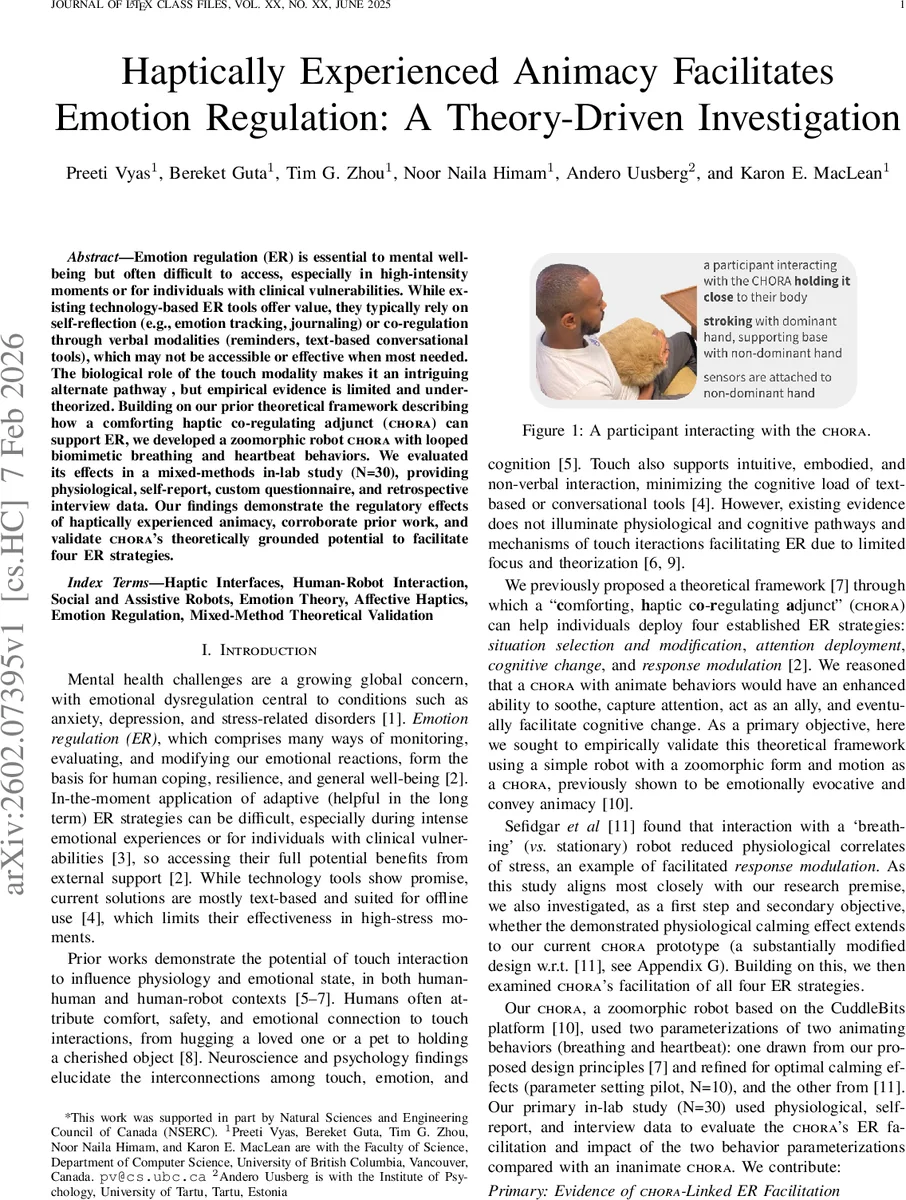
To test this, they designed a zoomorphic robot based on the CuddleBits “Ribbit” platform, encased in soft faux‑fur, weighted to feel lifelike, and equipped with two looped behaviors: slow breathing and a calm heartbeat. One behavior set was optimized in a pilot (N = 10), the other replicated parameters from Sefidgar et al. (2021). The robot (“CHORA”) thus offers an animate, haptic presence that users can hold.
A mixed‑methods laboratory study with 30 university participants compared three conditions in counterbalanced order: (1) active CHORA (breathing + heartbeat), (2) inactive CHORA (no movement), and (3) a non‑animate plastic object. Each condition lasted five minutes. Outcome measures included physiological indices (heart‑rate variability, skin conductance), standard self‑report scales (SAM, PANAS, ERQ), a custom CHORA questionnaire aligned with the four ER strategies, and semi‑structured post‑session interviews.
Physiologically, the active CHORA condition produced a significant increase in HRV (≈12 % above baseline) and a decrease in skin conductance (≈8 % reduction) relative to the control conditions (p < 0.01), confirming a parasympathetic calming response. Self‑report data showed higher scores on all four ER strategies for the active robot (average +1.4 / 5 points, p < 0.05). The largest effects were observed for attentional deployment and situation modification, with effect sizes ranging from d = 0.6 to 0.9.
Qualitative interview analysis revealed that participants perceived the robot’s rhythmic breathing and heartbeat as a “living” companion. This animacy acted as an emotional anchor, drawing attention away from stressors, enabling users to re‑appraise the situation, and providing a sense of safety that facilitated both automatic and deliberate regulation. Participants described the robot as a “co‑regulating ally” that helped them shift focus, calm their bodies, and reinterpret stressful thoughts.
Statistical analyses confirmed that the active robot outperformed both the inactive robot and the inanimate object across physiological, self‑report, and questionnaire metrics, supporting the hypothesis that haptic animacy can simultaneously engage multiple ER pathways.
The authors acknowledge limitations: the sample consists solely of young adults, limiting generalizability; the study captures only short‑term effects; and physiological measurement was restricted to HRV and skin conductance, omitting neurochemical markers such as oxytocin. Future work should test CHORA with diverse age groups, clinical populations, longer intervention periods, and multimodal designs (visual, auditory, tactile) to explore durability and broader applicability.
In sum, this research provides empirical evidence that a haptic, animate robot can facilitate all four core emotion‑regulation strategies, offering a compelling alternative to text‑ or voice‑based digital mental‑health tools. It advances the theoretical CHORA framework, demonstrates the robustness of prior findings on breathing robots, and opens new avenues for affective haptics in mental‑health interventions.
Comments & Academic Discussion
Loading comments...
Leave a Comment