The complexity of pinning simple multiloops
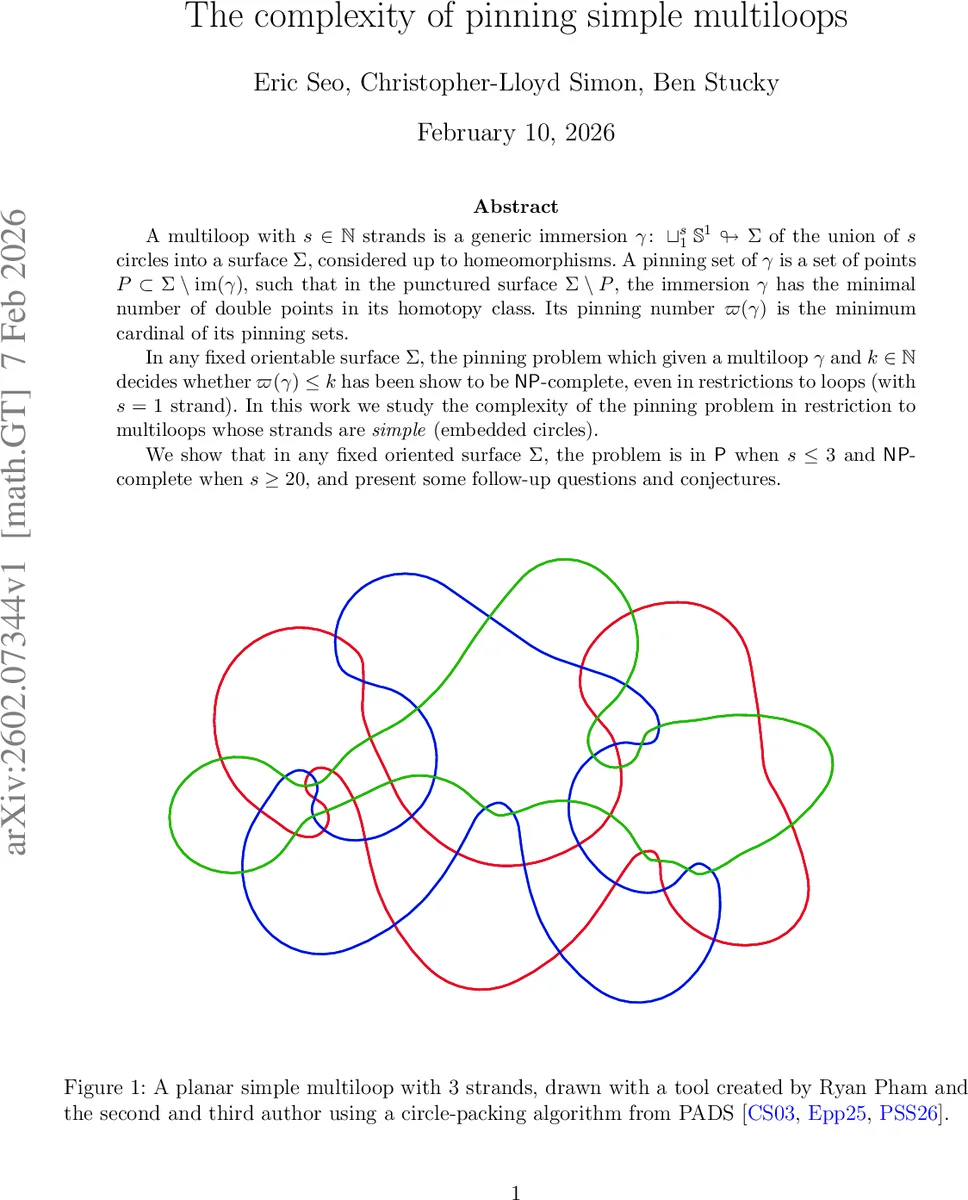
A multiloop with $s\in \mathbb{N}$ strands is a generic immersion $γ\colon \sqcup_1^s \mathbb{S}^1 \looparrowright Σ$ of the union of $s$ circles into a surface $Σ$, considered up to homeomorphisms. A pinning set of $γ$ is a set of points $P\subset Σ\setminus \operatorname{im}(γ)$, such that in the punctured surface $Σ\setminus P$, the immersion $γ$ has the minimal number of double points in its homotopy class. Its pinning number $\varpi(γ)$ is the minimum cardinal of its pinning sets. In any fixed orientable surface $Σ$, the pinning problem which given a multiloop $γ$ and $k\in \mathbb{N}$ decides whether $\varpi(γ)\le k$ has been show to be NP-complete, even in restrictions to loops (with $s=1$ strand). In this work we study the complexity of the pinning problem in restriction to multiloops whose strands are simple (embedded circles). We show that in any fixed oriented surface $Σ$, the problem is in P when $s\leq 3$ and NP-complete when $s\geq 20$, and present some follow-up questions and conjectures.
💡 Research Summary
The paper investigates the computational complexity of the “pinning” problem for simple multiloops—immersions of several disjoint circles into a fixed orientable surface Σ where each circle is embedded (i.e., has no self‑intersections). A pinning set P⊂Σ\im(γ) is a collection of points whose removal makes the immersion γ attain the minimal possible number of double points within its homotopy class; the pinning number ϖ(γ) is the size of a smallest such set. Prior work showed that for unrestricted multiloops the decision problem Pin(Σ,s) (“is ϖ(γ)≤k?”) is NP‑complete for any fixed s≥1, but the complexity when each strand is simple remained open.
The authors define SimplePin(Σ,s) as the restriction of Pin to simple multiloops and prove a striking “phase transition” in complexity as the number of strands s grows. Their first main theorem (Theorem 0.8) shows that for any fixed orientable surface Σ, SimplePin(Σ,s) lies in P when s≤3. The proof reduces the problem for three‑strand simple multiloops to a minimum vertex‑cover problem on a bipartite graph derived from the regions of Σ\im(γ). By Kőnig’s theorem and Dinitz’s algorithm, this bipartite vertex‑cover can be solved via maximum matching in polynomial time, yielding the pinning number.
The second main theorem (Theorem 0.9) establishes NP‑completeness for s≥20. The reduction starts from the known NP‑hard problem 3‑Connected Cubic Planar Vertex Cover (3C3PVC). Using a result of Dujmović, Eppstein, Suderman, and Wood, every cubic 3‑connected planar graph admits a planar straight‑line drawing where each edge has slope π/4, π/2, or 3π/4, except for three edges on the outer face. The authors encode such a drawing into a simple multiloop with exactly 20 strands: four strands for each of the three slopes, two strands for each of the three special outer edges, and two “anchor at infinity” strands to enforce planarity. This construction preserves the vertex‑cover structure, so a solution to the pinning problem on the resulting multiloop yields a solution to the original 3C3PVC instance. Consequently SimplePin(Σ,s) is NP‑complete for any s≥20.
Beyond these core results, the paper proposes several conjectures and research directions. Conjecture 0.11 posits that the hardness already begins at s=4, suggesting a sharp threshold at three strands. Conjecture 0.12 extends the investigation to non‑orientable surfaces, hypothesizing the same P/NP‑complete split at s=3/4. The authors also discuss the relationship between the positive CNF “mobidisc” formula Φ(γ) associated with a multiloop and SAT solving: pinning sets correspond to satisfying assignments, and minimal pinning sets correspond to minimal satisfying assignments (dualization from CNF to DNF). They raise the question of whether SAT solvers can be tuned to exploit the geometric constraints inherent in these formulas.
Further, three random models for generating simple multiloops are introduced (random state, random spin, random braid), with the aim of studying average‑case complexity via empirical SAT solver performance. Finally, a combinatorial game “Unpinning Avoidance” is defined, whose positions correspond to the pinning ideal. The authors relate this game to the classic Node Kayles game, conjecturing PSPACE‑completeness for the avoidance game (Conjecture 0.18) and noting that determining its complexity for small s (e.g., s=3) may be as hard as longstanding open problems in graph theory.
In summary, the paper demonstrates that for simple multiloops the pinning problem is tractable when the number of strands is at most three, but becomes NP‑complete once the number of strands reaches twenty, with a plausible conjectured threshold at four. The work bridges topological graph theory, computational geometry, and Boolean satisfiability, and opens a rich set of avenues for future exploration in both worst‑case and average‑case settings.
Comments & Academic Discussion
Loading comments...
Leave a Comment