Steer2Adapt: Dynamically Composing Steering Vectors Elicits Efficient Adaptation of LLMs
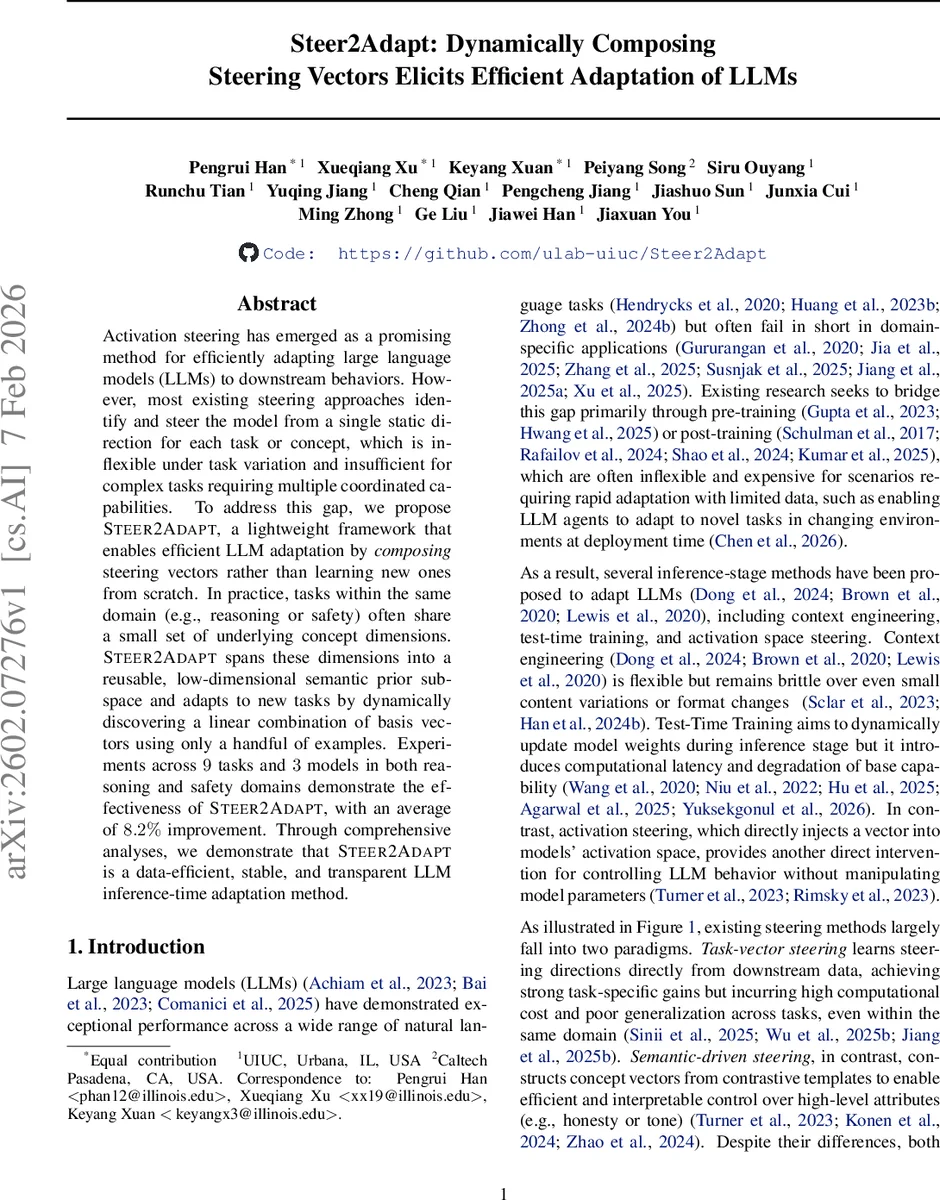
Activation steering has emerged as a promising approach for efficiently adapting large language models (LLMs) to downstream behaviors. However, most existing steering methods rely on a single static direction per task or concept, making them inflexible under task variation and inadequate for complex tasks that require multiple coordinated capabilities. To address this limitation, we propose STEER2ADAPT, a lightweight framework that adapts LLMs by composing steering vectors rather than learning new ones from scratch. In many domains (e.g., reasoning or safety), tasks share a small set of underlying concept dimensions. STEER2ADAPT captures these dimensions as a reusable, low-dimensional semantic prior subspace, and adapts to new tasks by dynamically discovering a linear combination of basis vectors from only a handful of examples. Experiments across 9 tasks and 3 models in both reasoning and safety domains demonstrate the effectiveness of STEER2ADAPT, achieving an average improvement of 8.2%. Extensive analyses further show that STEER2ADAPT is a data-efficient, stable, and transparent inference-time adaptation method for LLMs.
💡 Research Summary
Steer2Adapt introduces a novel inference‑time adaptation framework for large language models (LLMs) that moves beyond the traditional single‑direction steering paradigm. Existing activation‑steering methods either learn a dedicated task vector from downstream data (task‑vector steering) or rely on a single pre‑defined semantic concept vector (semantic‑driven steering). Both approaches suffer from inflexibility: a single static direction cannot simultaneously control multiple capabilities required by complex tasks, and vectors optimized for one task may degrade performance on others, even within the same domain.
The key insight of Steer2Adapt is that tasks within a particular domain (e.g., reasoning or safety) share a small set of underlying behavioral dimensions—such as the Big Five personality traits for reasoning. By extracting a low‑dimensional set of concept vectors that correspond to these dimensions, the authors construct a reusable “semantic prior subspace.” This subspace is represented by a matrix V =
Comments & Academic Discussion
Loading comments...
Leave a Comment