Moonworks Lunara Aesthetic Dataset
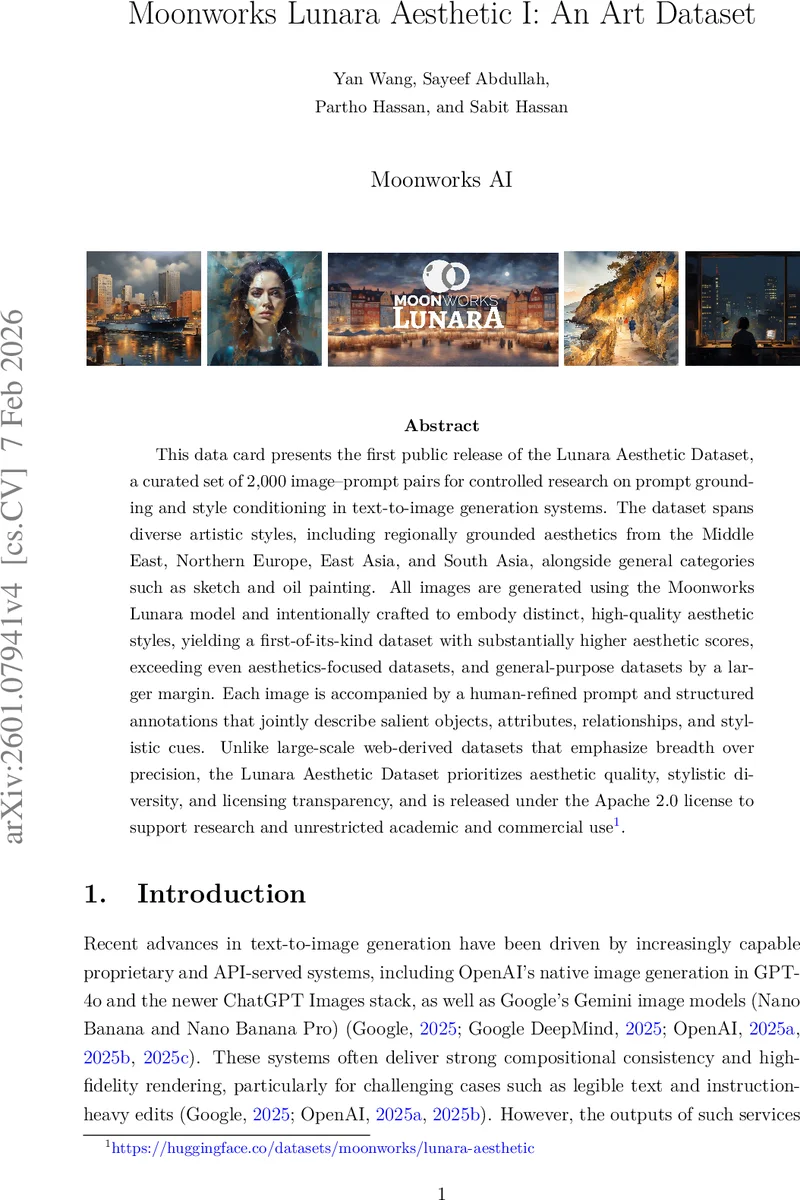
The dataset spans diverse artistic styles, including regionally grounded aesthetics from the Middle East, Northern Europe, East Asia, and South Asia, alongside general categories such as sketch and oil painting. All images are generated using the Moonworks Lunara model and intentionally crafted to embody distinct, high-quality aesthetic styles, yielding a first-of-its-kind dataset with substantially higher aesthetic scores, exceeding even aesthetics-focused datasets, and general-purpose datasets by a larger margin. Each image is accompanied by a human-refined prompt and structured annotations that jointly describe salient objects, attributes, relationships, and stylistic cues. Unlike large-scale web-derived datasets that emphasize breadth over precision, the Lunara Aesthetic Dataset prioritizes aesthetic quality, stylistic diversity, and licensing transparency, and is released under the Apache 2.0 license to support research and unrestricted academic and commercial use.
💡 Research Summary
The paper introduces the Moonworks Lunara Aesthetic Dataset, a curated collection of 2,000 image‑prompt pairs specifically designed for research on prompt grounding, style conditioning, and aesthetic evaluation in text‑to‑image generation. All images are synthesized with the proprietary Moonworks Lunara model, a sub‑10‑billion‑parameter diffusion‑mixture architecture that employs a novel “Composite Active Transfer” (CAT) active‑learning scheme to selectively activate regional‑style sub‑modules during generation. After generation, human annotators refine the prompts for factual correctness, clarity, and completeness, and assign structured annotations covering objects, attributes, relationships, topics, and stylistic cues.
The dataset spans four cultural regions—East Asia, Nordic (Northern Europe), the Middle East, and South Asia—plus a region‑agnostic “General” category. In total, 17 region‑style combinations are represented across seven high‑level topics (Nature & Landscape, Everyday Life, Portraits & Human Figures, City/Architecture, Rural & Agrarian Life, Work/Hobby/Occupations, Religion/Spirituality). Each prompt averages 18.3 tokens (≈130 characters) and is rich in nouns and adjectives that describe visual and aesthetic properties (e.g., “misty”, “cinematic lighting”, “glow”). Images are provided at a uniform resolution of 1024 × 1024 px.
Quantitative evaluation focuses on four dimensions: aesthetic quality, image‑text semantic alignment, cross‑modal retrieval performance, and visual diversity. Using the LAION‑Aesthetics v2 predictor, the dataset achieves a mean aesthetic score of 6.32 (σ 0.49), which is more than one point higher than comparable public datasets such as CC3M (4.78), LAION‑2B‑Aesthetic (5.25), and WIT (5.08). Notably, 33.99 % of images exceed the commonly used high‑aesthetic threshold of 6.5, representing a two‑order‑of‑magnitude improvement over the baselines. CLIP (ViT‑B/32) cosine similarity between images and their refined prompts averages 0.317 ± 0.025, indicating stable semantic grounding across all categories. Cross‑modal retrieval experiments yield Recall@1 of 43.07 % (text‑to‑image) and 41.87 % (image‑to‑text), with Recall@10 above 85 %, confirming that the paired captions are sufficiently informative for retrieval tasks despite the presence of visually similar portrait images. Visual diversity, measured via LPIPS and CLIP‑based perceptual metrics, shows adequate perceptual spread across regions and styles, mitigating concerns of mode collapse.
The authors argue that the dataset’s emphasis on aesthetic fidelity and structured annotation makes it a valuable benchmark for controlled experiments in style transfer, regional conditioning, and fine‑tuning of generative models. Potential applications include: (1) fine‑tuning diffusion models to acquire specific cultural or medium‑specific aesthetics; (2) serving as a standardized testbed for evaluating prompt adherence and style learning; (3) improving vision‑language models (VLMs) through high‑quality image‑text pairs; and (4) supporting image retrieval research that requires both semantic and stylistic similarity.
Limitations are acknowledged. The modest size (2,000 samples) restricts its utility as a sole pre‑training corpus; it is best suited as a high‑quality supplement to larger, noisier datasets. The generation pipeline is tied to the proprietary Lunara model, so reproducibility with alternative generators remains to be explored. Cultural coverage, while broader than many datasets, still omits regions such as Africa, Latin America, and Oceania. Finally, aesthetic scores rely on a CLIP‑based predictor rather than extensive human judgments, suggesting future work should incorporate direct human rating studies.
In conclusion, the Moonworks Lunara Aesthetic Dataset offers a rare combination of high aesthetic quality, diverse cultural styles, and richly annotated prompts, all released under an Apache 2.0 license that permits unrestricted academic and commercial use. By providing a clean, well‑structured resource, the authors aim to catalyze reproducible research on aesthetic modeling, style conditioning, and prompt grounding, and to encourage the community to expand upon this foundation with larger, more inclusive collections.
Comments & Academic Discussion
Loading comments...
Leave a Comment