On regions of mixed unitarity for semigroups of unital quantum channels
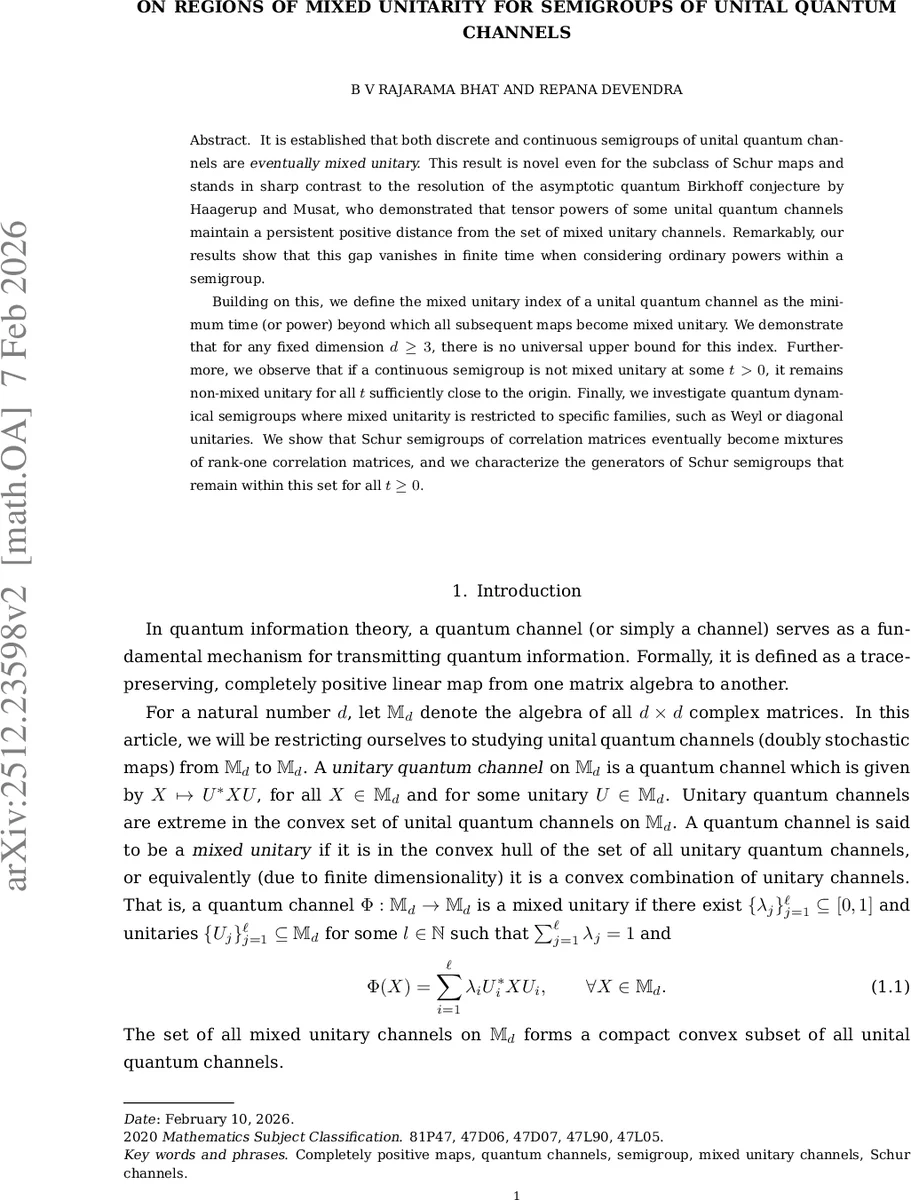
It is established that both discrete and continuous semigroups of unital quantum channels are eventually mixed unitary. This result is novel even for the subclass of Schur maps and stands in sharp contrast to the resolution of the asymptotic quantum Birkhoff conjecture by Haagerup and Musat, who demonstrated that tensor powers of some unital quantum channels maintain a persistent positive distance from the set of mixed unitary channels. Remarkably, our results show that this gap vanishes in finite time when considering ordinary powers within a semigroup. Building on this, we define the mixed unitary index of a unital quantum channel as the minimum time (or power) beyond which all subsequent maps become mixed unitary. We demonstrate that for any fixed dimension $d \geq 3$, there is no universal upper bound for this index. Furthermore, we observe that if a continuous semigroup is not mixed unitary at some $t > 0$, it remains non-mixed unitary for all $t$ sufficiently close to the origin. Finally, we investigate quantum dynamical semigroups where mixed unitarity is restricted to specific families, such as Weyl or diagonal unitaries. We show that Schur semigroups of correlation matrices eventually become mixtures of rank-one correlation matrices, and we characterize the generators of Schur semigroups that remain within this set for all $t \geq 0$.
💡 Research Summary
The paper investigates the long‑time behavior of semigroups of unital quantum channels, focusing on when such maps become mixed‑unitary (i.e., convex combinations of unitary channels). The authors prove that every discrete semigroup {Φⁿ}ₙ∈ℕ generated by a unital quantum channel Φ on M_d, as well as every continuous one‑parameter semigroup {Φ_t}_{t≥0} of unital channels, eventually consists entirely of mixed‑unitary maps. This is a striking contrast with the asymptotic quantum Birkhoff conjecture, which was disproved by Haagerup and Musat: tensor powers of certain unital channels can stay at a positive distance from the mixed‑unitary set for all tensor orders. In the present work, ordinary powers (or time evolution) within a semigroup eliminate this distance in finite time.
Key technical steps include:
-
Conditional Expectation Approximation. Using a finite‑dimensional C*-subalgebra A⊂M_d, the authors show (Lemma 3.5) that any trace‑preserving *‑automorphism on A is implemented by a unitary conjugation. They then prove (Theorem 3.8) that the iterates Φⁿ converge, in the Hilbert‑Schmidt norm, to a conditional expectation E_A onto A. Since Watrous’s result guarantees a ball around the completely depolarizing channel that lies inside the mixed‑unitary set, once Φⁿ is sufficiently close to E_A it must be mixed‑unitary. This yields Theorem 3.9: every discrete semigroup is eventually mixed‑unitary.
-
Continuous‑Time Extension. For a quantum dynamical semigroup (Φ_t) with Lindblad generator L, the same conditional‑expectation argument applies after a finite waiting time. Theorem 4.12 establishes that any continuous semigroup of unital channels becomes mixed‑unitary after some finite t₀. Moreover, Theorem 5.4 shows a dichotomy: if the semigroup is not mixed‑unitary at some positive time, then it remains non‑mixed‑unitary on an entire interval (0, t₀). Thus mixed‑unitarity cannot appear abruptly near the origin.
-
Mixed‑Unitary Index. The authors define the mixed‑unitary index m(Φ) as the smallest integer N such that Φⁿ is mixed‑unitary for all n≥N. While for primitive channels an upper bound exists (Kribs et al.), the paper proves (Theorem 4.15) that for any fixed dimension d≥3 there is no universal bound on m(Φ). By constructing Schur channels based on correlation matrices, they can make the index arbitrarily large.
-
Restricted Families of Unitaries. The paper studies semigroups that are covariant with respect to specific unitary families. Theorem 6.4 gives a complete structure theorem for Weyl‑covariant semigroups, while Theorem 6.8 extends the analysis to arbitrary subgroups G⊂U(d), defining G‑mixed‑unitary channels and characterizing generators that keep the semigroup inside this set for all times.
-
Schur Semigroups and Correlation Matrices. For a correlation matrix C (positive semidefinite with unit diagonal), the Schur powers C^{∘n} form a discrete semigroup. Theorem 6.10 shows that these powers eventually become convex combinations of rank‑one correlation matrices. The continuous analogue is treated similarly. Theorem 6.11 characterizes all generators A such that e^{tA} remains a mixture of rank‑one correlation matrices for every t≥0; essentially A must have zero diagonal and non‑positive off‑diagonal entries satisfying a specific symmetry condition.
Overall contributions:
- Eventual Mixed‑Unitary Behavior: The paper establishes that ordinary iteration (or continuous time evolution) forces any unital channel semigroup into the mixed‑unitary hull in finite time, a phenomenon absent for tensor powers.
- Unbounded Mixed‑Unitary Index: Demonstrates that the index can be arbitrarily large in dimensions three and higher, refuting the existence of a dimension‑dependent universal bound.
- Local Time Structure: Provides a precise description of how mixed‑unitarity can (or cannot) emerge near the origin of a continuous semigroup.
- Specialized Covariance: Supplies complete generator characterizations for Weyl‑covariant, diagonal‑covariant, and more general G‑covariant semigroups.
- Schur Map Analysis: Connects the theory to correlation matrices, showing eventual rank‑one mixture behavior and giving a full description of admissible generators.
These results deepen our understanding of quantum dynamical semigroups, offering new tools for analyzing decoherence models, designing quantum channels with prescribed long‑term behavior, and exploring the geometry of the mixed‑unitary set within the space of completely positive trace‑preserving maps.
Comments & Academic Discussion
Loading comments...
Leave a Comment