New rigidity theorem of Einstein manifolds and curvature operator of the second kind
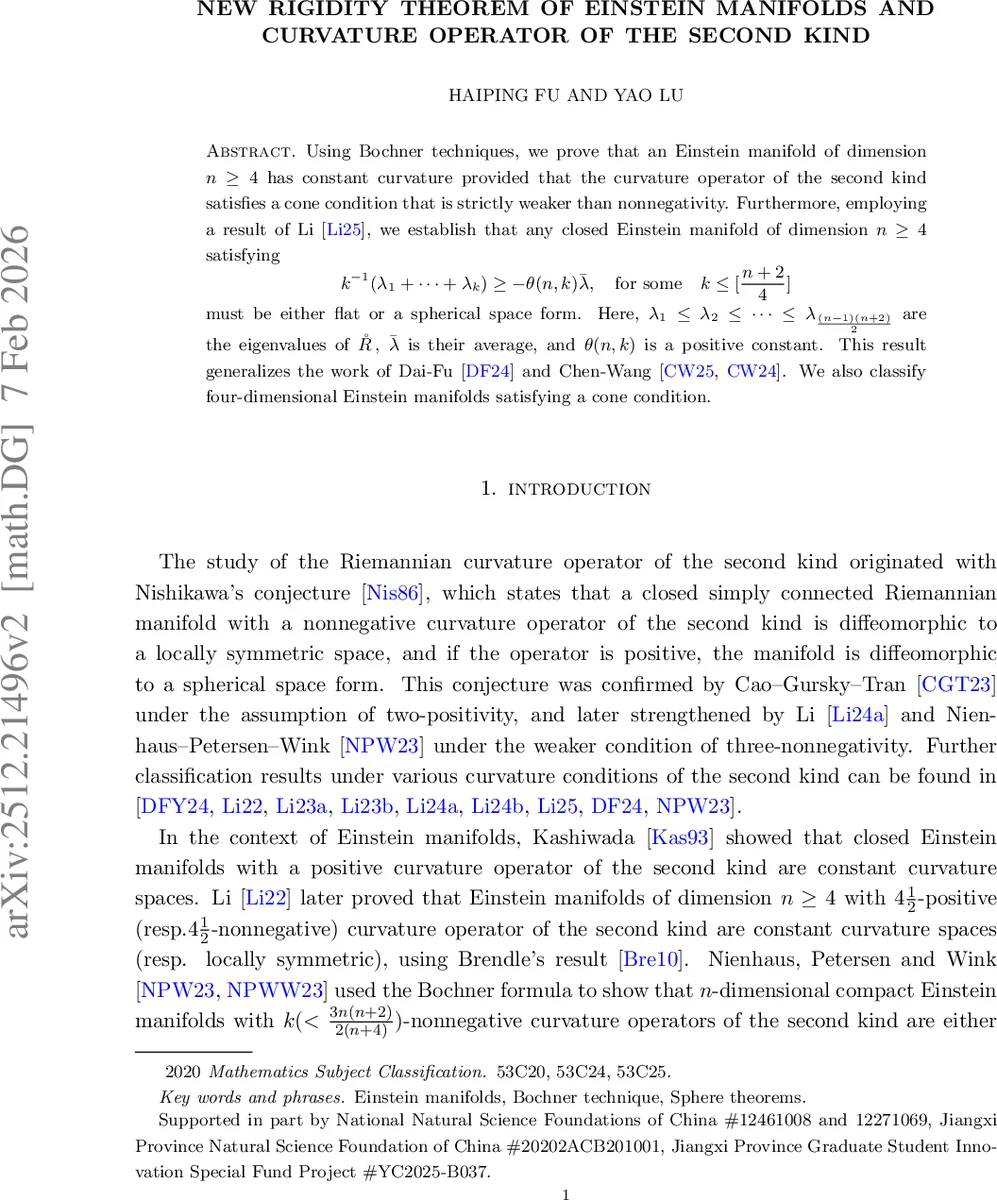
Using Bochner techniques, we prove that a compact Einstein manifold of dimension $n \ge 4$ has constant curvature provided that the curvature operator of the second kind satisfies a cone condition that is strictly weaker than nonnegativity. Furthermore, employing a result of Li \cite{Li5}, we establish that any closed Einstein manifold of dimension $n \ge 4$ satisfying [k^{-1}({λ}_1+\cdots +{λ}_k)\ge -θ(n,k) \bar{λ},\quad \text{for some} \quad k \le [\frac{n+2}{4}]] must be either flat or a spherical space form. Here, ${λ}_1\le {λ}2\le \cdots \le {λ}{\frac{(n-1)(n+2)}{2}}$ are the eigenvalues of $\mathring{R},$, $\bar{λ}$ is their average, and $θ(n,k)$ is a positive constant. This result generalizes the work of Dai-Fu \cite{DF} and Chen-Wang \cite{CW1,CW}.We also classify four-dimensional Einstein manifolds satisfying a cone condition.
💡 Research Summary
The paper investigates rigidity and classification results for Einstein manifolds by exploiting the spectrum of the curvature operator of the second kind, denoted by $\mathring R$. For an $n$‑dimensional Riemannian manifold $(M^n,g)$, $\mathring R$ acts on the space of traceless symmetric 2‑tensors $S^2_0(V)$ (with $V=T_pM$) and has eigenvalues \
Comments & Academic Discussion
Loading comments...
Leave a Comment