Parabolic Equations with Singular Coefficients and Boundary Data: Analysis and Numerical Simulations
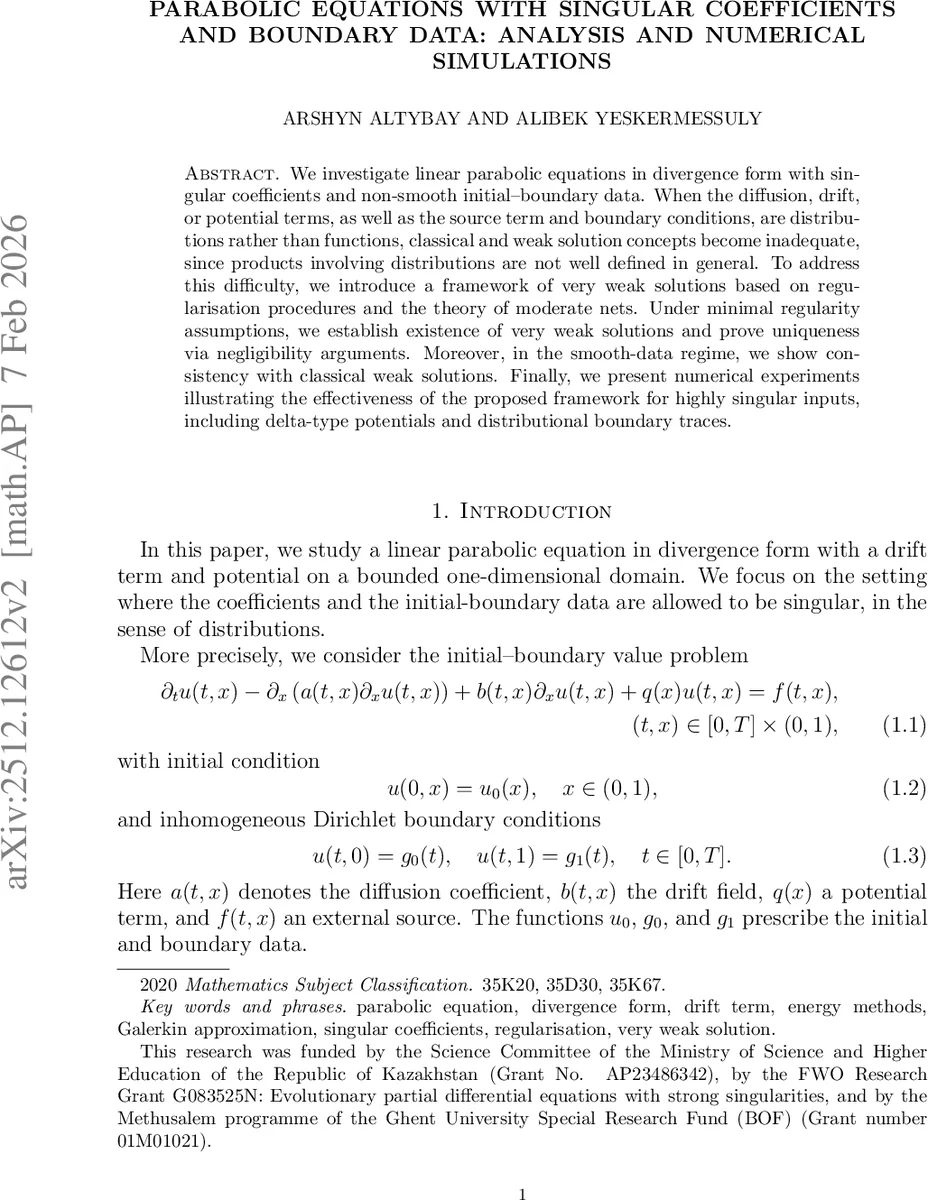
We investigate linear parabolic equations in divergence form with singular coefficients and non-smooth boundary data. When the diffusion, drift, or potential terms, as well as the initial or boundary conditions, are distributions rather than functions, classical and weak solution concepts become inadequate due to the ill-posedness of products involving distributions. To overcome this, we introduce a framework of very weak solutions based on regularization techniques and the theory of moderate nets. Existence of very weak solutions is established under minimal regularity assumptions. We further prove consistency with classical solutions when the data are smooth and demonstrate uniqueness via negligibility arguments. Finally, we present numerical computations that illustrate the robustness of the very weak solution framework in handling highly singular inputs, including delta-type potentials and distributional boundary traces.
💡 Research Summary
The paper addresses linear parabolic equations in divergence form on the one‑dimensional interval ((0,1)) where the diffusion coefficient (a(t,x)), drift term (b(t,x)), potential (q(x)), source (f(t,x)), initial datum (u_0(x)) and Dirichlet boundary data (g_0(t), g_1(t)) may be distributions rather than ordinary functions. Classical weak‑solution frameworks based on Sobolev spaces break down because products of distributions are generally undefined. To overcome this, the authors introduce the concept of a “very weak solution” built on regularisation and the theory of moderate nets (a notion closely related to Colombeau generalized functions).
Regularisation strategy. Each singular coefficient or datum is approximated by a family of smooth functions ({a_\varepsilon, b_\varepsilon, q_\varepsilon, f_\varepsilon, u_{0,\varepsilon}, g_{0,\varepsilon}, g_{1,\varepsilon}}_{\varepsilon>0}) that converge to the original distribution as (\varepsilon\to0). For every fixed (\varepsilon) the regularised problem is a standard linear parabolic PDE with bounded measurable coefficients, for which the Galerkin method and energy estimates apply.
Uniform a‑priori bounds. The authors derive an energy inequality (Theorem 2.2) that yields (\varepsilon)-independent bounds for the Galerkin approximations (u_\varepsilon) in the spaces \
Comments & Academic Discussion
Loading comments...
Leave a Comment