Does connected wedge imply distillable entanglement?
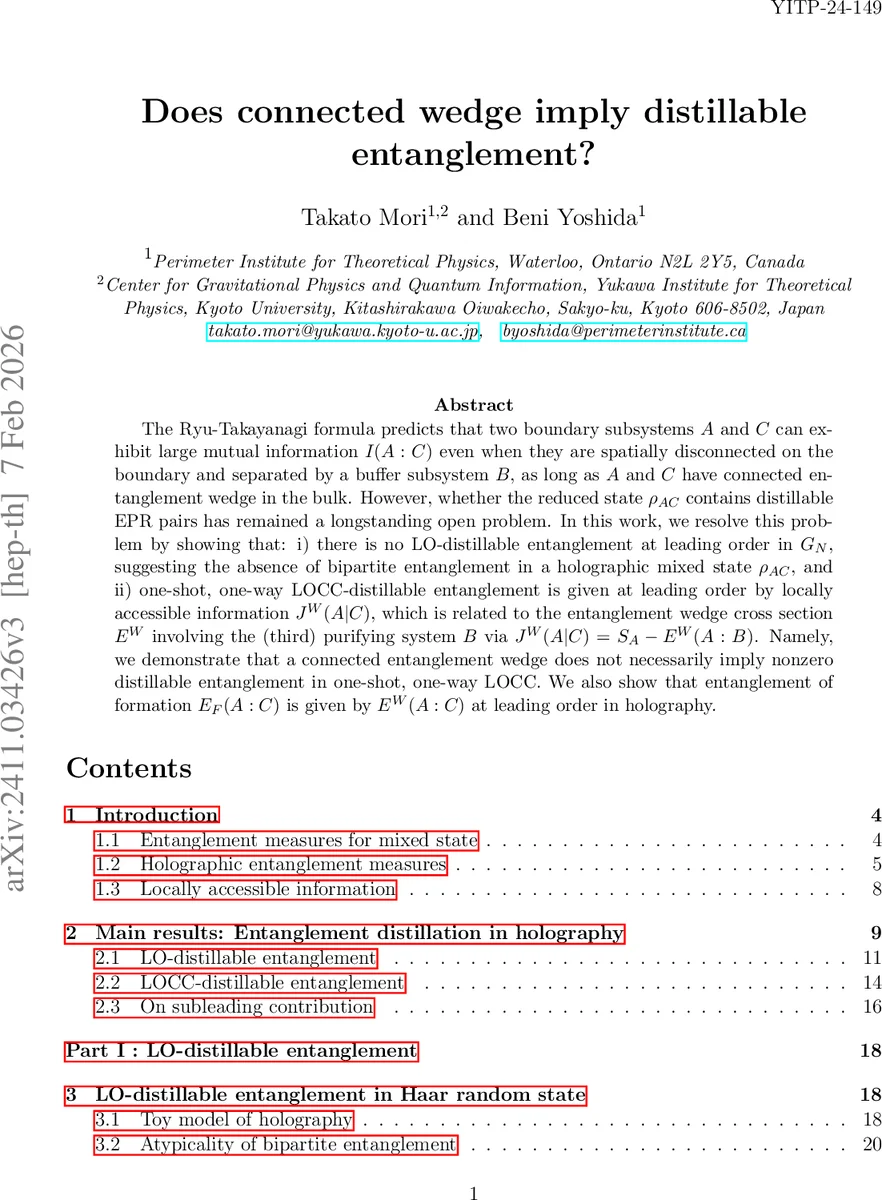
The Ryu-Takayanagi formula predicts that two boundary subsystems $A$ and $C$ can exhibit large mutual information $I(A:C)$ even when they are spatially disconnected on the boundary and separated by a buffer subsystem $B$, as long as $A$ and $C$ have connected entanglement wedge in the bulk. However, whether the reduced state $ρ_{AC}$ contains distillable EPR pairs has remained a longstanding open problem. In this work, we resolve this problem by showing that: i) there is no LO-distillable entanglement at leading order in $G_N$, suggesting the absence of bipartite entanglement in a holographic mixed state $ρ_{AC}$, and ii) one-shot, one-way LOCC-distillable entanglement is given at leading order by locally accessible information $J^W(A|C)$, which is related to the entanglement wedge cross section $E^W$ involving the (third) purifying system $B$ via $J^W(A|C) = S_A - E^W(A:B)$. Namely, we demonstrate that a connected entanglement wedge does not necessarily imply nonzero distillable entanglement in one-shot, one-way LOCC. We also show that entanglement of formation $E_{F}(A:C)$ is given by $E^W(A:C)$ at leading order in holography.
💡 Research Summary
The paper tackles a long‑standing question in holography: does a connected entanglement wedge between two boundary regions A and C guarantee that the reduced mixed state ρ_AC contains distillable EPR pairs? Using a combination of quantum‑information techniques and holographic geometry, the authors arrive at a nuanced answer.
First, they review standard mixed‑state entanglement measures—entanglement of purification (E_P), formation (E_F), cost (E_C), squashed entanglement (E_sq), and distillable entanglement (E_D)—and recall the holographic conjectures that at leading order in 1/G_N one has E_sq≈½ I(A:C) and E_P≈E^W(A:C), where E^W is the entanglement‑wedge cross‑section. They also introduce the locally accessible information J(A|C), defined via optimal local measurements on C, and note the Koashi‑Winter identity J(A|C)=S_A−E_F(A:B).
The core results are twofold. (i) LO‑distillable entanglement vanishes at leading order. By modeling holographic states with Haar‑random tripartite states, the authors construct a “pretty good” measurement (the Petz map) and a double‑copy protocol that yields a rigorous upper bound on any LO‑distillable EPR rate, showing it scales as o(1/G_N). This is reinforced by an argument based on entanglement‑wedge reconstruction: if A and C share a connected wedge, no logical operator can be localized purely on A∪C, implying that pure LO operations cannot extract bipartite entanglement. Consequently, E_D^{LO}=0 at O(1/G_N).
(ii) One‑way LOCC distillable entanglement is non‑zero and exactly equals the holographic locally accessible information. Restricting to one‑way protocols (only C measures and sends classical outcomes to A), the authors prove that the optimal one‑shot distillation rate E_D^{1W} equals J^W(A|C)≡S_A−E^W(A:B). The proof proceeds by (a) showing that the optimal measurement on C projects onto “disentangled basis states” living on the minimal surface of AC, (b) demonstrating that the post‑measurement state’s entropy reduction on A is precisely the cross‑section area E^W(A:B), and (c) invoking the Koashi‑Winter relation together with the conjectured equality E_F≈E^W to identify J(A|C) with J^W(A|C). Thus, even though a connected wedge does not guarantee LO‑distillable entanglement, it does support a one‑way LOCC resource quantified by the wedge cross‑section.
The authors further propose and substantiate the relation E_F≈E^W at leading holographic order. They verify it for Haar‑random tripartite states (which serve as a toy model of holography) and for explicit AdS_3/CFT_2 configurations, arguing that the optimal decomposition for E_F aligns with placing disentangled basis states along the minimal surface of AC. This resolves earlier “no‑go” arguments against the equality by emphasizing that subleading corrections may break the relation, but the leading O(1/G_N) term remains intact.
Additional sections discuss subleading effects such as traversable wormholes, holographic scattering, and Planck‑scale corrections, showing how they could modify the distillation rates but do not overturn the leading‑order conclusions. The paper also examines the instability of other measures (e.g., logarithmic negativity) in holographic settings, reinforcing the robustness of the presented hierarchy:
hash(A:C) ≤ E_D ≤ ½ I(A:C) ≤ E_F ≈ E_P ≈ E^W(A:C).
In summary, the work clarifies that a connected entanglement wedge signals large mutual information and a sizable cross‑section, but does not automatically imply bipartite, LO‑distillable entanglement. The only operationally accessible quantum resource in the one‑shot, one‑way LOCC scenario is the locally accessible information J^W, which is geometrically encoded by the entanglement‑wedge cross‑section. This deepens our understanding of how bulk geometry translates into quantum communication capabilities on the boundary and establishes precise holographic dictionary entries for several mixed‑state entanglement measures.
Comments & Academic Discussion
Loading comments...
Leave a Comment