Scaling laws for velocity profile of granular flow in rotating drums
We theoretically and numerically investigate the steady flow of two-dimensional granular materials in a rotating drum using the discrete element method and a continuum model with the $μ(I)$-rheology. The velocity fields obtained from both methods are in quantitative agreement. The granular flow exhibits two distinct regions: a surface flow layer and a static flow regime corresponding to rigid rotation near the drum bottom. The thickness of the surface flow layer increases with the drum diameter and shows a weak dependence on the angular velocity of the drum. Using dimensional analysis of the continuum equations, we analytically identify nondimensional parameters for the velocity profile and the surface flow layer thickness, which lead to scaling laws characterising the flow in rotating drums with low Froude number and large system size. The validity of the scaling laws is confirmed by numerical simulations.
💡 Research Summary
This paper presents a combined discrete element method (DEM) and continuum‐scale analysis of steady granular flow in two‑dimensional rotating drums. The authors first perform DEM simulations of half‑filled drums with three diameters (D = 150 d, 300 d, 450 d) and a range of angular velocities chosen so that the Froude number lies between 10⁻⁴ and 10⁻², i.e., the rolling regime. Particles are polydisperse (d ≤ d_i ≤ 1.2 d) and interact via linear springs, a tangential spring, a restitution coefficient e = 0.92 and a particle friction coefficient μ_p = 0.50. Time integration uses a leap‑frog scheme with a small timestep (Δt = 1.0 × 10⁻⁴ p_d/g).
In parallel, the granular material is modeled as an incompressible, non‑Newtonian fluid governed by the μ(I) rheology. The constitutive law μ(I)=μ_s+(μ_2−μ_s) I/(I_0+I) is calibrated from separate uniform‑shear DEM tests, yielding μ_s = 0.246, μ_2 = 0.401 and I_0 = 0.133. The momentum equation includes gravity, pressure gradient, and the divergence of the deviatoric stress τ = μ(I) p γ̇/|γ̇|. No‑slip wall conditions enforce the drum’s rigid rotation, while a stress‑free condition is applied at the free surface. The continuum equations are solved with a finite‑difference CFD code (Δx = D/75, Δt = 1.0 × 10⁻⁴ p_d/g).
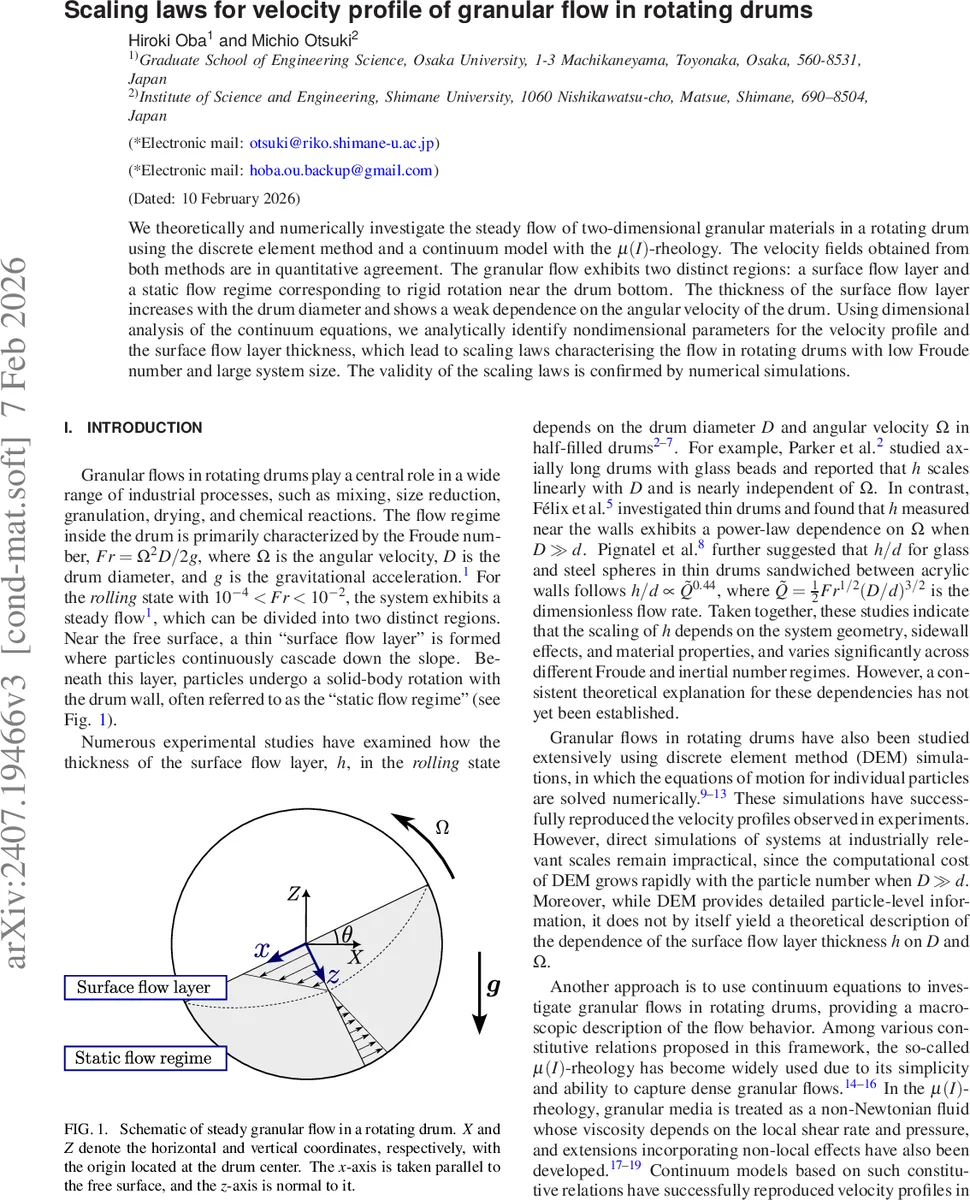
Both DEM and CFD produce velocity fields that are quantitatively indistinguishable. To compare them, the authors introduce a rotated coordinate system (x, z) where x is parallel to the instantaneous free surface and z measures depth from that surface. Velocity profiles u(z) at the drum centre (x = 0) show a thin surface‑flow layer where u drops sharply from a finite value at the surface to zero at a depth h, and a deeper region where u follows the rigid‑body rotation −Ωz. The thickness h is defined by u(z = h)=0. Across all cases, h grows linearly with drum diameter D and displays only a weak dependence on Ω, in agreement with earlier experimental observations.
The core theoretical contribution is a dimensional analysis of the μ(I) continuum model. By scaling length with D, velocity with ΩD, and pressure with ρ_gΩ²D², the governing equations become functions of only two nondimensional groups: the Froude number Fr = Ω²D/(2g) and the size ratio d/D. In the limit d/D → 0 (the regime studied), the μ(I) rheology simplifies because the pressure‑dependent term vanishes, leaving the velocity field determined solely by Fr. Consequently, the authors derive a scaling law for the surface‑flow thickness:
h/D ≈ C Fr^α
where C and α are constants obtained from fitting the DEM/CFD data. The fitted exponent α is small (≈0.2), confirming that h is only weakly sensitive to Ω, while the linear dependence on D is captured by the prefactor C. The scaling collapses all simulation data onto a single master curve, validating the theoretical prediction.
The paper concludes that (i) the μ(I) continuum model faithfully reproduces DEM velocity fields for rotating drums in the low‑Froude, large‑system limit; (ii) the flow is governed by only two nondimensional parameters, providing a compact description of a complex many‑body system; and (iii) the derived scaling laws offer a practical tool for designing and scaling up industrial rotating‑drum processes such as mixing, drying, and granulation. The authors also discuss the potential extension of the analysis to three‑dimensional drums, higher Froude numbers, and non‑local rheological extensions, suggesting avenues for future research.
Comments & Academic Discussion
Loading comments...
Leave a Comment