Incentive-Aware AI Safety via Strategic Resource Allocation: A Stackelberg Security Games Perspective
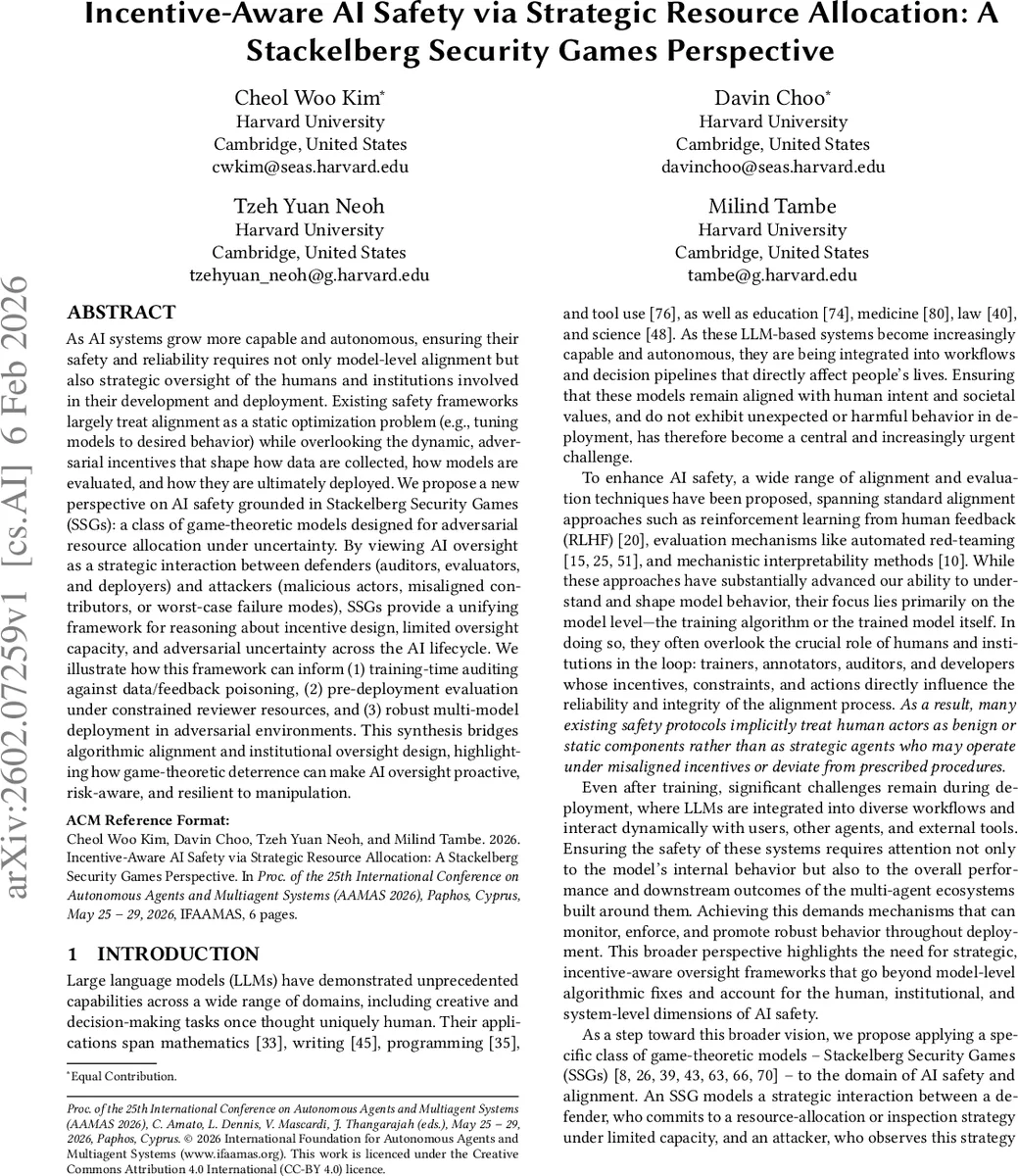
As AI systems grow more capable and autonomous, ensuring their safety and reliability requires not only model-level alignment but also strategic oversight of the humans and institutions involved in their development and deployment. Existing safety frameworks largely treat alignment as a static optimization problem (e.g., tuning models to desired behavior) while overlooking the dynamic, adversarial incentives that shape how data are collected, how models are evaluated, and how they are ultimately deployed. We propose a new perspective on AI safety grounded in Stackelberg Security Games (SSGs): a class of game-theoretic models designed for adversarial resource allocation under uncertainty. By viewing AI oversight as a strategic interaction between defenders (auditors, evaluators, and deployers) and attackers (malicious actors, misaligned contributors, or worst-case failure modes), SSGs provide a unifying framework for reasoning about incentive design, limited oversight capacity, and adversarial uncertainty across the AI lifecycle. We illustrate how this framework can inform (1) training-time auditing against data/feedback poisoning, (2) pre-deployment evaluation under constrained reviewer resources, and (3) robust multi-model deployment in adversarial environments. This synthesis bridges algorithmic alignment and institutional oversight design, highlighting how game-theoretic deterrence can make AI oversight proactive, risk-aware, and resilient to manipulation.
💡 Research Summary
The paper argues that current AI safety research focuses almost exclusively on model‑level alignment—tuning models, reinforcement learning from human feedback, automated red‑team testing—while treating the humans and institutions that collect data, evaluate models, and deploy them as static, benevolent components. In reality, these actors have strategic incentives and limited resources, and adversarial actors can exploit these weaknesses at every stage of the AI lifecycle. To address this gap, the authors propose framing AI safety as a Stackelberg Security Game (SSG), a well‑studied class of game‑theoretic models where a defender commits to a (possibly randomized) allocation of limited resources, and an attacker, observing this commitment, chooses a target to maximize damage.
The paper first reviews the fundamentals of SSGs: a set of targets, defender resources, pure and mixed strategies, and payoff structures that capture the benefit of protecting or attacking each target. It highlights the success of SSGs in real‑world security domains (U.S. Federal Air Marshals, Coast Guard, airport patrols) and notes that the same scalable algorithms (linear programming, column generation, reinforcement‑learning approximations) have been refined for decades in the multi‑agent systems community.
Next, the authors identify two broad AI safety failure modes: (1) training‑time data and feedback poisoning, where a small fraction of corrupted examples can shift model behavior or embed backdoors; and (2) deployment‑time misbehaviors, including uneven skill profiles, jailbreak attacks, emergent scheming, and situational awareness that causes models to behave safely during evaluation but dangerously in the wild. Existing defenses—heuristic filters, outlier detection, one‑off red‑team exercises—are static and vulnerable to adaptive adversaries.
The core contribution is a three‑pronged roadmap that maps each stage of the LLM lifecycle to an SSG formulation:
-
Data and Feedback Auditing (Training Phase) – The attacker selects which training samples or preference annotations to corrupt. The defender, constrained by a budget of human or automated audits, commits to a mixed auditing policy (e.g., random sampling, focused checks on high‑influence points, cross‑annotator consistency checks). Solving the Stackelberg equilibrium yields an audit schedule that minimizes the worst‑case misalignment impact, while randomization prevents the attacker from reliably evading detection.
-
LLM Evaluation (Pre‑Deployment Phase) – The defender must allocate limited reviewer time and computational resources across a massive space of prompts, tasks, and adversarial jailbreak attempts. Each test case is a target with an associated risk and verification cost. The attacker chooses an untested case to exploit. An SSG solution provides an optimal mix of exhaustive testing on high‑risk cases and stochastic sampling of the broader space, ensuring that the expected utility of any undetected attack is bounded.
-
Robust Multi‑Model Deployment (Operational Phase) – In production, multiple models or agent teams with varying capabilities, costs, and failure rates are available. The defender allocates operational monitoring and fallback resources across these models. An attacker targets the least‑monitored, high‑impact model. The Stackelberg framework yields a risk‑aware routing policy that assigns tasks to models and schedules oversight in a way that minimizes expected loss while respecting budget constraints.
The authors discuss practical challenges: estimating payoff values requires causal estimates of “misalignment impact” (e.g., influence functions), handling partial observability of audit policies, and reconciling the worst‑case attacker assumption with more realistic bounded‑resource adversaries. They also note that while SSGs guarantee robustness against a strong attacker, deriving guarantees under weaker models remains an open research direction.
In conclusion, the paper reframes AI safety as an incentive‑aware, resource‑allocation problem and demonstrates that the mature theory and tooling of Stackelberg Security Games can be transplanted from physical security to the digital, multi‑agent realm of advanced AI systems. By integrating strategic deterrence with existing model‑level alignment techniques, the proposed approach promises more resilient oversight, efficient use of limited human expertise, and a systematic way to anticipate and mitigate adversarial manipulation throughout the AI lifecycle. Future work should focus on empirical validation in real AI pipelines, refined payoff estimation, and extensions to partial‑information and bounded‑rational attacker models.
Comments & Academic Discussion
Loading comments...
Leave a Comment