Adaptive Retrieval helps Reasoning in LLMs -- but mostly if it's not used
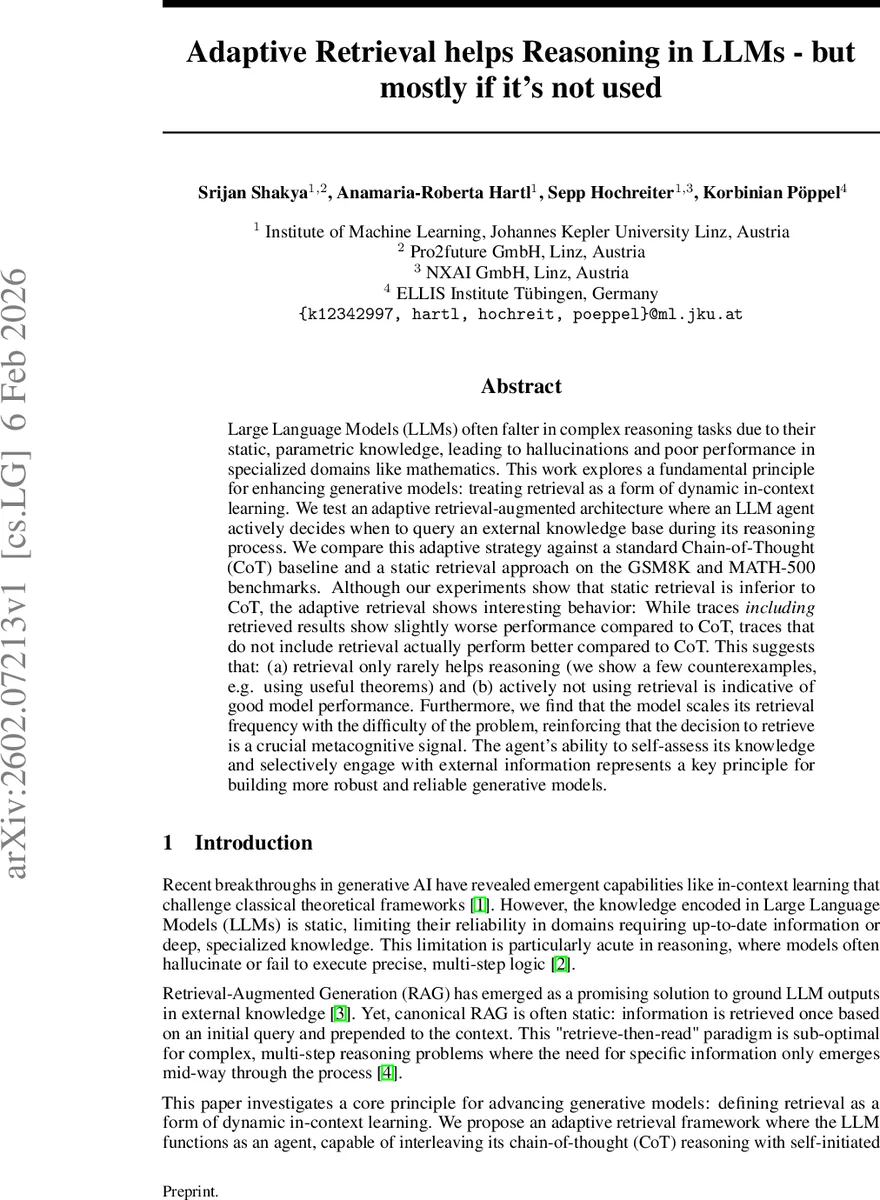
Large Language Models (LLMs) often falter in complex reasoning tasks due to their static, parametric knowledge, leading to hallucinations and poor performance in specialized domains like mathematics. This work explores a fundamental principle for enhancing generative models: treating retrieval as a form of dynamic in-context learning. We test an adaptive retrieval-augmented architecture where an LLM agent actively decides when to query an external knowledge base during its reasoning process. We compare this adaptive strategy against a standard Chain-of-Thought (CoT) baseline and a static retrieval approach on the GSM8K and MATH-500 benchmarks. Although our experiments show that static retrieval is inferior to CoT, the adaptive retrieval shows interesting behavior: While traces including retrieved results show slightly worse performance compared to CoT, traces that do not include retrieval actually perform better compared to CoT. This suggests that: (a) retrieval only rarely helps reasoning (we show a few counterexamples, e.g. using useful theorems) and (b) actively not using retrieval is indicative of good model performance. Furthermore, we find that the model scales its retrieval frequency with the difficulty of the problem, reinforcing that the decision to retrieve is a crucial metacognitive signal. The agent’s ability to self-assess its knowledge and selectively engage with external information represents a key principle for building more robust and reliable generative models.
💡 Research Summary
The paper tackles a well‑known limitation of large language models (LLMs): their static, parametric knowledge often fails on complex, multi‑step reasoning tasks, especially in mathematics, leading to hallucinations and poor performance. While retrieval‑augmented generation (RAG) has been proposed to ground LLM outputs in external knowledge, most existing RAG systems are static: they retrieve information once at the beginning and prepend it to the prompt. This “retrieve‑then‑read” approach is ill‑suited for problems where the need for specific facts emerges only part‑way through a reasoning chain.
To address this, the authors introduce an adaptive retrieval‑augmented reasoning agent. The core model is Llama‑3.1‑8B‑Instruct operating in a zero‑shot chain‑of‑thought (CoT) setting. A two‑stage retrieval pipeline is built using the BAAI/bge‑m3 bi‑encoder for dense embeddings and FAISS HNSW for fast nearest‑neighbor search, followed by a cross‑encoder reranker (bge‑m3‑reranker) to select the top‑k most relevant documents. Two corpora are used: MathPile (a broad math text collection) and OpenMathInstruct‑2 (curated math Q&A pairs). The agent is equipped with a special
Three strategies are compared on two benchmarks: GSM8K (elementary math word problems) and MATH‑500 (harder competition‑style problems). (1) Baseline CoT with no retrieval, (2) Static Retrieval‑CoT where the model receives a single batch of retrieved documents at the start, and (3) Adaptive Retrieval‑CoT where the model decides autonomously when to search. The primary metric is exact‑match accuracy.
Results show that Adaptive Retrieval‑CoT outperforms both baselines: +1.1 percentage points (pp) over CoT on GSM8K (83.2 % vs 82.1 %) and +6.4 pp on MATH‑500 (50.6 % vs 44.2 %). In contrast, Static Retrieval‑CoT harms performance, dropping 6.3 pp on GSM8K (75.8 % vs 82.1 %). This confirms that indiscriminate pre‑appended knowledge can be noisy and disruptive.
A deeper behavioral analysis reveals that the model’s retrieval frequency correlates strongly with problem difficulty. On GSM8K the agent searches in only 7 % of instances, whereas on MATH‑500 it searches in 38.8 % of cases, rising from 14 % for difficulty level 1 to 60 % for level 5. Thus the model appears to gauge its own uncertainty and allocate external resources accordingly—a form of metacognitive control.
However, the raw utility of the retrieved snippets is modest. On GSM8K, retrieval corrected only 6 out of 240 wrong answers (2.5 %) and introduced errors in 16 cases (1.5 %). On MATH‑500, retrieval helped and hurt equally (25 each). The overall gain in accuracy stems less from the content of the retrieved documents and more from the “retrieval‑triggered reflection” process: the act of pausing, re‑evaluating, and possibly revising the reasoning path.
The most striking finding is that when the agent decides not to retrieve, its accuracy is highest—84.2 % on GSM8K (vs 82.1 % CoT) and 63.7 % on MATH‑500 (vs 44.2 % CoT). This suggests that the decision to forego retrieval is a reliable proxy for the model’s confidence and competence. The authors argue that this metacognitive signal is the true value of adaptive retrieval, not the retrieved facts themselves.
In the discussion, the authors generalize these observations into a broader principle: retrieval should be treated as a dynamic, controllable tool rather than a static context augmentation. The model’s ability to self‑regulate its informational boundaries—deciding when to query and when to rely on internal knowledge—leads to more robust and trustworthy generation. They highlight future directions such as improving the trigger policy, better filtering of retrieved content, and extending the approach to other domains beyond mathematics.
Overall, the paper provides compelling empirical evidence that adaptive, agent‑driven retrieval can modestly improve LLM reasoning, especially on harder tasks, while also revealing that the metacognitive decision to not retrieve is an even stronger indicator of correct performance. This insight points toward a new design paradigm where LLMs are equipped with self‑assessment mechanisms that govern when external knowledge should be consulted, paving the way for more reliable and self‑aware generative AI systems.
Comments & Academic Discussion
Loading comments...
Leave a Comment