Exactly Computing do-Shapley Values
Structural Causal Models (SCM) are a powerful framework for describing complicated dynamics across the natural sciences. A particularly elegant way of interpreting SCMs is do-Shapley, a game-theoretic method of quantifying the average effect of $d$ variables across exponentially many interventions. Like Shapley values, computing do-Shapley values generally requires evaluating exponentially many terms. The foundation of our work is a reformulation of do-Shapley values in terms of the irreducible sets of the underlying SCM. Leveraging this insight, we can exactly compute do-Shapley values in time linear in the number of irreducible sets $r$, which itself can range from $d$ to $2^d$ depending on the graph structure of the SCM. Since $r$ is unknown a priori, we complement the exact algorithm with an estimator that, like general Shapley value estimators, can be run with any query budget. As the query budget approaches $r$, our estimators can produce more accurate estimates than prior methods by several orders of magnitude, and, when the budget reaches $r$, return the Shapley values up to machine precision. Beyond computational speed, we also reduce the identification burden: we prove that non-parametric identifiability of do-Shapley values requires only the identification of interventional effects for the $d$ singleton coalitions, rather than all classes.
💡 Research Summary
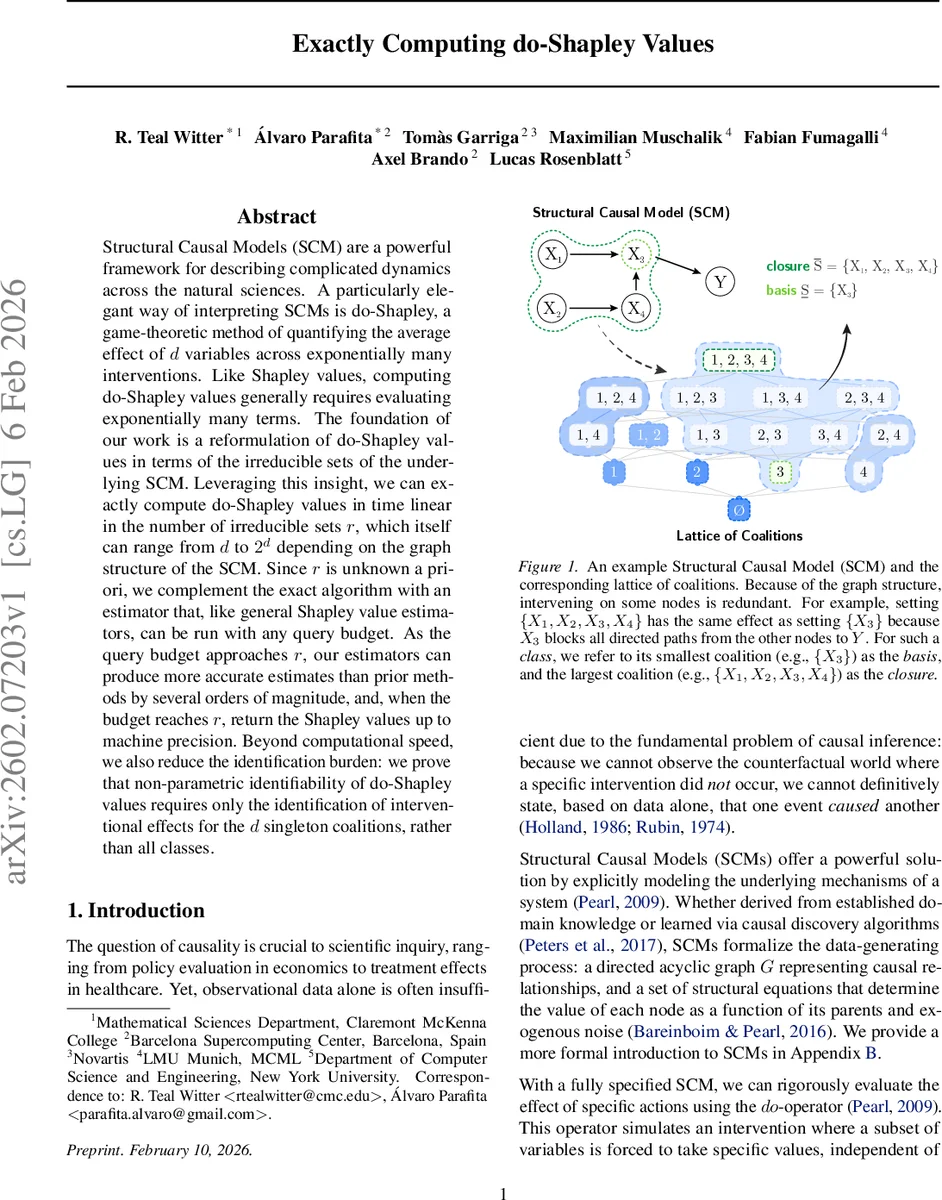
The paper tackles the computational bottleneck of do‑Shapley values, which quantify the average causal contribution of each of d variables in a Structural Causal Model (SCM) by averaging over all 2^d possible interventions. The authors observe that many interventions are redundant because the causal graph often blocks the effect of some variables once a smaller set is intervened upon. They formalize this redundancy using two notions: the basis of a coalition (the minimal set of variables in the coalition that have a directed path to the outcome Y that does not intersect any other variable in the coalition) and the closure of a coalition (the maximal set of variables whose effect on Y is blocked by the basis). A coalition is called irreducible if it equals its own basis; each irreducible set defines an equivalence class of coalitions that all yield the same interventional value ν(S)=E
Comments & Academic Discussion
Loading comments...
Leave a Comment