Massive Sound Embedding Benchmark (MSEB)
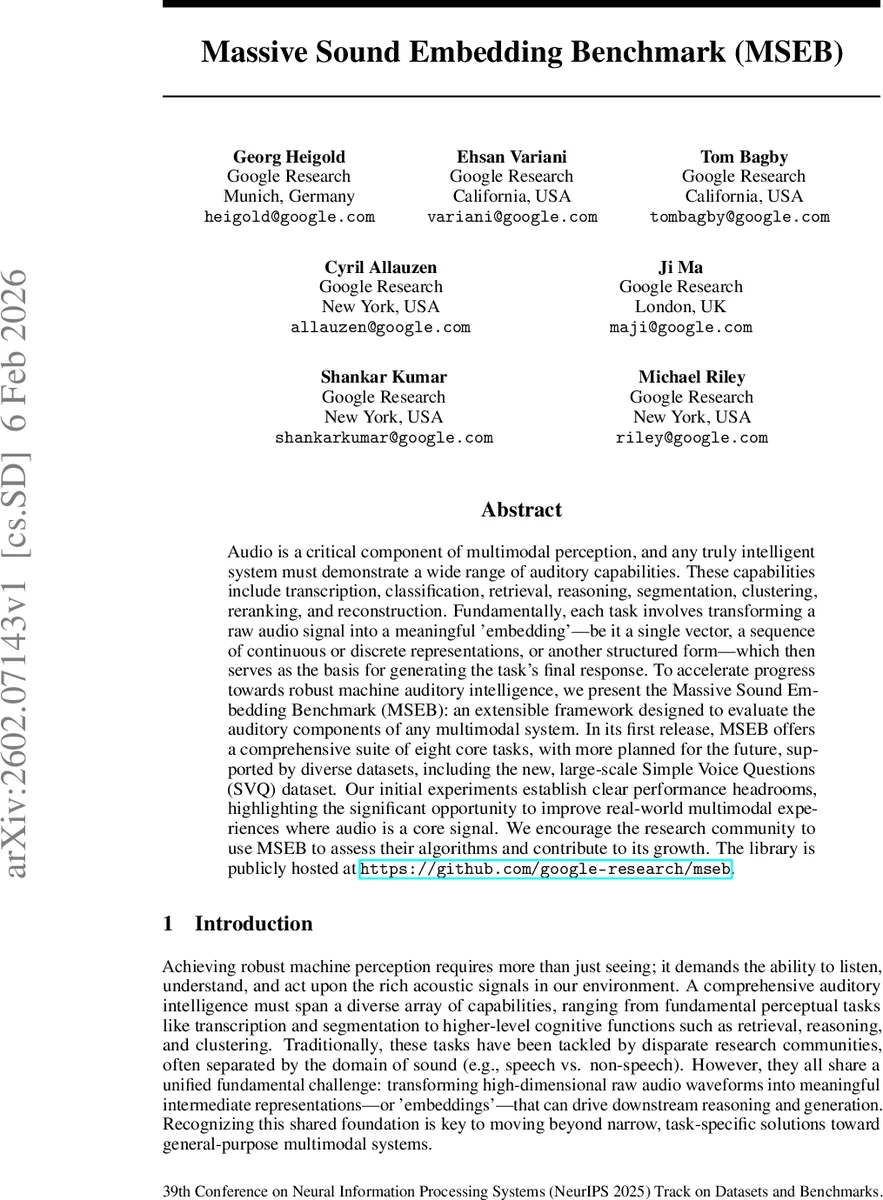
Audio is a critical component of multimodal perception, and any truly intelligent system must demonstrate a wide range of auditory capabilities. These capabilities include transcription, classification, retrieval, reasoning, segmentation, clustering, reranking, and reconstruction. Fundamentally, each task involves transforming a raw audio signal into a meaningful ’embedding’ - be it a single vector, a sequence of continuous or discrete representations, or another structured form - which then serves as the basis for generating the task’s final response. To accelerate progress towards robust machine auditory intelligence, we present the Massive Sound Embedding Benchmark (MSEB): an extensible framework designed to evaluate the auditory components of any multimodal system. In its first release, MSEB offers a comprehensive suite of eight core tasks, with more planned for the future, supported by diverse datasets, including the new, large-scale Simple Voice Questions (SVQ) dataset. Our initial experiments establish clear performance headrooms, highlighting the significant opportunity to improve real-world multimodal experiences where audio is a core signal. We encourage the research community to use MSEB to assess their algorithms and contribute to its growth. The library is publicly hosted at github.
💡 Research Summary
The Massive Sound Embedding Benchmark (MSEB) is introduced as a unified, extensible framework for evaluating the auditory capabilities of any multimodal AI system. Recognizing that modern intelligent agents must not only see but also listen, the authors identify eight “super‑tasks” that together cover the full spectrum of practical sound‑related functions: Retrieval, Reranking, Reasoning, Classification, Transcription, Segmentation, Clustering, and Reconstruction. Each super‑task is further broken down into concrete sub‑tasks that reflect real‑world use cases such as voice search, intelligent assistants, speaker verification, environmental sound monitoring, and bio‑acoustic analysis.
A central contribution is the Simple Voice Questions (SVQ) dataset, a newly collected resource of over 177 000 short spoken queries spanning 26 locales and 17 languages, recorded in four acoustic environments (clean, background speech, traffic, media noise). SVQ is deliberately released as a single, undivided collection, providing rich metadata—including aligned Wikipedia passages, speaker attributes, and precise temporal annotations—that can be reused across multiple tasks. In addition to SVQ, MSEB incorporates three established corpora: Speech‑MASSIVE (multilingual spoken language understanding), FSD50K (general environmental sounds), and BirdSet (large‑scale bird‑call recordings).
The benchmark’s evaluation protocol is model‑agnostic: models submit an embedding for each input, and the evaluator maps it to the task‑specific space to compute metrics. Primary performance metrics are chosen per task (e.g., Mean Reciprocal Rank for Retrieval, mean Average Precision for Reranking, Word Error Rate for Transcription). Crucially, MSEB also reports two universal efficiency measures—Compression Ratio (memory footprint relative to the raw audio) and FLOPS (computational complexity)—to encourage development of compact, fast embeddings suitable for deployment.
Baseline experiments with several state‑of‑the‑art speech models (wav2vec 2.0, HuBERT, Whisper) and multimodal architectures demonstrate that current methods leave a sizable performance headroom of roughly 20‑30 % across most tasks. The gap widens dramatically under cross‑lingual or noisy conditions, underscoring the need for embeddings that are both language‑agnostic and robust to acoustic interference. The Reconstruction task, which requires generating the original waveform from an embedding, serves as a stringent test of whether low‑level acoustic detail is preserved, not just high‑level semantics.
By mirroring the structure of successful text (MTEB) and image benchmarks while explicitly addressing the continuous, multi‑scale, and noise‑sensitive nature of audio, MSEB fills a critical void in the evaluation landscape. The authors invite the research community to contribute additional datasets, tasks, and models, envisioning MSEB as a living platform that will drive progress toward truly general auditory intelligence.
Comments & Academic Discussion
Loading comments...
Leave a Comment