Adaptive Control and Mittag-Leffler Stability of Caputo Fractional Systems with State-Dependent Delays
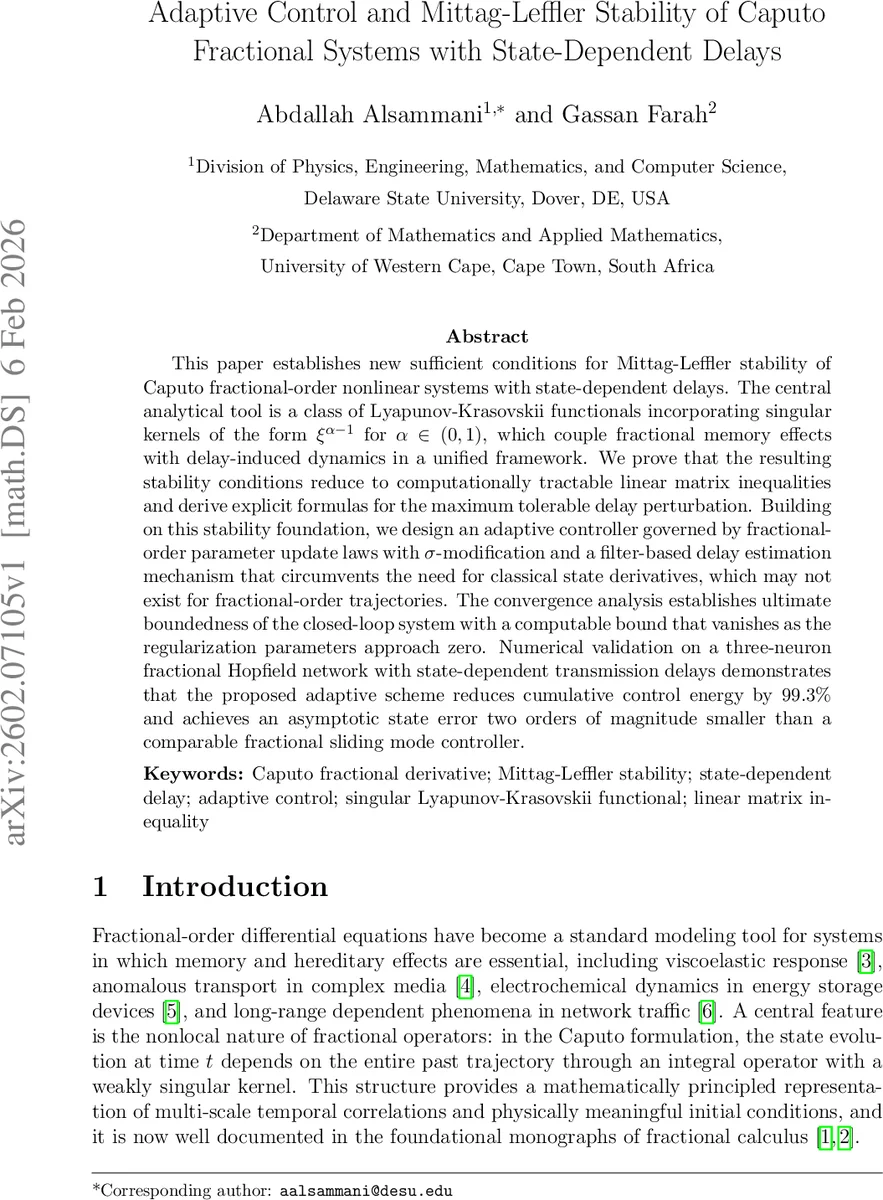
This paper establishes new sufficient conditions for Mittag-Leffler stability of Caputo fractional-order nonlinear systems with state-dependent delays. The central analytical tool is a class of Lyapunov-Krasovskii functionals that incorporate singular kernels of the form $ξ^{α-1}$ for $α\in (0,1)$, coupling fractional memory effects with delay-induced dynamics in a unified framework. We prove that the resulting stability conditions reduce to computationally tractable linear matrix inequalities and derive explicit formulas for the maximum tolerable delay perturbation. Building on this stability foundation, we design an adaptive controller governed by fractional-order parameter update laws with $σ$-modification and a filter-based delay estimation mechanism that circumvents the need for classical state derivatives, which may not exist for fractional-order trajectories. The convergence analysis establishes ultimate boundedness of the closed-loop system with a computable bound that vanishes as the regularization parameters approach zero. Numerical validation on a three-neuron fractional Hopfield network with state-dependent transmission delays demonstrates that the proposed adaptive scheme reduces cumulative control energy by 99.3% and achieves an asymptotic state error two orders of magnitude smaller than a comparable fractional sliding mode controller.
💡 Research Summary
This paper tackles the challenging problem of stabilizing and controlling nonlinear Caputo fractional‑order systems that feature state‑dependent delays. The authors introduce a novel class of Lyapunov‑Krasovskii functionals whose third term contains a singular kernel ξ^{α‑1} (with α∈(0,1)). This kernel mirrors the weakly singular memory kernel of the Caputo derivative, thereby coupling the fractional memory effect with the delay‑induced dynamics in a unified analytical framework.
Using this functional, the authors derive sufficient conditions for Mittag‑Leffler stability—a natural generalization of exponential stability for fractional‑order systems. The key result is an LMI (linear matrix inequality) condition (7) involving positive‑definite matrices P, Q, R and scalar slack variables ε₁, ε₂, ε₃. Feasibility of the LMI guarantees that the Caputo derivative of the functional satisfies CDαV ≤ –γ‖x‖² for some γ>0. By invoking a fractional comparison principle (Lemma 2), they obtain the bound V(t) ≤ V(t₀)Eα(–γc⁻¹(t‑t₀)^{α}), which directly yields the Mittag‑Leffler decay estimate (9). The LMI is standard semidefinite programming and can be solved efficiently with tools such as YALMIP and MOSEK.
A further contribution is the explicit delay‑margin formula (14). If the LMI is feasible with a minimal eigenvalue δ of –Ω, then any perturbation of the nominal bound \barτ up to Δτ* = δ·λ_max(Q*) + \barτ^{α‑1}·λ_max(R*) preserves stability. This provides a closed‑form robustness measure against variations of the state‑dependent delay.
Building on the stability foundation, the paper designs an adaptive controller that does not require the classical state derivative—an important consideration because trajectories of Caputo systems are generally only Hölder continuous of order α. The controller consists of three parts: (i) a linear feedback –Kx that stabilizes the known linear part A–BK, (ii) a compensation term –BᵀPx that stems from the Lyapunov analysis, and (iii) a parameter‑adaptive term that uses the regressor matrices Φ_f(x) and Φ_g(x‑τ̂) together with estimates \hatθ_f, \hatθ_g. The adaptation laws are fractional‑order (Caputo) differential equations equipped with σ‑modification, which prevents parameter drift and yields boundedness of the estimation error.
Since the delay τ(x) is unknown and varies with the state, a filter‑based estimator is introduced. A first‑order exponential filter T_f·\dot{\hat x}=–\hat x + x generates a smoothed estimate \hat x(t) without requiring \dot x. The delay estimate is then \hat τ(t)=τ(\hat x(t)). Lemma 8 shows that the estimation error is bounded by a term proportional to T_f^{α}, reflecting the Hölder regularity of the fractional trajectory. Larger T_f improves accuracy but must be balanced against responsiveness.
The closed‑loop convergence proof employs a composite Lyapunov function W = V + ½(\tildeθ_fᵀΓ_f⁻¹\tildeθ_f + \tildeθ_gᵀΓ_g⁻¹\tildeθ_g), where \tildeθ denotes the parameter estimation error. Substituting the controller and adaptation laws, the cross‑terms cancel, and the σ‑modification contributes negative quadratic terms in the parameter errors. The resulting inequality CDαW ≤ –µ‖x‖² –σ_f‖\tildeθ_f‖² –σ_g‖\tildeθ_g‖² + c₀, with µ>0 and c₀ gathering the delay‑estimation residuals, leads to ultimate boundedness: lim sup_{t→∞}‖x(t)‖ ≤ √
Comments & Academic Discussion
Loading comments...
Leave a Comment