Towards Lang--Vojta via Degeneration
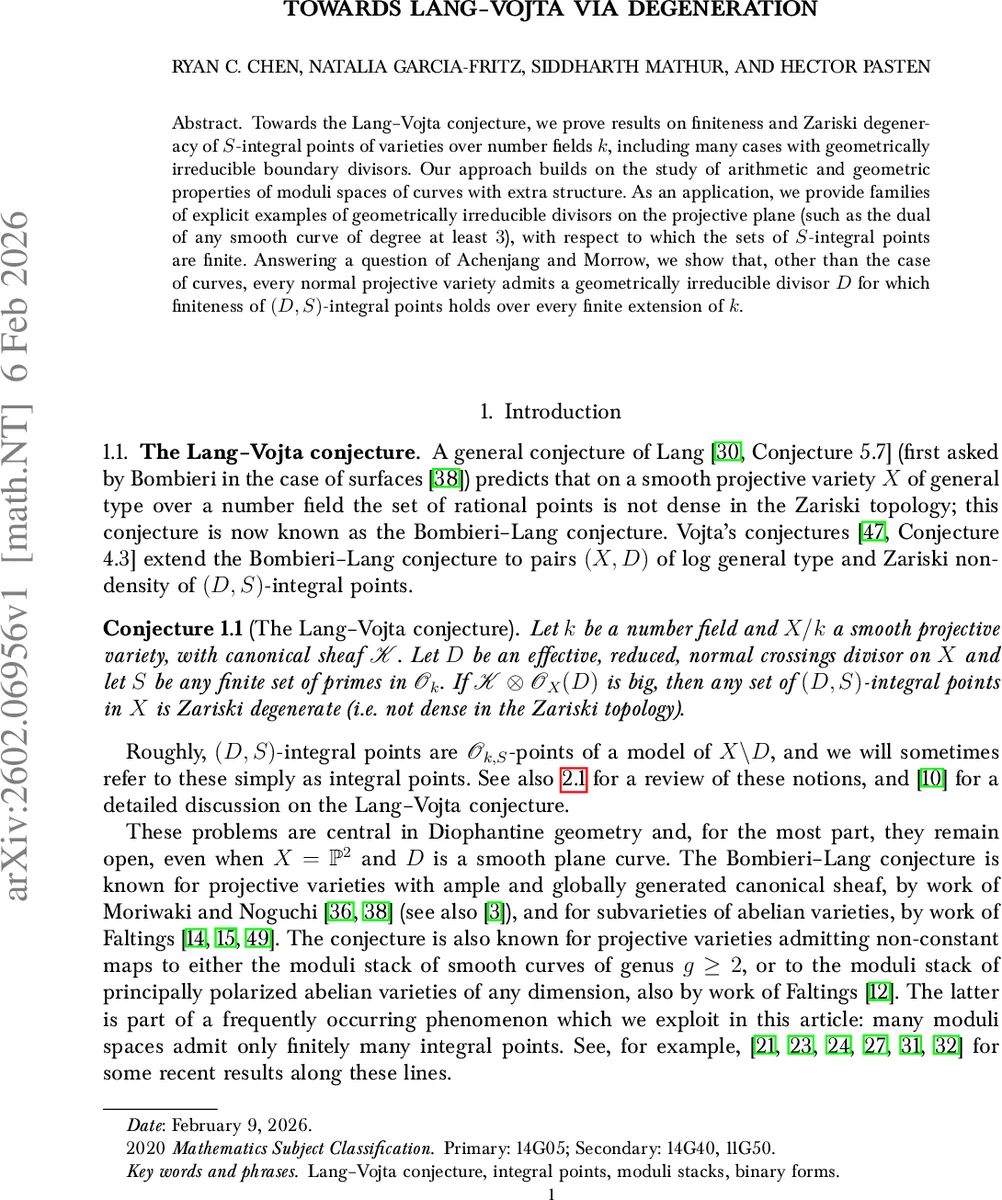
Towards the Lang–Vojta conjecture, we prove results on finiteness and Zariski degeneracy of $S$-integral points of varieties over number fields $k$, including many cases with geometrically irreducible boundary divisors. Our approach builds on the study of arithmetic and geometric properties of moduli spaces of curves with extra structure. As an application, we provide families of explicit examples of geometrically irreducible divisors on the projective plane (such as the dual of any smooth curve of degree at least $3$), with respect to which the sets of $S$-integral points are finite. Answering a question of Achenjang and Morrow, we show that, other than the case of curves, every normal projective variety admits a geometrically irreducible divisor $D$ for which finiteness of $(D,S)$-integral points holds over every finite extension of $k$.
💡 Research Summary
This paper advances the study of the Lang–Vojta conjecture in Diophantine geometry, which predicts the non-density (Zariski degeneracy) of sets of S-integral points on pairs (X, D) of log general type. The authors focus on cases where the boundary divisor D is geometrically irreducible, often singular, and provide both general finiteness criteria and explicit, infinite families of examples.
The core methodology involves a novel degeneration strategy (Strategy 1.6) that leverages the arithmetic properties of moduli spaces. The approach consists of three steps: (1) Select a moduli space M known to have only finitely many integral points (e.g., moduli of curves of genus g≥2) and a compactification M̅ whose boundary parametrizes degenerations. (2) Construct a morphism φ: X → M̅ from the variety of interest such that the preimage of the boundary M̅ \ M is precisely the divisor D. This φ often comes from a family of geometric objects over X that degenerates along D. (3) Analyze the restriction φ|_{X\D} to propagate the finiteness or non-density property from M to X \ D. A significant technical hurdle addressed is the non-separatedness of certain useful moduli stacks (like those for genus 0 curves) and the presence of infinite automorphism groups, which the authors overcome using results on the arithmetic hyperbolicity of algebraic stacks by Javanpeykar-Loughran.
The main theorems are powerful applications of this strategy. Theorem 1.2 states that for a smoothly branched, geometrically integral projective curve C ⊂ P^n of geometric genus g ≥ 1 not contained in a hyperplane, the pair (P^n, C*) – where C* is the dual variety – is arithmetically hyperbolic. This means the set of (C*, S)-integral points on P^n is finite for every finite set S of primes. For rational curves (Theorem 1.3), the result is slightly weaker: for degree d ≥ 4, the sets of integral points are always Zariski degenerate, and they are finite under an additional condition prohibiting hyperplane sections that pull back to divisors with a point of multiplicity ≥ d-1 on the normalization. These theorems yield explicit examples, such as the dual of the Fermat cubic (a sextic curve), where integral points are provably finite.
A key consequence, answering a question of Achenjang and Morrow, is Theorem 1.5 (Corollary 6.5): Every geometrically normal projective variety X of dimension at least 2 admits a geometrically irreducible divisor D such that (X, D) is arithmetically hyperbolic over every finite extension of the base field. This stands in contrast to the case of curves, where such a D exists only if the genus is at least 1 (by Siegel’s theorem).
The authors place their work in context by comparing it to previous constructions. Their examples, arising as dual varieties of curves, are explicit and not covered by earlier methods of Faltings, Zannier, or Levin, which used projections from higher-dimensional varieties. While the final arithmetic results often reduce to classical finiteness theorems (Siegel, Faltings on moduli of curves/abelian varieties), the novelty lies in the systematic degeneration strategy that “lifts” these properties to new geometric settings. The paper also provides a more general criterion (Theorem 1.9/7.1) concerning families of curves P → X with a finite étale subscheme I that degenerates to a non-reduced fiber over a divisor Δ, implying Zariski degeneracy or finiteness of integral points on X relative to Δ. This framework unifies their examples and recovers some prior ones.
Comments & Academic Discussion
Loading comments...
Leave a Comment