A global stability result for incompressible magnetohydrodynamics
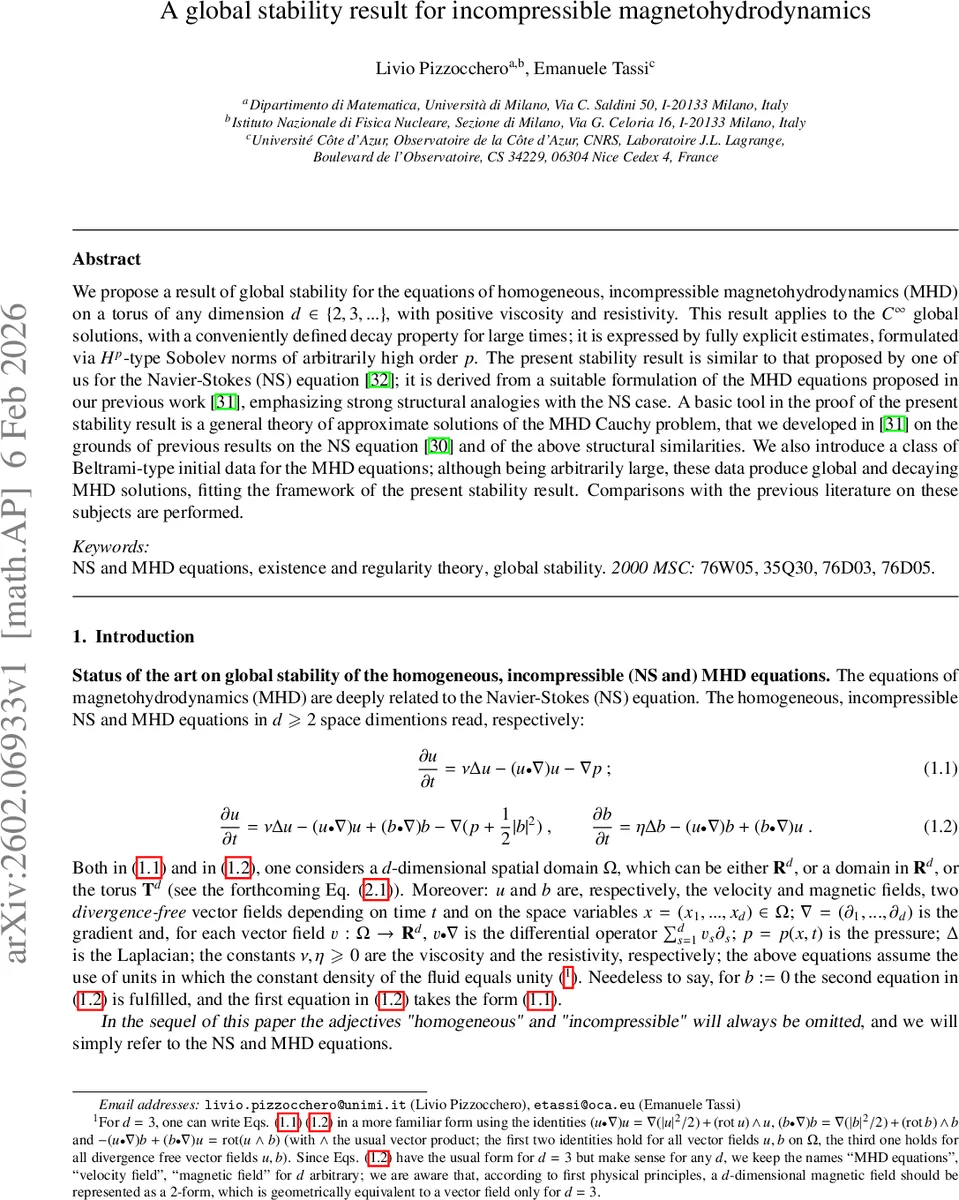
We propose a result of global stability for the equations of homogeneous, incompressible magnetohydrodynamics (MHD) on a torus of any dimension $d \in {2,3,…}$, with positive viscosity and resistivity. This result applies to the $C^\infty$ global solutions, with a conveniently defined decay property for large times; it is expressed by fully explicit estimates, formulated via $H^p$-type Sobolev norms of arbitrarily high order $p$. The present stability result is similar to that proposed by one of us for the Navier-Stokes (NS) equation \cite{glosta}; it is derived from a suitable formulation of the MHD equations proposed in our previous work \cite{MHD}, emphasizing strong structural analogies with the NS case. A basic tool in the proof of the present stability result is a general theory of approximate solutions of the MHD Cauchy problem, that we developed in \cite{MHD} on the grounds of previous results on the NS equation \cite{smooth} and of the above structural similarities. We also introduce a class of Beltrami-type initial data for the MHD equations; although being arbitrarily large, these data produce global and decaying MHD solutions, fitting the framework of the present stability result. Comparisons with the previous literature on these subjects are performed.
💡 Research Summary
The paper establishes a quantitative global‑stability theorem for the incompressible, homogeneous magnetohydrodynamics (MHD) system on the torus (T^{d}) for any spatial dimension (d\ge 2), assuming strictly positive viscosity (\nu) and resistivity (\eta). The authors work in a smooth functional framework: velocity (u) and magnetic field (b) are taken as divergence‑free, zero‑mean (C^{\infty}) vector fields on the torus, and are placed in the Fréchet space (H^{\infty}{\Sigma0}), the intersection of Sobolev spaces (H^{p}{\Sigma0}) for all real orders (p). The product space (H^{p}{\Sigma0}\times H^{p}{\Sigma0}) is used to treat the pair ((u,b)).
After applying the Leray projection to eliminate the pressure term, the MHD equations become \
Comments & Academic Discussion
Loading comments...
Leave a Comment