Proton-Size Resolution of the Hyperfine Puzzle in Hydrogen
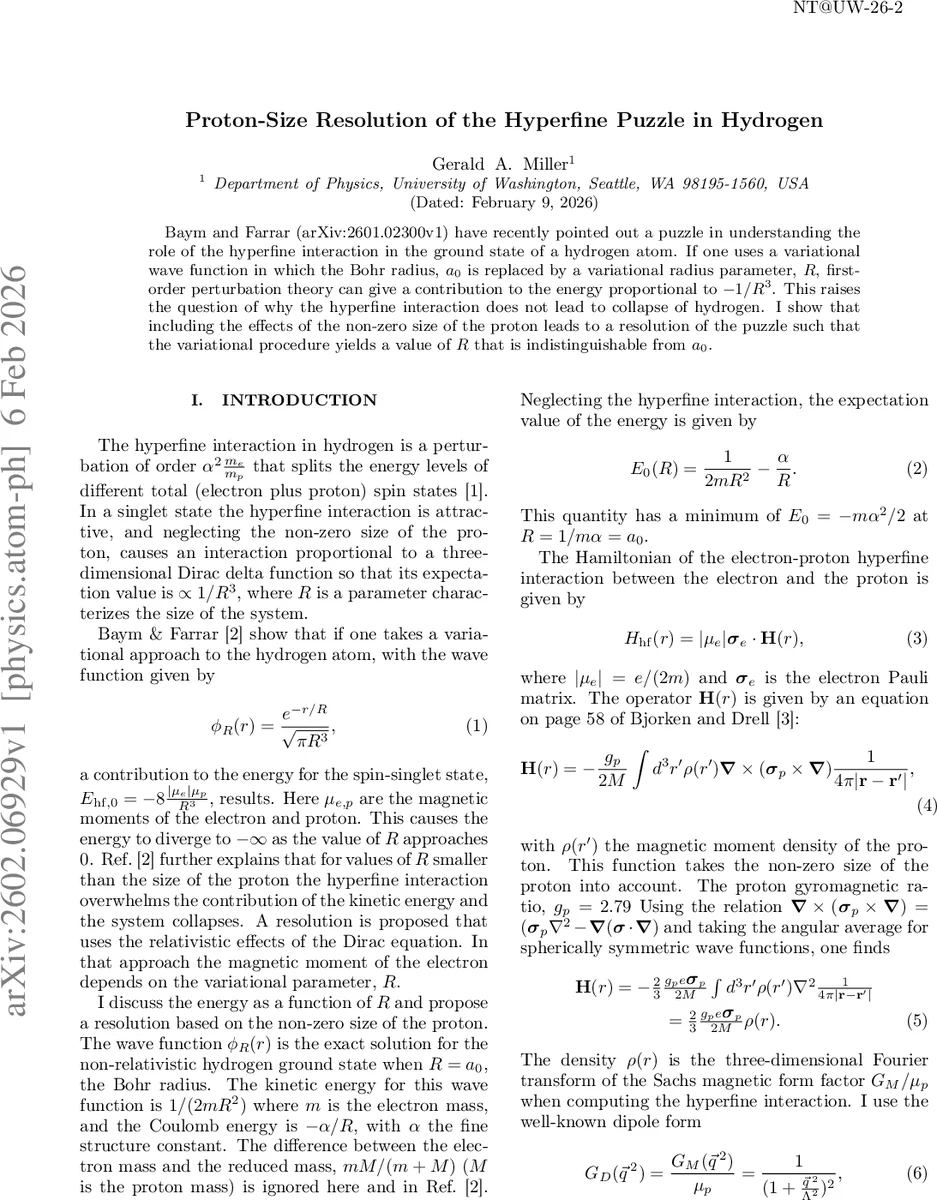
Baym and Farrar (arXiv:2601.02300v1) have recently pointed out a puzzle in understanding the role of the hyperfine interaction in the ground state of a hydrogen atom. If one uses a variational wave function in which the Bohr radius, $a_0$ is replaced by a variational radius parameter, $R$, first-order perturbation theory can give a contribution to the energy proportional to $-1/R^3$. This raises the question of why the hyperfine interaction does not lead to collapse of hydrogen. I show that including the effects of the non-zero size of the proton leads to a resolution of the puzzle such that the variational procedure yields a value of $R$ that is indistinguishable from $a_0$.
💡 Research Summary
In this paper Gerald A. Miller addresses the “hyperfine puzzle” recently highlighted by Baym and Farrar (arXiv:2601.02300v1). The puzzle arises when one treats the hydrogen atom with a variational wave function ϕ_R(r)=e^{‑r/R}/√(πR³) and evaluates the hyperfine interaction in first‑order perturbation theory. Because the hyperfine operator reduces to a three‑dimensional delta function for a point‑like proton, the expectation value scales as –1/R³. Consequently, as the variational radius R is reduced toward zero, the hyperfine contribution drives the total energy to –∞, suggesting an unphysical collapse of the atom.
Miller’s resolution is to abandon the point‑proton approximation and incorporate the finite spatial extent of the proton’s magnetic moment. He adopts the well‑known dipole parametrization of the Sachs magnetic form factor, \
Comments & Academic Discussion
Loading comments...
Leave a Comment