Understanding Workplace Relatedness Support among Healthcare Professionals: A Four-Layer Model and Implications for Technology Design
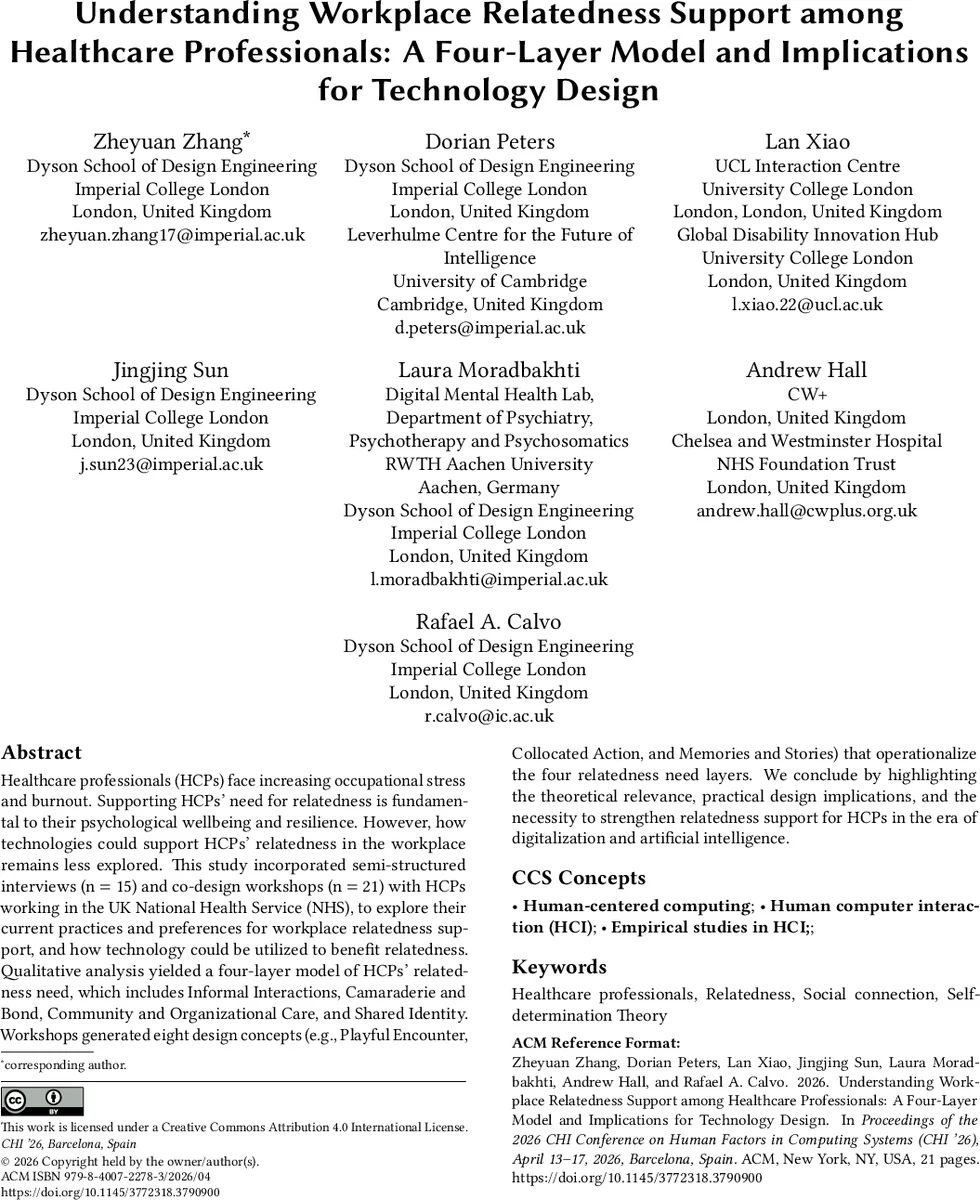
Healthcare professionals (HCPs) face increasing occupational stress and burnout. Supporting HCPs need for relatedness is fundamental to their psychological wellbeing and resilience. However, how technologies could support HCPs relatedness in the workplace remains less explored. This study incorporated semi-structured interviews (n = 15) and co-design workshops (n = 21) with HCPs working in the UK National Health Service (NHS), to explore their current practices and preferences for workplace relatedness support, and how technology could be utilized to benefit relatedness. Qualitative analysis yielded a four-layer model of HCPs relatedness need, which includes Informal Interactions, Camaraderie and Bond, Community and Organizational Care, and Shared Identity. Workshops generated eight design concepts (e.g., Playful Encounter, Collocated Action, and Memories and Stories) that operationalize the four relatedness need layers. We conclude by highlighting the theoretical relevance, practical design implications, and the necessity to strengthen relatedness support for HCPs in the era of digitalization and artificial intelligence.
💡 Research Summary
This paper investigates how technology can support the fundamental psychological need for relatedness among healthcare professionals (HCPs) working in the UK National Health Service (NHS). Recognising that occupational stress, burnout, and the erosion of face‑to‑face interactions have intensified during and after the COVID‑19 pandemic, the authors adopt Self‑Determination Theory (SDT) as a guiding framework and conduct a two‑phase qualitative study.
Phase 1 consists of semi‑structured interviews with 15 HCPs (clinical and administrative staff) to uncover current practices, barriers, and preferences for workplace relatedness support. Participants describe how informal hallway chats, brief break‑time conversations, and shared spaces historically served as “social buffers” against stress, but note that the proliferation of electronic health records, remote communication tools, and shift‑work schedules have reduced these spontaneous interactions.
Thematic analysis of the interview data yields a four‑layer model of relatedness needs specific to the healthcare context:
- Informal Interactions – brief, low‑effort exchanges (e.g., greetings, coffee‑break talk).
- Camaraderie and Bond – deeper, trust‑based relationships such as peer‑support, mentorship, and shared emotional experiences.
- Community and Organizational Care – structural and cultural provisions from the organization (e.g., dedicated break rooms, supportive policies, team debriefs).
- Shared Identity – a collective sense of belonging to the hospital or professional group, reinforced through shared narratives, rituals, and symbols.
Phase 2 builds on these insights through co‑design workshops with 21 additional HCPs. Using participatory methods (brainstorming, sketching, low‑fidelity prototyping), participants generate eight concrete design concepts that map onto the four layers:
- Playful Encounter – interactive displays or ambient sensors in communal areas that trigger short games or quizzes, prompting spontaneous conversation.
- Collocated Action – real‑time visualizations of co‑location and schedule overlap that suggest joint activities (e.g., a quick walk, shared lunch).
- Memories and Stories – a digital “story board” where teams upload anecdotes, successes, or patient‑care moments, fostering a shared narrative.
- Peer‑Support Beacon – wearable devices that detect physiological stress signals and emit a subtle, privacy‑preserving cue to nearby colleagues indicating a need for a brief check‑in.
- Additional concepts include micro‑mentor matching, ritual reminders, community pulse dashboards, and care‑bundle notifications. All concepts emphasize lightweight, low‑intrusion, and privacy‑aware design suitable for high‑pressure clinical workflows.
The authors discuss theoretical contributions, noting that the four‑layer model extends SDT and related theories (belongingness hypothesis, social identity theory, sense‑of‑community theory) by contextualizing them within the hierarchical, shift‑based, and multidisciplinary nature of healthcare work. Practically, the design concepts illustrate how ambient computing, tangible interfaces, and simple mobile applications can re‑introduce informal social glue without adding significant workload.
Limitations include a single‑site sample, lack of prototype implementation, and limited reporting on inter‑rater reliability in coding. The paper calls for future work that (a) validates the model across multiple hospitals and cultural settings, (b) builds and evaluates functional prototypes in real clinical environments, and (c) addresses ethical concerns such as data privacy, consent, and potential stigma around mental‑health signaling.
In sum, the study provides an empirically grounded, multi‑level framework of relatedness needs for HCPs and offers a suite of technology‑informed design directions that could help mitigate burnout and improve wellbeing in increasingly digitalized healthcare systems.
Comments & Academic Discussion
Loading comments...
Leave a Comment