Parameter-free Dynamic Regret: Time-varying Movement Costs, Delayed Feedback, and Memory
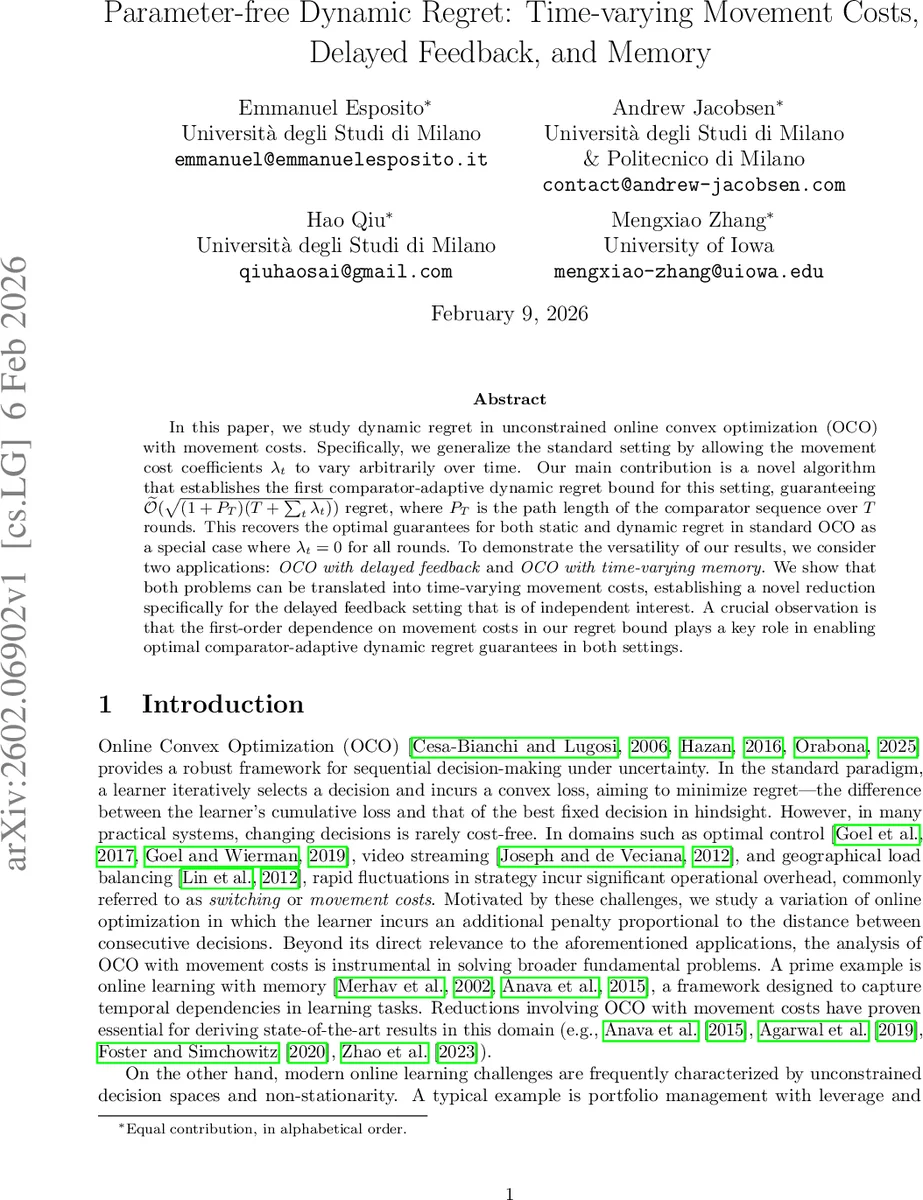
In this paper, we study dynamic regret in unconstrained online convex optimization (OCO) with movement costs. Specifically, we generalize the standard setting by allowing the movement cost coefficients $λ_t$ to vary arbitrarily over time. Our main contribution is a novel algorithm that establishes the first comparator-adaptive dynamic regret bound for this setting, guaranteeing $\widetilde{\mathcal{O}}(\sqrt{(1+P_T)(T+\sum_t λ_t)})$ regret, where $P_T$ is the path length of the comparator sequence over $T$ rounds. This recovers the optimal guarantees for both static and dynamic regret in standard OCO as a special case where $λ_t=0$ for all rounds. To demonstrate the versatility of our results, we consider two applications: OCO with delayed feedback and OCO with time-varying memory. We show that both problems can be translated into time-varying movement costs, establishing a novel reduction specifically for the delayed feedback setting that is of independent interest. A crucial observation is that the first-order dependence on movement costs in our regret bound plays a key role in enabling optimal comparator-adaptive dynamic regret guarantees in both settings.
💡 Research Summary
This paper tackles the problem of online convex optimization (OCO) in an unconstrained setting where the learner incurs not only the convex loss fₜ(wₜ) but also a movement (switching) cost λₜ‖wₜ–wₜ₋₁‖. Unlike prior work that assumes a fixed movement‑cost coefficient, the authors allow the coefficient λₜ to vary arbitrarily over time, thereby capturing realistic scenarios such as fluctuating transaction fees, varying network latency, or time‑dependent energy costs.
The main contribution is a parameter‑free algorithm—Algorithm 1—based on Composite Mirror Descent (CMD). The algorithm employs a specially designed “linear‑logarithmic” regularizer
\
Comments & Academic Discussion
Loading comments...
Leave a Comment