Explicit composition identities for higher composition laws
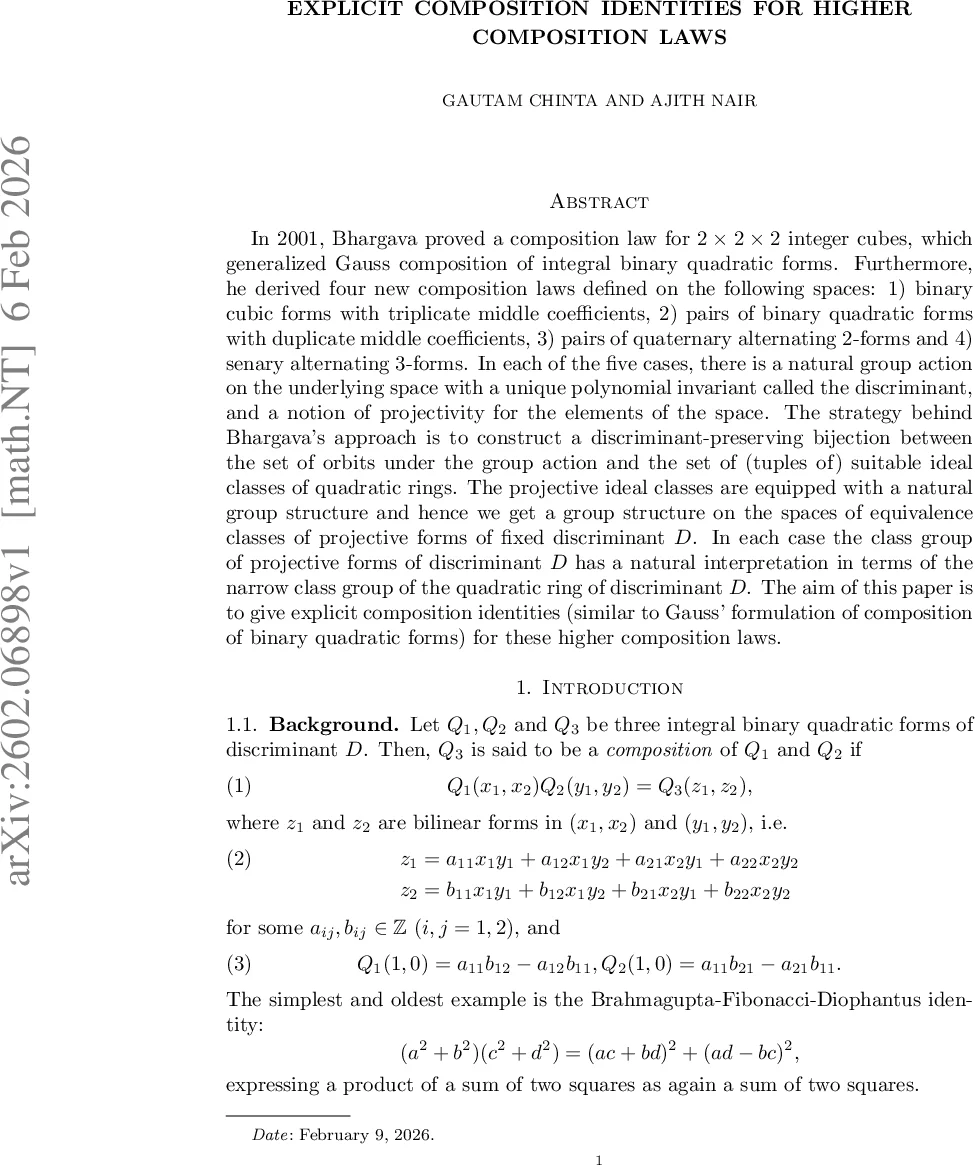
In 2001, Bhargava proved a composition law for $2 \times 2 \times 2$ integer cubes, which generalized Gauss composition of integral binary quadratic forms. Furthermore, he derived four new composition laws defined on the following spaces: 1) binary cubic forms with triplicate middle coefficients, 2) pairs of binary quadratic forms with duplicate middle coefficients, 3) pairs of quaternary alternating 2-forms and 4) senary alternating 3-forms. In each of the five cases, there is a natural group action on the underlying space with a unique polynomial invariant called the discriminant, and a notion of projectivity for the elements of the space. The strategy behind Bhargava’s approach is to construct a discriminant-preserving bijection between the set of orbits under the group action and the set of (tuples of) suitable ideal classes of quadratic rings. The projective ideal classes are equipped with a natural group structure and hence we get a group structure on the spaces of equivalence classes of projective forms of fixed discriminant $D$. In each case the class group of projective forms of discriminant $D$ has a natural interpretation in terms of the narrow class group of the quadratic ring of discriminant $D$. The aim of this paper is to give explicit composition identities (similar to Gauss’ formulation of composition of binary quadratic forms) for these higher composition laws.
💡 Research Summary
The paper develops explicit composition identities for the higher composition laws introduced by Manjul Bhargava, extending Gauss’s classical composition of binary quadratic forms to a variety of higher-degree objects. Starting with Bhargava’s 2 × 2 × 2 integer cubes, the authors describe the natural action of Γ = SL₂(ℤ)³ on the space ℤ² ⊗ ℤ² ⊗ ℤ², define the unique polynomial invariant (the discriminant D), and explain how primitive cubes (those whose three associated binary quadratic forms are primitive) correspond bijectively to oriented ideal classes in the quadratic ring S(D). This bijection endows the set of Γ‑orbits of primitive cubes with a finite abelian group structure denoted Cl(ℤ² ⊗ ℤ² ⊗ ℤ²; D).
A central device is the “Cube Law”: given three primitive cubes A₁, A₂, A₃ of the same discriminant, the nine binary quadratic forms Q_{A_i}^j (i‑row, j‑column) satisfy that each row and each column sums to the identity class in the class group of binary quadratic forms. By swapping rows and columns one obtains a triple of “dual cubes” (T₁,T₂,T₃) characterized by Q_{T_j}^i = Q_{A_i}^j. The existence and uniqueness (up to the natural automorphism groups) of dual cubes follows from Bhargava’s inverse theorem.
The authors then present their first main result, Theorem 3.1, which gives an explicit composition identity for cubes. For primitive cubes B and C of discriminant D, they define a bilinear “form product” B ⊙ C and show that there exist three auxiliary cubes R, S, T (explicitly constructed from the coefficients of B, C and the parity ε ≡ D mod 4) such that (B ⊙ C)(x,y,z; u,v,w) = A(R_σ(x,u), S_σ(y,v), T_σ(z,w)). Moreover, the associated quadratic forms satisfy Q_R¹ = Q_A¹, Q_S² = Q_B², Q_T³ = Q_C³, and the products of the values at (1,0) match prescribed coefficients of the auxiliary cubes. This identity mirrors Gauss’s bilinear composition (the three equations (1)–(3) in the introduction) but works in the trilinear setting, with the change of variables given explicitly by the matrices built from R, S, T.
After treating the cube case, the paper systematically extends the same pattern to the remaining four spaces that Bhargava studied:
- Sym³ ℤ² – binary cubic forms with tripled middle coefficient;
- ℤ² ⊗ Sym² ℤ² – pairs of binary quadratic forms with duplicated middle coefficients;
- ℤ² ⊗ ∧² ℤ⁴ – pairs of quaternary alternating 2‑forms;
- ∧³ ℤ⁶ – senary alternating 3‑forms. In each setting there is a natural group G(ℤ) acting (e.g., SL₂ × SL₃, etc.), a unique discriminant invariant, and a notion of projectivity analogous to primitivity. The authors construct the corresponding class groups, prove that they are isomorphic to narrow class groups of quadratic rings, and then give explicit composition identities that replace the abstract ideal‑class correspondence. The identities always have the same shape: a product (or sum) of two forms equals a third form evaluated after a multilinear change of variables, and the change of variables is expressed directly in terms of the coefficients of the two original forms.
The paper also situates these results within the broader context of prehomogeneous vector spaces (Sato–Kimura) and rational‑number parametrizations (Wright–Yukie). It notes that the integer orbits of these spaces encode rich arithmetic information, and that the explicit identities enable concrete computations without recourse to ideal‑class theory. Applications mentioned include counting number fields of degree ≤ 5, solving Diophantine equations, and studying genus‑1 curves via composition laws.
In summary, the authors provide a unified, explicit framework for higher composition laws, delivering concrete formulas that generalize Gauss’s classical composition and that can be used directly in computational and theoretical investigations of arithmetic objects associated with these higher‑degree forms.
Comments & Academic Discussion
Loading comments...
Leave a Comment