Bulk heights of the KPZ line ensemble
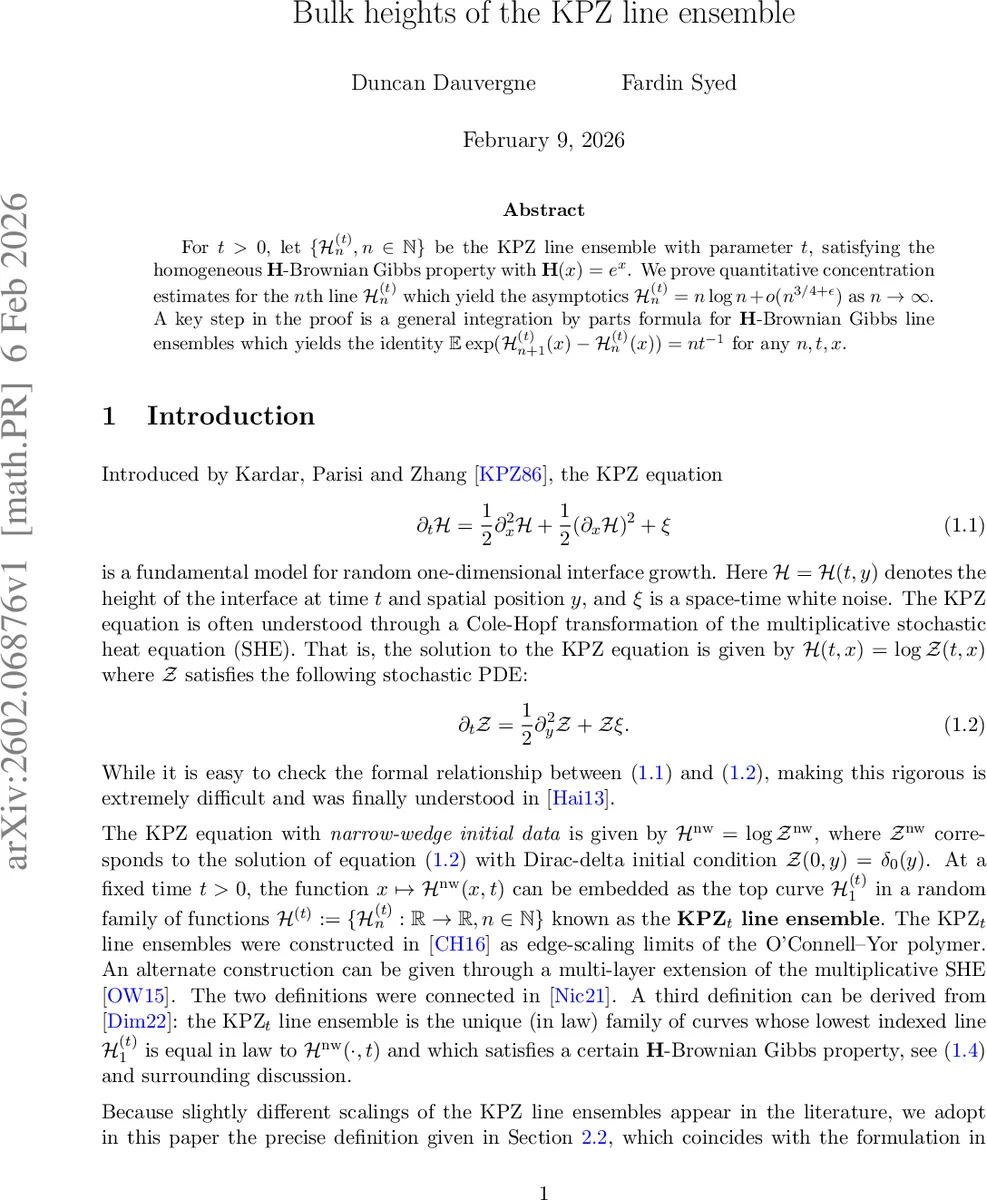
For $t > 0$, let ${\mathcal{H}^{(t)}_n, n \in \mathbb{N}}$ be the KPZ line ensemble with parameter $t$, satisfying the homogeneous $\mathbf{H}$-Brownian Gibbs property with $\mathbf{H}(x) =e^x$. We prove quantitative concentration estimates for the $n$th line $\mathcal{H}^{(t)}_n$ which yield the asymptotics $\mathcal{H}^{(t)}n = n \log n + o(n^{3/4 + ε})$ as $n \to \infty$. A key step in the proof is a general integration by parts formula for $\mathbf{H}$-Brownian Gibbs line ensembles which yields the identity $\mathbb{E} \exp(\mathcal{H}^{(t)}{n + 1}(x) - \mathcal{H}^{(t)}_n (x)) = n t^{-1}$ for any $n, t, x$.
💡 Research Summary
The paper investigates the large‑index behavior of the Kardar‑Parisi‑Zhang (KPZ) line ensemble, a collection of random continuous curves ({\mathcal H^{(t)}n}{n\in\mathbb N}) indexed by a time parameter (t>0). The ensemble satisfies a homogeneous (\mathbf H)-Brownian Gibbs property with (\mathbf H(x)=e^{x}); that is, conditioned on the values outside a finite space‑time rectangle, the interior curves are independent Brownian bridges weighted by a Radon–Nikodym factor (\exp{-\int \mathbf H(\mathcal H_{i+1}-\mathcal H_i)}).
The main quantitative result (Theorem 1.1) gives a concentration bound for the (n)‑th line at the origin. Defining
\
Comments & Academic Discussion
Loading comments...
Leave a Comment