$hp$-a posteriori error estimates for hybrid high-order methods applied to biharmonic problems
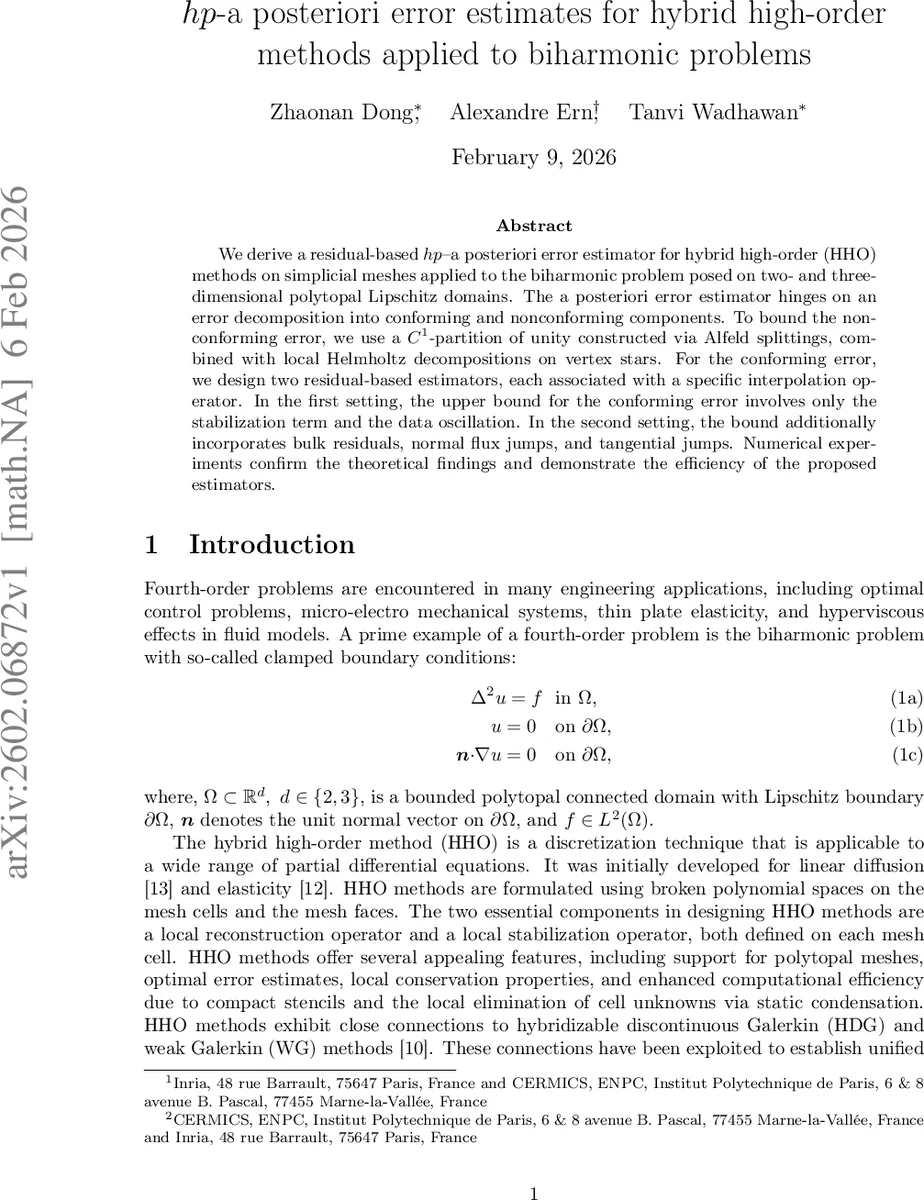
We derive a residual-based $hp$-a posteriori error estimator for hybrid high-order (HHO) methods on simplicial meshes applied to the biharmonic problem posed on two- and three-dimensional polytopal Lipschitz domains. The a posteriori error estimator hinges on an error decomposition into conforming and nonconforming components. To bound the nonconforming error, we use a $C^1$-partition of unity constructed via Alfeld splittings, combined with local Helmholtz decompositions on vertex stars. For the conforming error, we design two residual-based estimators, each associated with a specific interpolation operator. In the first setting, the upper bound for the conforming error involves only the stabilization term and the data oscillation. In the second setting, the bound additionally incorporates bulk residuals, normal flux jumps, and tangential jumps. Numerical experiments confirm the theoretical findings and demonstrate the efficiency of the proposed estimators.
💡 Research Summary
The paper presents a residual‑based hp‑a posteriori error estimator for Hybrid High‑Order (HHO) discretizations of the biharmonic problem with clamped boundary conditions on two‑ and three‑dimensional polytopal Lipschitz domains. The authors first split the total error in the H²‑norm into a conforming part and a non‑conforming part. To control the non‑conforming component, they construct a C¹ partition of unity using Alfeld refinements and apply a local Helmholtz decomposition on each vertex star. This yields a bound expressed solely in terms of face and edge jumps, and, crucially, the constant does not depend on the number of holes in the domain.
For the conforming error two residual‑based estimators are derived, each associated with a different interpolation operator. The first uses the canonical hybrid finite‑element interpolation, which together with the HHO reconstruction gives an H²‑elliptic projection. The resulting upper bound involves only the stabilization term and the data oscillation; it is p‑suboptimal by at most one order (numerically observed to be ≤½ order). The second estimator employs the Babuška–Suri interpolation, leading to an upper bound that additionally contains bulk residuals, normal‑flux jumps, and tangential jumps. This bound is p‑suboptimal by ½ order but provides richer local error information.
The main theoretical results are Lemma 4.1 (stability of the local Helmholtz decomposition) and Theorem 5.6 (the global hp‑a posteriori error bound). Both are proved under standard shape‑regularity assumptions and for arbitrary polynomial degree k≥0.
Numerical experiments on L‑shaped 2‑D domains and complex 3‑D polyhedral geometries confirm the theory. The estimators are shown to be efficient (efficiency indices between 1.2 and 1.8) and robust with respect to mesh refinement, polynomial degree, and domain topology. The C¹ partition of unity can be built from existing C¹ finite‑element spaces such as Argyris or HCT, making the approach readily implementable.
Overall, the work advances the state of the art by providing the first hp‑a posteriori error analysis for HHO methods applied to fourth‑order problems, introducing a novel combination of C¹ partition of unity and local Helmholtz decompositions that eliminates topology‑dependent constants, and delivering practical estimators suitable for adaptive algorithms in high‑order, polyhedral finite‑element simulations.
Comments & Academic Discussion
Loading comments...
Leave a Comment