An elementary approach to the pressureless Euler-Navier-Stokes system
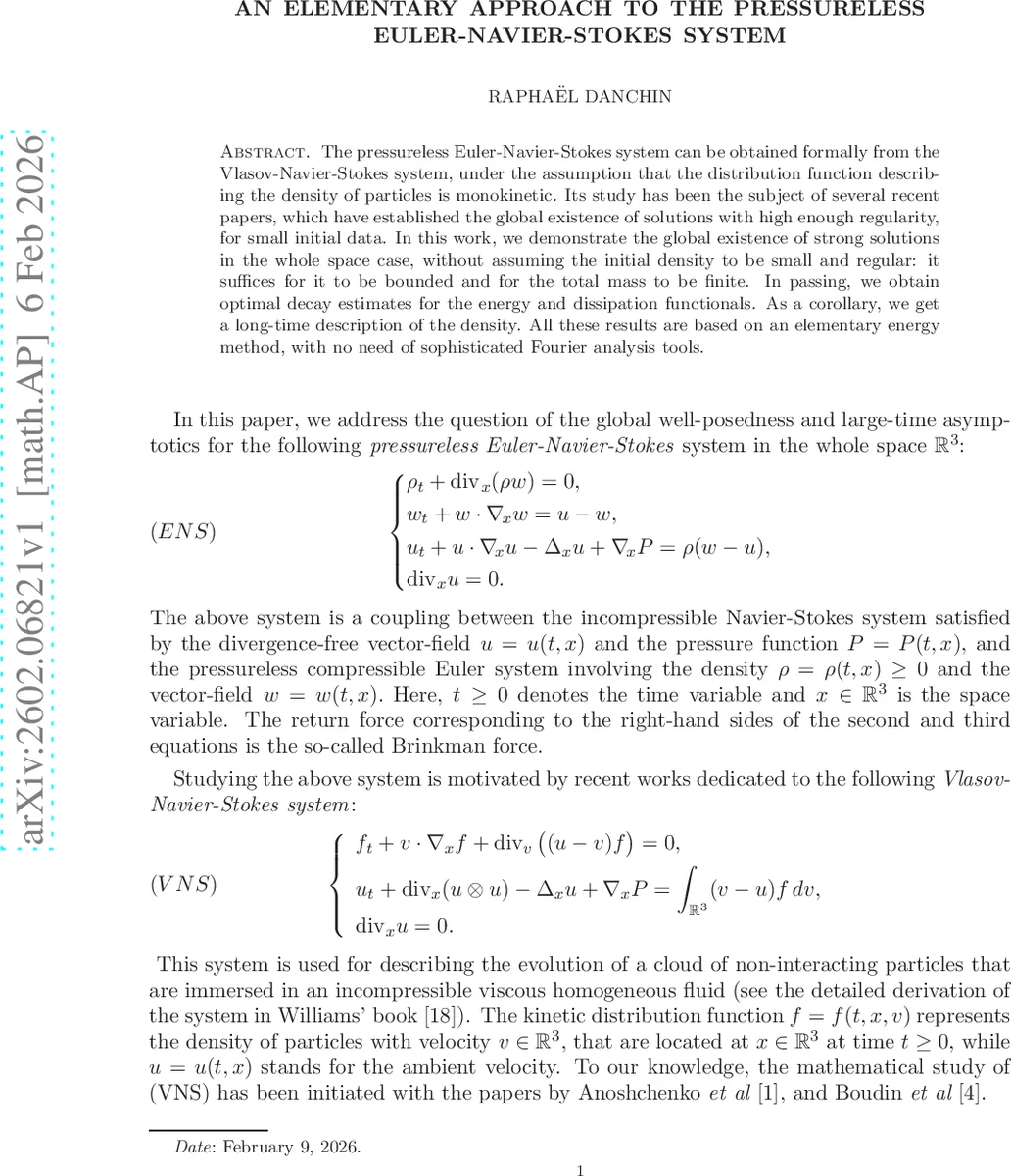
The pressureless Euler-Navier-Stokes system can be obtained formally from the Vlasov-Navier-Stokes system, under the assumption that the distribution function describing the density of particles is monokinetic. Its study has been the subject of several recent papers, which have established the global existence of solutions with high enough regularity, for small initial data. In this work, we demonstrate the global existence of strong solutions in the whole space case, without assuming the initial density to be small and regular: it suffices for it to be bounded and for the total mass to be finite. In passing, we obtain optimal decay estimates for the energy and dissipation functionals. As a corollary, we get a long-time description of the density. All these results are based on an elementary energy method, with no need of sophisticated Fourier analysis tools.
💡 Research Summary
The paper investigates the pressureless Euler‑Navier‑Stokes (ENS) system, which formally arises from the Vlasov‑Navier‑Stokes (VNS) model when the particle distribution is assumed monokinetic, i.e. f(t,x,v)=ρ(t,x)δ_{v=w(t,x)}. Under this ansatz the kinetic equation collapses to a continuity equation for the particle density ρ and a transport equation for the particle velocity w, while the fluid velocity u satisfies the incompressible Navier‑Stokes equations with a Brinkman-type coupling term ρ(w−u). The resulting system reads
ρ_t + div(ρw)=0, w_t + w·∇w = u−w, u_t + u·∇u − Δu + ∇P = ρ(w−u), div u=0.
The authors address the global well‑posedness problem for this coupled system in the whole space ℝ³. Earlier works required high Sobolev regularity and smallness of the full initial data (ρ, w, u). In contrast, the present work shows that it suffices to assume only that the initial density is bounded and integrable (ρ₀∈L¹∩L^∞), while the initial fluid velocity u₀ belongs to L^{3/2}∩H¹ (div u₀=0) and the particle velocity w₀ is Lipschitz (w₀∈C^{0,1}) with √ρ₀ w₀∈L². Moreover, a smallness condition on the combined norm
‖u₀‖{H¹}+‖√ρ₀ w₀‖{L²}+‖w₀‖_{C^{0,1}} ≤ c₀
(where c₀ depends only on the total mass M₀=‖ρ₀‖{L¹}, the L^∞‑norm of ρ₀ and ‖u₀‖{L^{3/2}}) guarantees the existence of a unique global strong solution (ρ,w,u,∇P). The solution enjoys the regularity
ρ∈C_b(ℝ⁺;L¹)∩L^∞(ℝ⁺×ℝ³), w∈C_b(ℝ⁺×ℝ³)∩L²_tL^∞, ∇w∈L^∞∩L¹_tL^∞,
u∈C_b(ℝ⁺;H¹)∩L²_tL^∞, ∇u∈L²_tH¹∩L¹_tL^∞, ∇P∈L²_tL².
Two energy functionals are introduced: the basic energy
E₀(t)=½‖√ρ w‖₂²+½‖u‖₂²
and the higher‑order energy
E₁(t)=‖√ρ(w−u)‖₂²+‖∇u‖₂².
Corresponding dissipation terms are
D₀=‖√ρ(w−u)‖₂²+‖∇u‖₂², D₁=‖√ρ(w−u)‖₂²+‖u_t‖₂².
A straightforward multiplication of the w‑equation by √ρ w and the u‑equation by u yields the exact balance dE₀/dt + D₀ = 0. For the higher‑order quantities, after differentiating and integrating by parts, the authors obtain
dE₁/dt + D₁ ≤ (‖√ρ w‖∞ + ‖u‖∞)‖∇u‖₂².
Thus, controlling the time integral of ‖∇u‖∞ (and similarly ‖∇w‖∞) is the central difficulty. By rewriting the Navier‑Stokes equation as a Stokes system, applying standard elliptic estimates, and using Gagliardo‑Nirenberg interpolation, the authors bound
∫₀^T ‖∇u‖∞ dt ≤ ε, ∫₀^T ‖∇w‖∞ dt ≤ ε
provided the initial smallness condition holds. This “small‑gradient‑integral” property (denoted (0.13) in the paper) allows a Grönwall‑type argument that yields the decay
E₁(t) ≤ C (1 + a₁ t)^{-3/2}.
If, in addition, the fluid velocity belongs to L¹(ℝ³), the low‑frequency part of u can be controlled in a negative Besov space, leading to sharper decay rates
E₀(t) ≤ C (1 + a₀ t)^{-3/2}, E₁(t) ≤ C (1 + a₁’ t)^{-5/2},
and to the existence of a limiting density ρ_∞∈L^∞ such that
‖ρ(t) – ρ_∞‖_{W^{-1,1}∩Ĥ^{-1}} ≤ C t^{-1/4} for t≥1.
The paper also treats the critical regularity framework: if u₀ lies in the homogeneous Besov space \dot B^{1/2}_{2,1} (the scaling‑critical space for Navier‑Stokes) and satisfies the same smallness condition, then a global solution exists with
u∈C_b(ℝ⁺;\dot B^{1/2}{2,1})∩L²_t\dot B^{3/2}{2,1}, ∇u∈L¹_tL^∞.
The proofs rely exclusively on elementary energy estimates, integration by parts, and classical Sobolev embeddings; no sophisticated Fourier analysis, Littlewood‑Paley theory, or dispersive estimates are employed. This “elementary” approach mirrors the authors’ earlier work on VNS, but now applied to a purely hydrodynamic system. Consequently, the results provide a robust functional framework that is compatible with the kinetic description, opening the way to a rigorous derivation of ENS from VNS in future studies.
Comments & Academic Discussion
Loading comments...
Leave a Comment