Optimized Photoemission from Organic Molecules in 2D Layered Halide Perovskites
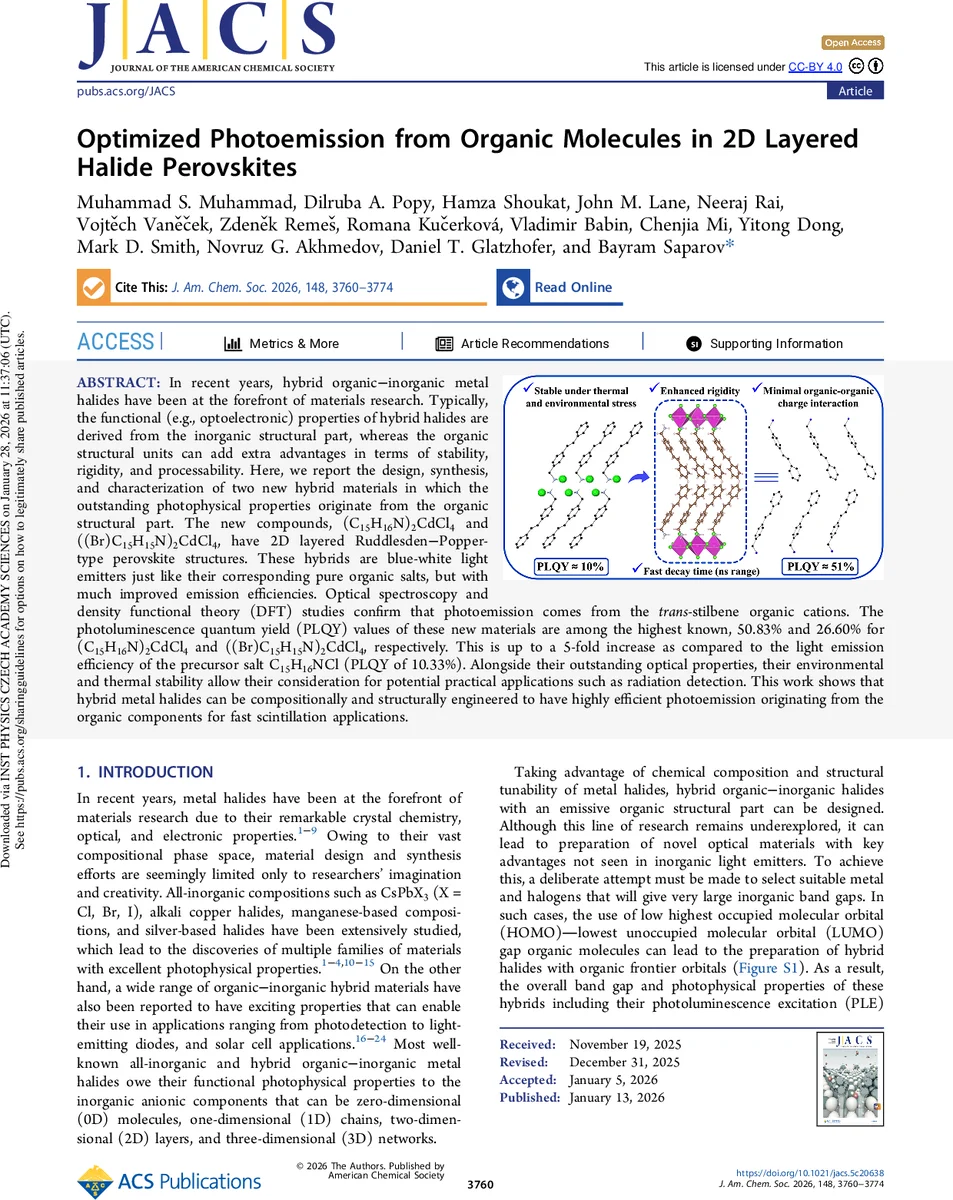
In recent years, hybrid organic-inorganic metal halides have been at the forefront of materials research. Typically, the functional (e.g., optoelectronic) properties of hybrid halides are derived from the inorganic structural part, whereas the organic structural units can add extra advantages in terms of stability, rigidity, and processability. Here, we report the design, synthesis, and characterization of two new hybrid materials in which the outstanding photophysical properties originate from the organic structural part. The new compounds, (C15H16N)2CdCl4 and ((Br)C15H15N)2CdCl4, have 2D layered Ruddlesden-Poppertype perovskite structures. These hybrids are blue-white light emitters just like their corresponding pure organic salts, but with much improved emission efficiencies. Optical spectroscopy and density functional theory (DFT) studies confirm that photoemission comes from the trans-stilbene organic cations. The photoluminescence quantum yield (PLQY) values of these new materials are among the highest known, 50.83 % and 26.60 % for (C15H16N)2CdCl4 and ((Br)C15H15N)2CdCl4, respectively. This is up to a 5-fold increase as compared to the light emission efficiency of the precursor salt C15H16NCl (PLQY of 10.33 %). Alongside their outstanding optical properties, their environmental and thermal stability allow their consideration for potential practical applications such as radiation detection. This work shows that hybrid metal halides can be compositionally and structurally engineered to have highly efficient photoemission originating from the organic components for fast scintillation applications.
💡 Research Summary
This paper presents a significant advancement in the field of hybrid organic-inorganic perovskites by demonstrating that the photoemission properties can be dominantly engineered from the organic component, achieving record-high efficiencies. The authors designed, synthesized, and characterized two novel 2D layered Ruddlesden-Popper perovskite-type hybrids: (C15H16N)2CdCl4 and its brominated analogue ((Br)C15H15N)2CdCl4. The core design principle involved using a large-bandgap inorganic framework (cadmium chloride layers) to host optically active organic cations based on trans-stilbene derivatives. This strategy ensures that the frontier orbitals and thus the optical excitation and emission processes are confined to the organic moiety.
A key innovation was the molecular modification of the organic cation. By simplifying the previously used bulky trimethyl(4-stilbenyl)methylammonium cation to (E)-(4-styrylphenyl)methanaminium, the researchers reduced steric hindrance. This allowed the ammonium group to nestle more deeply into the pockets formed by the inorganic perovskite sheets, increasing intermolecular distances between the organic cations. This structural modification effectively mitigated aggregation-caused quenching (ACQ), a common limitation for organic emitters in solid-state assemblies.
Structural characterization via single-crystal X-ray diffraction confirmed the 2D perovskite architecture. Optical spectroscopy, including photoluminescence (PL) and photoluminescence excitation (PLE) measurements, revealed that both hybrids exhibit bright blue-white emission with spectra nearly identical to their pure organic precursor salts, unambiguously confirming the organic origin of the light emission. The most striking result is the dramatically enhanced photoluminescence quantum yield (PLQY). (C15H16N)2CdCl4 achieved a remarkable PLQY of 50.83%, while ((Br)C15H15N)2CdCl4 showed a PLQY of 26.60%. This represents up to a fivefold increase compared to the PLQY of the precursor organic salt C15H16NCl (10.33%). To the authors’ knowledge, the 50.83% value is among the highest reported for Cd-based hybrid halides where emission originates purely from the organic component.
Density Functional Theory (DFT) calculations provided theoretical support, showing that the HOMO and LUMO orbitals are completely localized on the organic cations, with the inorganic layers possessing a much larger band gap (~5 eV). This electronic structure isolates the optical processes within the organic species. Furthermore, the materials exhibit excellent thermal stability, decomposing above 300°C, and can be uniformly dispersed in polymer matrices like PMMA to form stable composite films. Their photophysical properties also include fast nanosecond-scale photoluminescence decay lifetimes and measurable radioluminescence under X-ray excitation with low afterglow, outperforming a standard scintillator like BGO in afterglow characteristics.
In conclusion, this work successfully demonstrates that through rational compositional and structural engineering—specifically, tailoring the organic cation and its integration into a wide-bandgap inorganic host—hybrid perovskites can be optimized to exhibit highly efficient emission from organic components. The achieved PLQYs rival those of many inorganic-emissive hybrids, but with the added advantage of fast decay times inherent to organic fluorophores. This breakthrough opens promising avenues for the application of these materials in fast scintillation detectors for radiation detection and other optoelectronic devices where high efficiency and speed are critical.
Comments & Academic Discussion
Loading comments...
Leave a Comment