Purified Two-Relaxation-Time Lattice Boltzmann Method: Removing Ghost Modes from TRT for Enhanced Stability
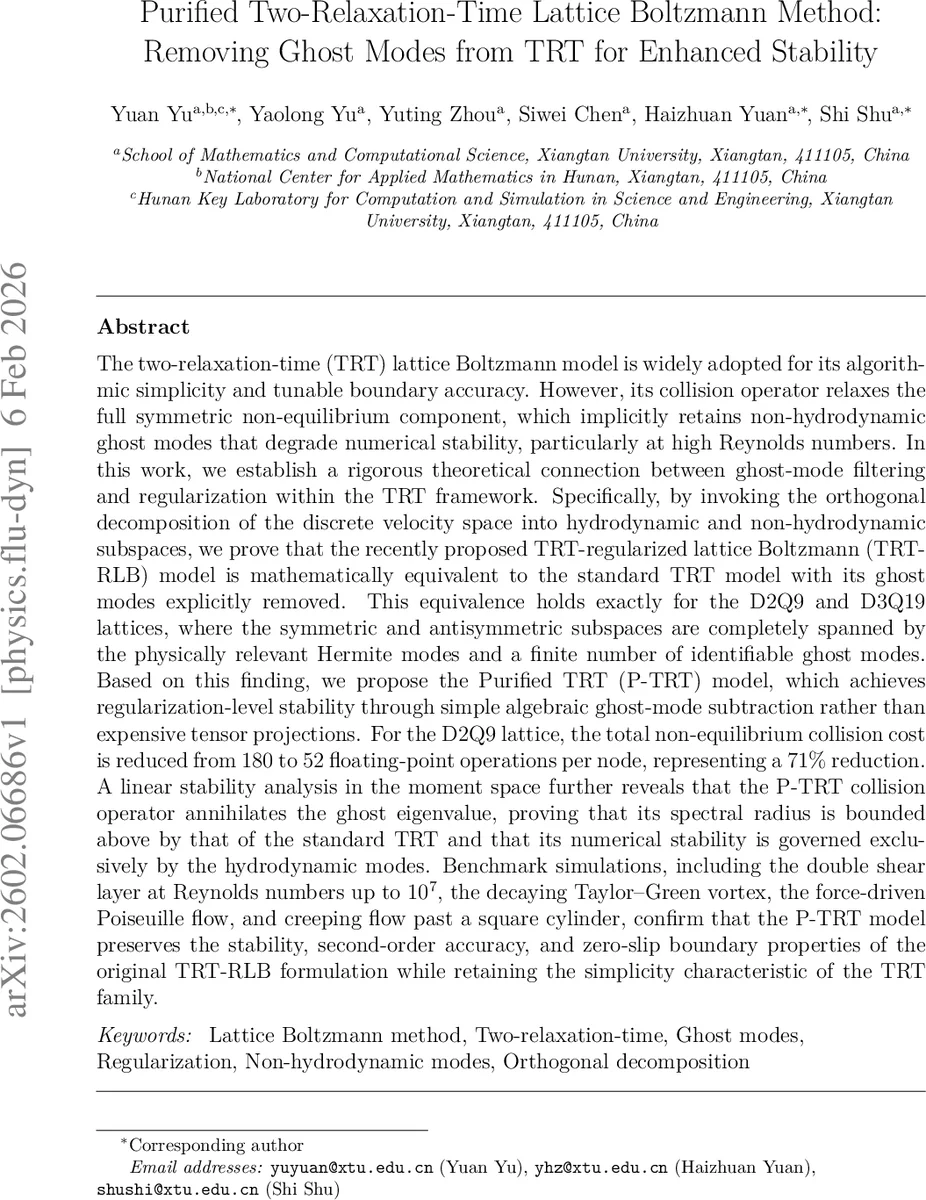
The two-relaxation-time (TRT) lattice Boltzmann model is widely adopted for its simplicity and tunable boundary accuracy. However, its collision operator relaxes the full symmetric non-equilibrium component, implicitly retaining non-hydrodynamic ghost modes that degrade stability at high Reynolds numbers. In this work, we establish a rigorous connection between ghost-mode filtering and regularization within the TRT framework. By decomposing the discrete velocity space into hydrodynamic and non-hydrodynamic subspaces, we prove that the TRT-regularized lattice Boltzmann (TRT-RLB) model is mathematically equivalent to the standard TRT model with ghost modes explicitly removed. This equivalence holds exactly for D2Q9 and D3Q19 lattices, where the symmetric and antisymmetric subspaces are completely spanned by the physically relevant Hermite modes and identifiable ghost modes. Based on this finding, we propose the Purified TRT (P-TRT) model, which achieves regularization-level stability through simple algebraic ghost-mode subtraction rather than expensive tensor projections. For D2Q9, the non-equilibrium collision cost is reduced from 180 to 52 floating-point operations per node, a 71% reduction. Linear stability analysis in moment space further reveals that the P-TRT operator annihilates the ghost eigenvalue, proving its spectral radius is bounded above by that of standard TRT and that stability is governed exclusively by hydrodynamic modes. Benchmarks including the double shear layer at Re up to 10^7, Taylor–Green vortex decay, force-driven Poiseuille flow, and creeping flow past a square cylinder confirm that P-TRT preserves the stability, second-order accuracy, and zero-slip boundary properties of TRT-RLB while retaining the simplicity of the TRT family.
💡 Research Summary
The paper addresses a fundamental limitation of the two‑relaxation‑time (TRT) lattice Boltzmann method (LBM), namely the retention of non‑hydrodynamic “ghost” modes in the symmetric non‑equilibrium component. While the TRT‑regularized lattice Boltzmann (TRT‑RLB) model improves stability by projecting the non‑equilibrium distribution onto the second‑ and third‑order Hermite basis, this projection is computationally expensive because it requires tensor contractions.
The authors first formalize the discrete velocity space as a direct sum of a symmetric subspace S and an antisymmetric subspace A, exploiting the parity of the lattice (e¯i = −ei). Within S, the zeroth‑order mass mode and the second‑order stress modes span the physically relevant hydrodynamic subspace; the remaining dimensions constitute the ghost‑mode subspace Sᴳ. For the D2Q9 lattice, Sᴳ is one‑dimensional, represented by the fourth‑order polynomial ϕᴳi = (eix² − cs²)(eiy² ‑ cs²). For D3Q19, three orthogonal fourth‑order ghost modes exist, and for D3Q27 even higher‑order ghosts appear.
The key theoretical contribution is the proof that the Hermite‑based regularization employed in TRT‑RLB is mathematically equivalent to explicitly removing the ghost‑mode component from the symmetric non‑equilibrium distribution. In algebraic terms, after decomposing fⁿᵉᵠ into symmetric and antisymmetric parts, the post‑collision state is obtained by subtracting the projection onto Sᴳ:
fⁿᵉᵠ_i ← fⁿᵉᵠ_i − (ϕᴳ·fⁿᵉᵠ) ϕᴳ_i /‖ϕᴳ‖².
This operation eliminates all non‑hydrodynamic contributions without computing any third‑order Hermite tensors. Consequently, the number of floating‑point operations required for the non‑equilibrium collision step on D2Q9 drops from 180 to 52, a 71 % reduction.
A linear stability analysis performed in moment space shows that the standard TRT collision matrix possesses a ghost eigenvalue λ_G = 1 − 1/τ_s,1, which approaches the unit circle as τ_s,1 decreases, leading to instability. In the purified TRT (P‑TRT) the ghost eigenvalue is forced to zero, guaranteeing that the spectral radius of the collision operator is never larger than that of the original TRT. Hence, numerical stability depends solely on the hydrodynamic modes.
The authors validate the P‑TRT scheme with four benchmark problems:
- Double shear layer up to Re = 10⁷ on a 256 × 256 grid, demonstrating that P‑TRT can sustain the transition to turbulence without divergence, matching the accuracy of TRT‑RLB.
- Decaying Taylor–Green vortex, confirming second‑order convergence of kinetic energy decay rates.
- Force‑driven Poiseuille flow, showing zero slip at solid walls and exact agreement with analytical velocity profiles.
- Creeping flow past a square cylinder, reproducing benchmark drag and lift coefficients over a wide range of Reynolds numbers (0.1 – 100) without numerical blow‑up.
In all cases, P‑TRT retains the second‑order spatial accuracy, the exact no‑slip boundary condition, and the regularization‑level stability of TRT‑RLB, while achieving a noticeable reduction in computational cost (≈30 % faster runtime).
The paper concludes that “ghost‑mode filtering = regularization” is a rigorous identity for TRT on common lattices, and that the purified TRT provides a minimal, physically transparent modification that can be incorporated into existing TRT codes with negligible effort. This opens the door for similar subspace‑based optimizations in more sophisticated LBM variants such as MRT, ELBM, or entropic formulations, where eliminating non‑hydrodynamic degrees of freedom can yield both stability and efficiency gains.
Comments & Academic Discussion
Loading comments...
Leave a Comment