Probing valley quantum oscillations via the spin Seebeck effect in transition metal dichalcogenide/ferromagnet hybrids
We theoretically investigate spin-valley-locked tunneling transport in a transition-metal dichalcogenide/ferromagnetic-insulator heterostructure under a perpendicular magnetic field, driven by the spin Seebeck effect. We demonstrate that spin-valley coupling together with the magnetic-field-induced valley-asymmetric Landau-level structure enables the generation of a valley-polarized spin current from valley-selective spin excitation. We compare the spin current and the valley-polarized spin current in the conduction and valence bands and clarify their distinct microscopic origins. We predict pronounced quantum oscillations of the valley-polarized spin current, providing a clear experimental signature of quantized valley states.
💡 Research Summary
**
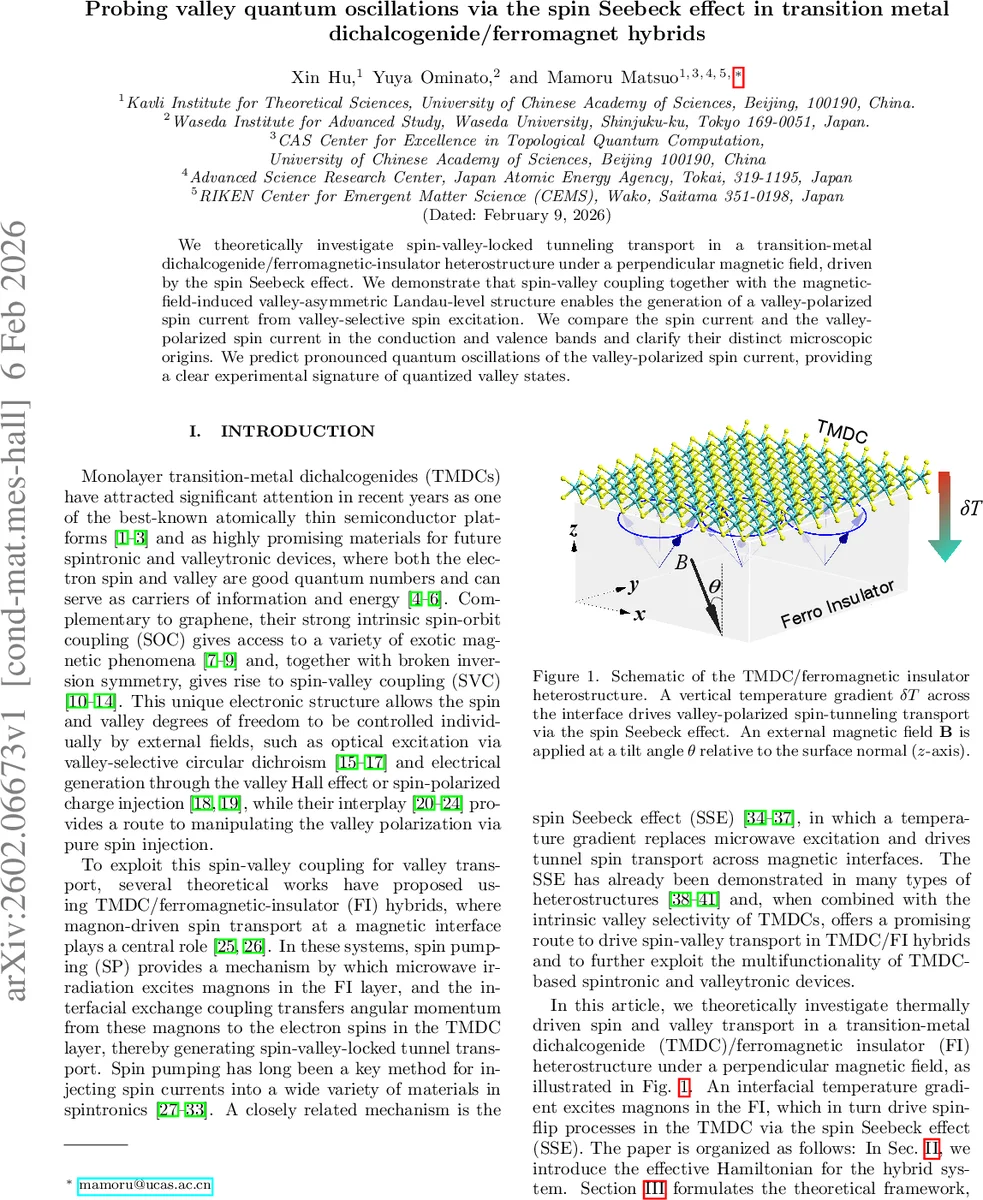
In this work the authors present a comprehensive theoretical study of spin‑valley‑locked tunneling transport in a heterostructure composed of a monolayer transition‑metal dichalcogenide (TMDC) placed on a ferromagnetic insulator (FI). The central idea is to use the spin Seebeck effect (SSE) – a temperature gradient across the TMDC/FI interface – to generate a magnon‑driven spin current without the need for microwave spin‑pumping. The temperature difference excites magnons in the FI; through an interfacial exchange interaction these magnons flip the spins of electrons in the TMDC, thereby creating a spin‑polarized tunneling current.
The electronic structure of the TMDC is described by a low‑energy Dirac‑type Hamiltonian that captures the strong spin‑orbit coupling (SOC) and the resulting spin‑valley coupling (SVC). Near the K (τ = +1) and K′ (τ = −1) valleys the Hamiltonian reads
( H_{\rm eff}=v(\tau \pi_x\sigma_x+\pi_y\sigma_y)+\frac{\Delta}{2}\sigma_z-\tau s\lambda\sigma_z-\frac12),
where (v) is the Dirac velocity, (\Delta) the band gap, (\lambda) the SOC‑induced spin splitting, and (\pi=p+eA) includes the vector potential of a perpendicular magnetic field (B). The magnetic field quantizes the electronic spectrum into Landau levels (LLs). Importantly, the LL spectrum is valley‑asymmetric: in the conduction band the K valley hosts a field‑independent n = 0 LL, while the K′ valley starts from n = 1; in the valence band the situation is reversed. A proximity‑exchange term (J_0S_0) further shifts spin‑up and spin‑down levels in opposite directions. This intrinsic valley asymmetry together with the exchange‑induced shift is the key to achieving valley‑selective spin excitation.
The FI is modeled within the spin‑wave approximation, giving a magnon dispersion (\hbar\omega_k = 2JSa^2k^2 + \hbar\gamma B). The interfacial exchange Hamiltonian is split into a Zeeman‑like term (producing a static exchange field) and a tunneling term that flips spins. Treating the tunneling term as a perturbation, the authors compute the spin current using second‑order perturbation theory. The spin‑current operator is defined as the time derivative of the total electron spin, and its expectation value becomes
\
Comments & Academic Discussion
Loading comments...
Leave a Comment