Une formule des traces pour les espaces symétriques. Le cas de Guo-Jacquet
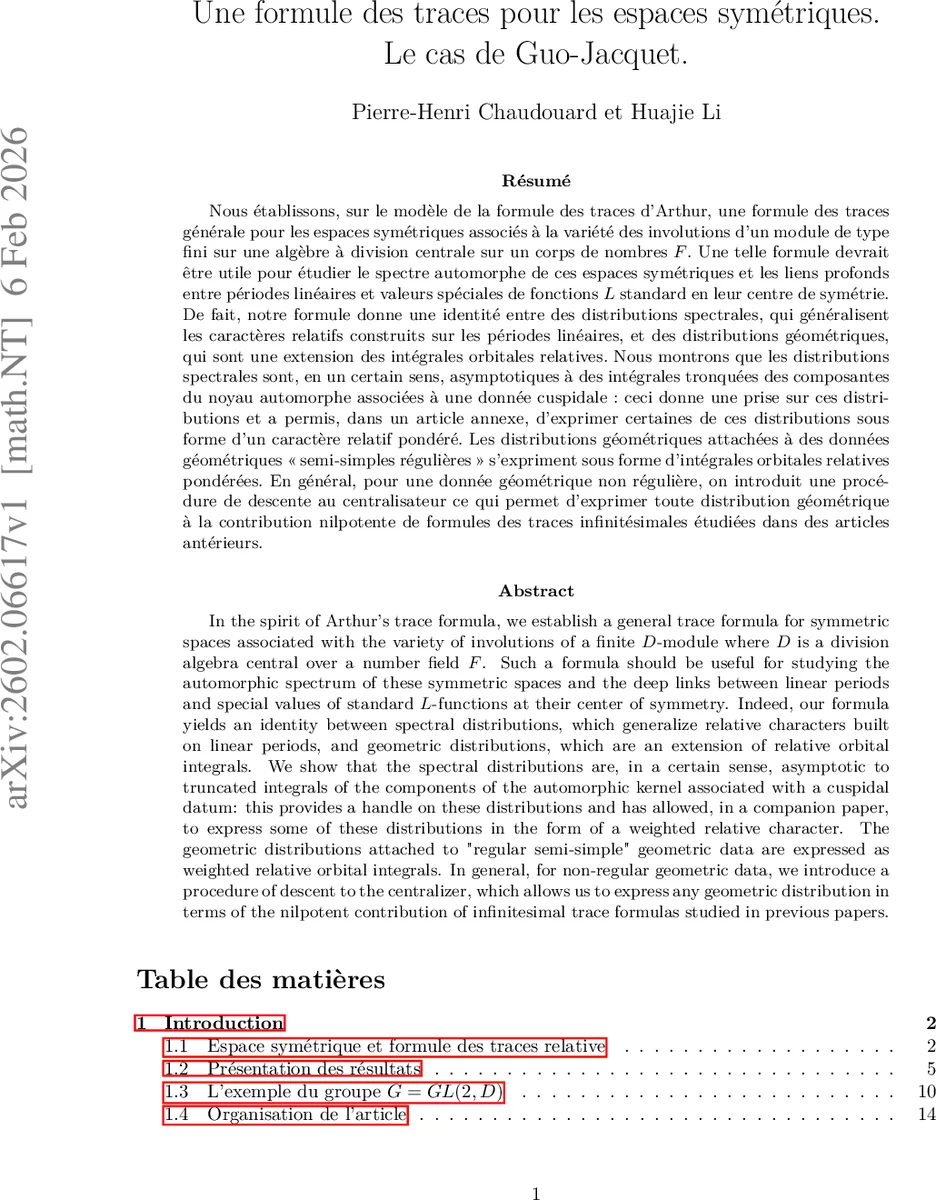
In the spirit of Arthur’s trace formula, we establish a general trace formula for symmetric spaces associated with the variety of involutions of a finite $D$-module where $D$ is a division algebra central over a number field $F$. Such a formula should be useful for studying the automorphic spectrum of these symmetric spaces and the deep links between linear periods and special values of standard $L$-functions at their center of symmetry. Indeed, our formula yields an identity between spectral distributions, which generalize relative characters built on linear periods, and geometric distributions, which are an extension of relative orbital integrals. We show that the spectral distributions are, in a certain sense, asymptotic to truncated integrals of the components of the automorphic kernel associated with a cuspidal datum: this provides a handle on these distributions and has allowed, in a companion paper, to express some of these distributions in the form of a weighted relative character. The geometric distributions attached to “regular semi-simple” geometric data are expressed as weighted relative orbital integrals. In general, for non-regular geometric data, we introduce a procedure of descent to the centralizer, which allows us to express any geometric distribution in terms of the nilpotent contribution of infinitesimal trace formulas studied in previous papers.
💡 Research Summary
The paper develops a general relative trace formula for symmetric spaces attached to the variety of involutions of a finite‑dimensional module over a central division algebra D defined over a number field F. The authors work in the framework of Arthur’s trace formula, adapting its truncation and spectral decomposition techniques to the setting where the symmetric space is the fixed‑point set S = { g ∈ G | g² = 1 } of the involution on the reductive group G = Aut_D(Dⁿ). The space S decomposes into several connected components indexed by pairs (p,q) with p + q = n, each component being a homogeneous G‑space with rational points.
Key constructions begin with the Schwartz spaces S(S(𝔸)) and S(G(𝔸)) of adelic test functions. For each conjugacy class θ in S(F) a Haar measure on its centralizer G_θ(𝔸) is fixed, and a corresponding function Φ_θ on G(𝔸) is defined so that Φ(g⁻¹θg) integrates to Φ_θ(g). This leads to the automorphic kernel \
Comments & Academic Discussion
Loading comments...
Leave a Comment