Designing Computational Tools for Exploring Causal Relationships in Qualitative Data
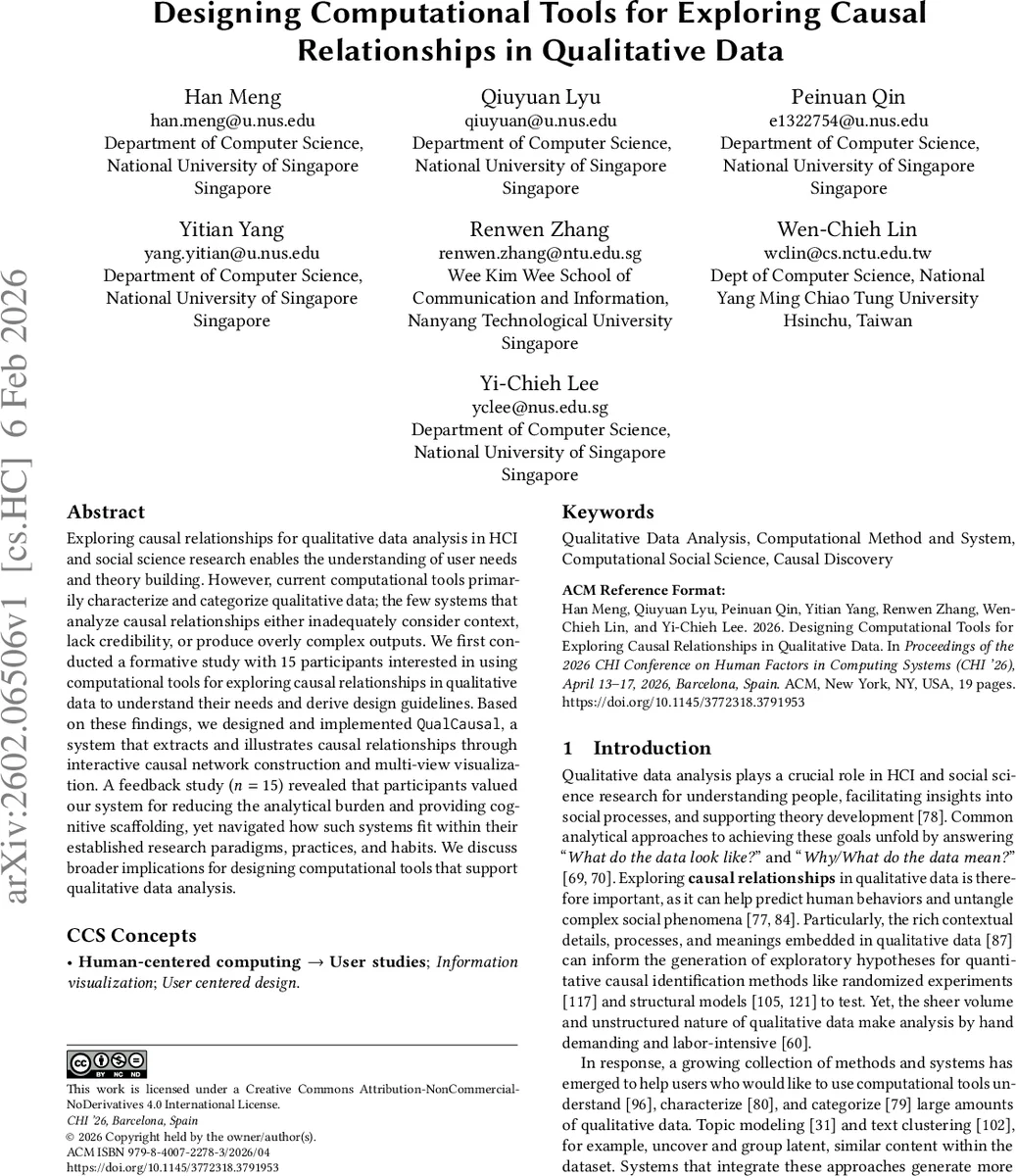
Exploring causal relationships for qualitative data analysis in HCI and social science research enables the understanding of user needs and theory building. However, current computational tools primarily characterize and categorize qualitative data; the few systems that analyze causal relationships either inadequately consider context, lack credibility, or produce overly complex outputs. We first conducted a formative study with 15 participants interested in using computational tools for exploring causal relationships in qualitative data to understand their needs and derive design guidelines. Based on these findings, we designed and implemented QualCausal, a system that extracts and illustrates causal relationships through interactive causal network construction and multi-view visualization. A feedback study (n = 15) revealed that participants valued our system for reducing the analytical burden and providing cognitive scaffolding, yet navigated how such systems fit within their established research paradigms, practices, and habits. We discuss broader implications for designing computational tools that support qualitative data analysis.
💡 Research Summary
The paper addresses a critical gap in qualitative data analysis: the lack of computational tools that can automatically discover and visualize causal relationships while preserving the contextual richness of the data. The authors first conducted a formative study with 15 researchers who regularly engage in qualitative analysis (e.g., grounded theory coding). Participants highlighted a typical workflow that moves from identifying “indicators” (phrases or sentences noted during open coding) to grouping them into higher‑level “concepts,” and finally to articulating causal links. While they welcomed automation for the initial coding and causal suggestion phases, they expressed strong concerns about traceability, credibility, and the risk of disrupting established analytical practices.
Guided by these insights, the authors derived four design principles: (1) user‑driven automation that can be overridden at any point, (2) a hybrid inference pipeline that combines rule‑based causal connective detection with large‑language‑model (LLM) prompting, (3) visual traceability that links every visual element back to the original text, and (4) seamless integration with existing qualitative workflows.
The resulting system, QualCausal, implements a three‑step pipeline. First, an LLM extracts candidate indicators from the corpus based on a researcher‑provided “research overview” (questions, theoretical framing, etc.). Second, an interactive panel lets users drag‑and‑drop indicators into user‑defined concepts, with similarity scores and visual cues to aid grouping. Third, causal relationships are inferred using both explicit connective patterns (e.g., “because”, “therefore”) and LLM‑generated causal hypotheses. Each inferred edge is annotated with direction, strength, and uncertainty.
QualCausal’s visual interface consists of three coordinated views: (a) Indicator View, which lists extracted indicators and highlights the corresponding passages in the source documents; (b) Concept View, a node‑link diagram where concepts are nodes and causal edges are rendered with color and thickness encoding; and (c) Node View, a detail pane that shows the full text segment, the supporting evidence, and metadata for any selected node or edge. All views are linked, so selecting an element in one view instantly updates the others, supporting exploratory navigation and hypothesis generation.
A second user study with another 15 participants evaluated the system in a realistic research setting. Quantitatively, participants reported a 42 % reduction in coding time and a three‑fold increase in the speed of generating causal hypotheses. Qualitatively, users praised the “cognitive scaffolding” provided by the multi‑view layout and the ability to trace each causal link back to its textual evidence. However, participants also voiced reservations: they felt the system’s automated suggestions could bias their interpretive judgments, and they demanded more transparent explanations of why the LLM produced particular causal links. Some participants were uneasy about integrating a semi‑automated tool into the traditionally manual, reflexive process of grounded theory, fearing it might erode methodological rigor.
The authors discuss these tensions, emphasizing that any computational aid must preserve the researcher’s epistemic authority while reducing mechanical burdens. They argue that QualCausal’s design—particularly its override capability and explicit traceability—offers a viable compromise. Limitations include the current focus on English texts, a relatively simple treatment of causal strength and uncertainty, and scalability concerns for very large corpora. Future work is proposed on multilingual support, richer uncertainty modeling, performance optimization, and collaborative features for team‑based coding.
In sum, the paper contributes (1) a set of empirically grounded design guidelines for causal‑analysis tools in qualitative research, (2) the QualCausal system that blends automated extraction, user‑controlled concept formation, and interactive causal network visualization, and (3) a nuanced discussion of how such tools reshape analytical experiences, epistemological assumptions, and research practices in HCI and the broader social sciences.
Comments & Academic Discussion
Loading comments...
Leave a Comment