Instance-Free Domain Adaptive Object Detection
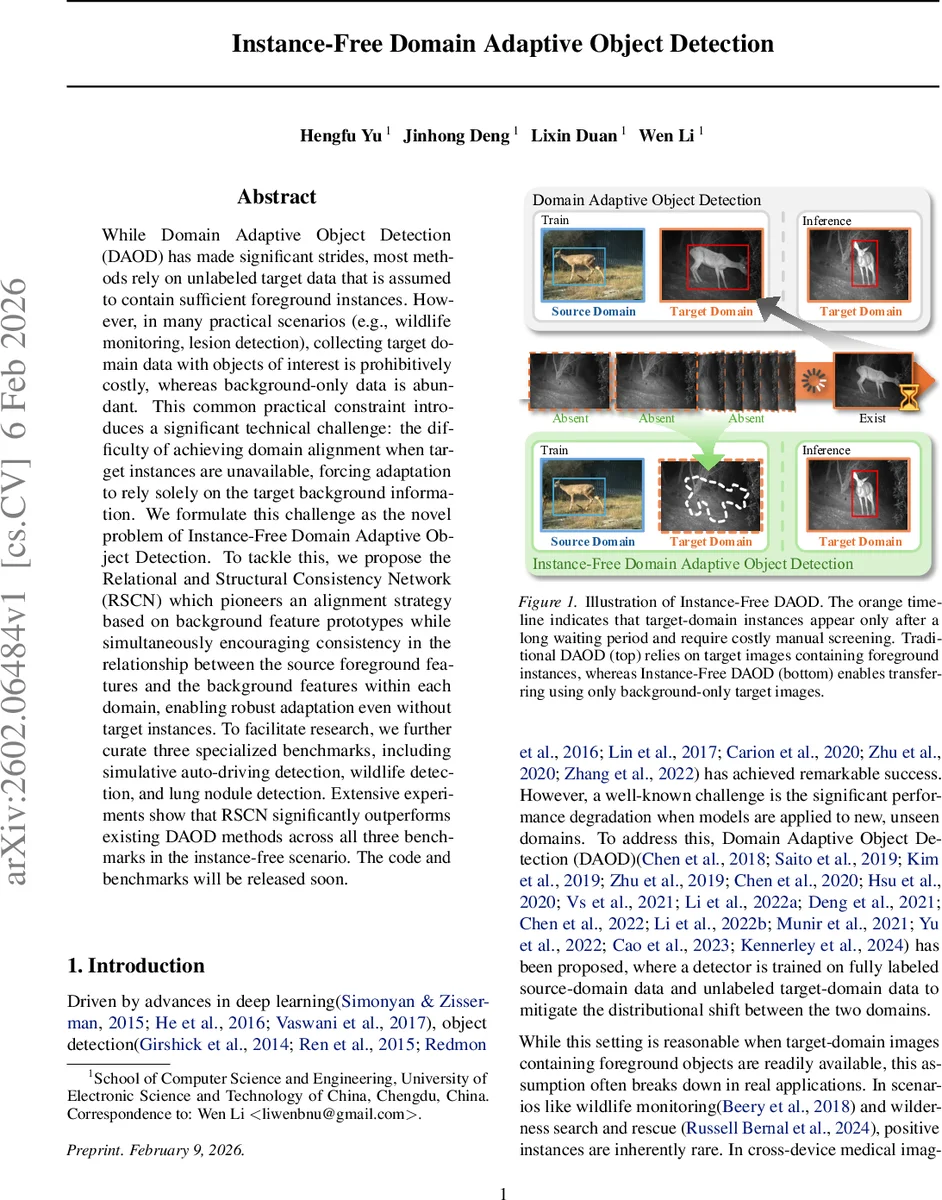
While Domain Adaptive Object Detection (DAOD) has made significant strides, most methods rely on unlabeled target data that is assumed to contain sufficient foreground instances. However, in many practical scenarios (e.g., wildlife monitoring, lesion detection), collecting target domain data with objects of interest is prohibitively costly, whereas background-only data is abundant. This common practical constraint introduces a significant technical challenge: the difficulty of achieving domain alignment when target instances are unavailable, forcing adaptation to rely solely on the target background information. We formulate this challenge as the novel problem of Instance-Free Domain Adaptive Object Detection. To tackle this, we propose the Relational and Structural Consistency Network (RSCN) which pioneers an alignment strategy based on background feature prototypes while simultaneously encouraging consistency in the relationship between the source foreground features and the background features within each domain, enabling robust adaptation even without target instances. To facilitate research, we further curate three specialized benchmarks, including simulative auto-driving detection, wildlife detection, and lung nodule detection. Extensive experiments show that RSCN significantly outperforms existing DAOD methods across all three benchmarks in the instance-free scenario. The code and benchmarks will be released soon.
💡 Research Summary
Domain Adaptive Object Detection (DAOD) has achieved impressive results by jointly training on labeled source data and unlabeled target data that contain sufficient foreground objects. However, many real‑world scenarios—such as wildlife monitoring, search‑and‑rescue, and medical imaging—provide abundant background images but very few or no target‑domain foreground instances, making the standard DAOD assumption unrealistic. This paper formalizes this practical constraint as a new problem: Instance‑Free Domain Adaptive Object Detection (Instance‑Free DAOD), where the target domain supplies only background‑only images during training.
To address the lack of target foregrounds, the authors propose the Relational and Structural Consistency Network (RSCN). RSCN introduces three complementary constraints that together align the source and target domains while preserving the discriminative geometry of the source domain.
- Background Prototype Alignment (BPA): For each training batch, the Region Proposal Network (RPN) of a Faster‑RCNN detector generates proposal features. Source images are grouped by ground‑truth class to form class‑wise foreground prototypes and a source background prototype; target images (which contain no objects) are averaged into a single target background prototype. A three‑layer MLP discriminator D_bg, preceded by a Gradient Reversal Layer, is trained to distinguish source versus target background prototypes, while the feature extractor is trained adversarially to make the prototypes indistinguishable. This aligns the background distributions across domains without any foreground supervision.
- Relative Space Harmonization (RSH): Although foreground prototypes are unavailable in the target domain, the source foreground prototypes can serve as geometric anchors. For each source class c, the normalized vector from the source background prototype to the foreground prototype (d_s^c = N(p_s^c – p_s^bg)) is computed, and similarly the vector from the target background prototype to the same source foreground prototype (d_t^c = N(p_s^c – p_t^bg)). The RSH loss minimizes the L1 distance between d_s^c and d_t^c across all present classes, encouraging the target background to occupy the same relative positions with respect to the source foreground anchors. This triangulation stabilizes the alignment and injects source‑domain object structure into the target feature space.
- Source Structure Preservation (SSP): RSH alone may cause the source feature space to collapse, eroding class separability. To prevent this, a frozen reference detector—trained only on source data—is used to provide a stable embedding of source features. A distance‑based loss penalizes deviations between the current detector’s source features and the reference features, thereby preserving the discriminative geometry of the source domain during adaptation.
The overall training objective combines the standard supervised detection loss on source data with weighted BPA, RSH, and SSP terms:
L_total = L_det(source) + λ₁·L_BPA + λ₂·L_RSH + λ₃·L_SSP.
To evaluate RSCN, the authors construct three specialized benchmarks that reflect the instance‑free setting: (1) a synthetic autonomous‑driving dataset generated with CARLA, (2) a wildlife camera‑trap dataset where target images are empty natural scenes, and (3) a lung‑nodule CT dataset where only healthy scans are available for the target domain. In all three cases, target images contain no annotated or even visible objects.
Experiments show that conventional DAOD methods—pixel‑level style transfer, feature‑level adversarial alignment, and label‑level self‑training—dramatically lose performance when target foregrounds are absent, often collapsing due to false pseudo‑labels. In contrast, RSCN consistently outperforms these baselines, achieving 7–12 percentage‑point gains in mean Average Precision (mAP) across the benchmarks. Notably, on the medical CT benchmark, detection of small nodules (<10 mm) improves by over 15 percentage points, demonstrating the clinical relevance of the approach.
Ablation studies confirm the necessity of each component: removing BPA leaves a large domain gap; omitting RSH reduces the benefit of background alignment because the relative geometry is not enforced; discarding SSP leads to feature collapse and degraded source‑domain detection accuracy. Visualizations of feature maps reveal that after RSCN training, target background features are positioned in the same relational space as source foreground‑background pairs, and false positives are markedly reduced.
The paper’s contributions are threefold: (1) defining the Instance‑Free DAOD problem that mirrors realistic data‑collection constraints, (2) proposing a prototype‑based alignment framework that leverages source foreground geometry to guide background adaptation, and (3) releasing three new benchmarks for future research. Limitations include reliance on the representativeness of background prototypes (which may be insufficient for highly heterogeneous backgrounds) and the current focus on Faster‑RCNN with an RPN; extending the method to transformer‑based detectors or multi‑scale feature hierarchies remains an open direction. Future work could explore dynamic prototype updates via memory banks, multi‑level feature alignment, and integration with weakly supervised or contrastive self‑training to capture latent target‑domain objects. Overall, this work opens a new avenue for domain adaptation when target foregrounds are unavailable, offering a practical solution for many safety‑critical and resource‑constrained applications.
Comments & Academic Discussion
Loading comments...
Leave a Comment