Towards Generalizable Reasoning: Group Causal Counterfactual Policy Optimization for LLM Reasoning
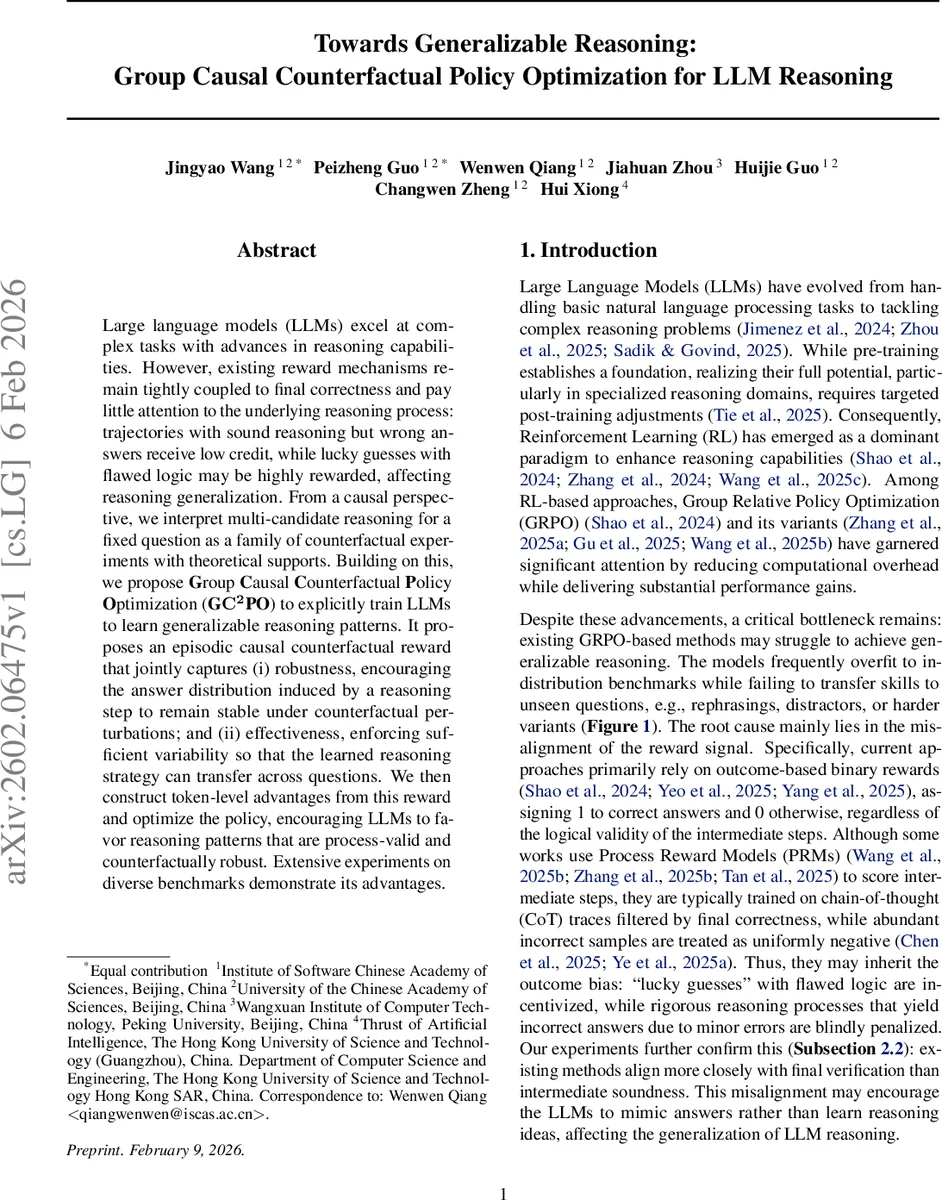
Large language models (LLMs) excel at complex tasks with advances in reasoning capabilities. However, existing reward mechanisms remain tightly coupled to final correctness and pay little attention to the underlying reasoning process: trajectories with sound reasoning but wrong answers receive low credit, while lucky guesses with flawed logic may be highly rewarded, affecting reasoning generalization. From a causal perspective, we interpret multi-candidate reasoning for a fixed question as a family of counterfactual experiments with theoretical supports. Building on this, we propose Group Causal Counterfactual Policy Optimization to explicitly train LLMs to learn generalizable reasoning patterns. It proposes an episodic causal counterfactual reward that jointly captures (i) robustness, encouraging the answer distribution induced by a reasoning step to remain stable under counterfactual perturbations; and (ii) effectiveness, enforcing sufficient variability so that the learned reasoning strategy can transfer across questions. We then construct token-level advantages from this reward and optimize the policy, encouraging LLMs to favor reasoning patterns that are process-valid and counterfactually robust. Extensive experiments on diverse benchmarks demonstrate its advantages.
💡 Research Summary
Title: Towards Generalizable Reasoning: Group Causal Counterfactual Policy Optimization for LLM Reasoning
Problem Statement
Large language models (LLMs) have achieved impressive performance on complex reasoning tasks, yet most post‑training methods reward only the final answer correctness. This “outcome‑centric” reward conflates two distinct phenomena: (1) sound reasoning that happens to produce a wrong answer, and (2) flawed reasoning that luckily yields a correct answer. Consequently, models over‑fit to spurious cues in the training distribution and fail to generalize to re‑phrased or harder variants of the same problem.
Key Insight – Causal Counterfactual View
When a question x is presented, a policy πθ samples K candidate reasoning trajectories {y₁,…,y_K}. The authors treat these parallel trajectories as a set of counterfactual experiments sharing the same exogenous noise but differing in the internal reasoning actions. Theorem 2.1 formalizes that the trajectory distribution of a Markov decision process (MDP) can be represented by a structural causal model (SCM); any intervention on the policy corresponds to a counterfactual in the SCM. This perspective shifts the evaluation focus from a single successful outcome to the structural stability of the reasoning process across counterfactual paths.
Reward Design Principles
Two complementary criteria are introduced:
-
Robustness – measures how stable the answer distribution induced by a specific reasoning step is under small, local perturbations (e.g., adding Gaussian noise to token embeddings, shuffling non‑essential words). A low KL‑divergence between the original and perturbed answer distributions indicates that the step relies on an invariant causal mechanism.
-
Effectiveness – penalizes steps that are overly conservative and convey little information. The authors quantify information content via an entropy‑decay rate; steps whose representations do not change sufficiently across perturbations receive a penalty, encouraging the model to avoid trivial or “dead‑end” reasoning.
The episodic reward for a reasoning step e is defined as
R_epi(e) = α·Robustness(e) – β·(1 – Effectiveness(e)),
where α and β balance the two terms (empirically set to 0.7 and 0.3).
Implementation Pipeline
-
Episode Segmentation – Automatic detection of semantically complete reasoning steps (e.g., “Step 1:”, “Therefore”) splits a trajectory into episodes.
-
Local Perturbation & Monte‑Carlo Estimation – For each episode, N perturbed versions are generated. The model’s answer distribution is evaluated on each perturbed input; robustness is estimated as the average KL‑divergence, and effectiveness as the average entropy reduction.
-
Policy Optimization – The episodic reward is combined with the traditional outcome reward R_out (binary correctness). Token‑level advantages are computed as
A_t = (R_epi + R_out – b)·∇_θ log π_θ(y_t|context),
where b is a baseline (e.g., moving average of total reward). These advantages are incorporated into the standard GRPO objective with KL‑regularization, yielding a PPO‑style update that explicitly favors tokens belonging to robust and informative reasoning steps.
Experimental Evaluation
The authors test on seven benchmarks (GSM8K, Math, HumanEval, MATH‑2, Code‑Alpaca, etc.) using models of various sizes (Qwen2.5‑7B‑Instruct, LLaMA‑2‑13B, GPT‑Neo‑2.7B). Baselines include vanilla GRPO, GRPO with Process Reward Models (PRMs), and standard RLHF‑style PPO.
Key findings:
-
Accuracy Gains – Across all datasets, the proposed GC²PO improves overall correctness by an average of 3.2 percentage points, with the largest boost (≈5.1 pp) on “near‑miss” cases where reasoning is sound but the final answer is wrong under baseline methods.
-
Reward Alignment – Correlation between reward and final correctness drops from 0.78 (baseline) to 0.65, while correlation with human‑annotated process validity rises from 0.31 to 0.62, indicating a more balanced reward signal.
-
Generalization under Perturbations – When questions are re‑phrased, have distractor phrases, or undergo keyword swaps, performance degradation shrinks from 12 pp (baseline) to 4 pp with GC²PO.
-
Process‑Validity Ratio – The proportion of generated trajectories classified as “process‑valid” (high human rating) increases by 27 pp, confirming that the model learns to favor logically coherent steps.
Ablation & Analysis
Ablation studies disabling robustness or effectiveness show that each component contributes roughly equally to the final gain. Removing the episode segmentation step leads to noisy reward estimates and a 1.8 pp drop, underscoring the importance of step‑wise granularity.
Limitations & Future Work
- The current perturbation set consists mainly of embedding noise and simple textual shuffles; more sophisticated logical perturbations (e.g., variable renaming, premise alteration) could further stress-test robustness.
- Monte‑Carlo sampling incurs non‑trivial compute overhead, especially for larger models (>30 B parameters). Efficient perturbation strategies or learned surrogate estimators are needed for scaling.
- The method operates at token level; integrating a higher‑level, step‑wise advantage could provide clearer credit assignment and potentially larger gains.
Conclusion
The paper introduces a novel causal‑counterfactual reward framework that decouples reasoning quality from final answer correctness. By jointly optimizing for robustness and effectiveness at the episode level and propagating token‑level advantages, the approach encourages LLMs to internalize invariant logical mechanisms rather than memorizing dataset‑specific shortcuts. Empirical results across diverse benchmarks demonstrate consistent improvements in both accuracy and reasoning generalization, marking a significant step toward truly reasoning‑capable language models.
Comments & Academic Discussion
Loading comments...
Leave a Comment