Fractional diffusion-wave equations with critical nonlinearities in Lebesgue spaces
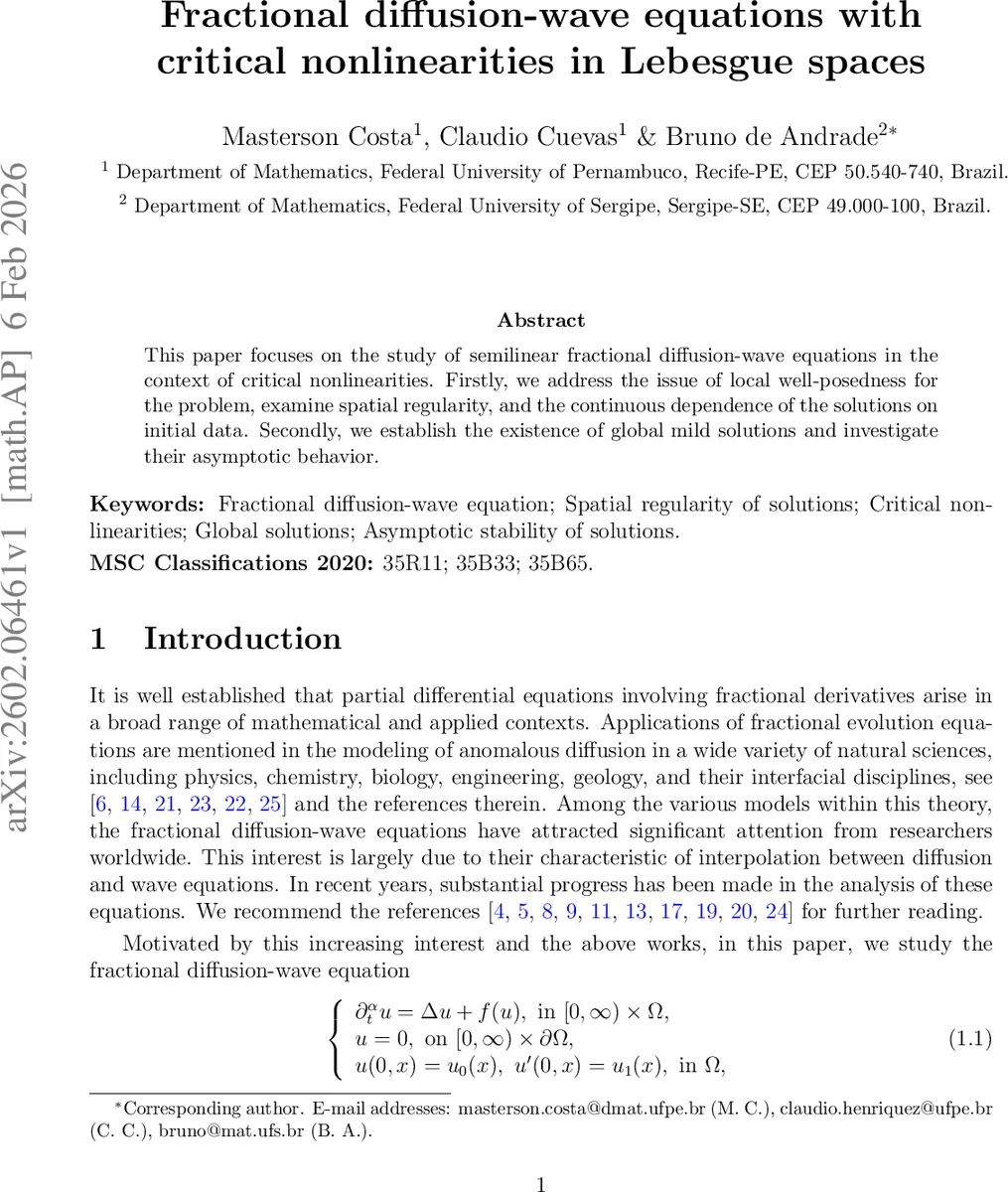
This paper focuses on the study of semilinear fractional diffusion-wave equations in the context of critical nonlinearities. Firstly, we address the issue of local well-posedness for the problem, examine spatial regularity, and the continuous dependence of the solutions on initial data. Secondly, we establish the existence of global mild solutions and investigate their asymptotic behavior.
💡 Research Summary
The paper investigates semilinear fractional diffusion‑wave equations of the form
∂ₜ^α u = Δu + f(u), u|_{∂Ω}=0, u(0)=u₀, u′(0)=u₁, (1.1)
where Ω⊂ℝᴺ is a smooth bounded domain, α∈(1,2) denotes the order of the Caputo fractional derivative, and the nonlinearity f satisfies the growth and Lipschitz condition
|f(r)−f(s)| ≤ C (|r|^{ρ−1}+|s|^{ρ−1})|r−s|, f(0)=0.
The authors focus on initial data (u₀,u₁) belonging to Lebesgue spaces L^q(Ω) with 1<q<∞, and they identify the critical exponent
ρ_c = 1 + 2q/N,
which plays the same decisive role as in the classical heat (γ∈(0,1)) and wave (γ=2) equations. The main contributions can be summarized as follows.
1. Functional‑analytic setting
The Laplacian with Dirichlet boundary conditions is regarded as a sectorial operator L = −Δ on E₀^q = L^q(Ω) with domain E₁^q = W^{2,q}(Ω)∩W₀^{1,q}(Ω). Using the fractional power scale {E_γ^q}γ∈ℝ, the authors define X_γ^q := E{γ−1}^q and introduce the operator A_q = L^{−1}: X₁^q → X₀^q. This yields a hierarchy of spaces X_γ^q that interpolates between L^q and higher Sobolev‑type regularities.
The fractional evolution problem (1.1) is rewritten abstractly as
D_t^α u = A_q u + f(u), u(0)=u₀, u′(0)=u₁, (2.3)
with u₀,u₁∈X₁^q = L^q(Ω). The solution concept relies on the Mittag‑Leffler families E_α(tA_q), S_α(tA_q), R_α(tA_q) generated by A_q.
2. Smoothing estimates
Lemma 2.2 provides crucial decay and smoothing bounds for the linear operators:
‖E_α(tA_q) x‖{X{1+θ}^q} ≤ M t^{-α(1+θ−β)}‖x‖{X_β^q},
‖S_α(tA_q) x‖{X_{1+θ}^q} ≤ M t^{1−α(1+θ−β)}‖x‖{X_β^q},
‖R_α(tA_q) x‖{X_{1+θ}^q} ≤ M t^{-1−α(θ−β)}‖x‖_{X_β^q},
for 0≤θ<β≤1. In particular, the operators t^{αθ}E_α(tA_q) are uniformly bounded from X₁^q to X_{1+θ}^q, and they vanish uniformly on compact subsets as t→0⁺. These estimates are the backbone for the fixed‑point argument.
3. Nonlinearity on the scale
Lemma 2.4 shows that, when q = N(ρ−1)/2 and 0<ε<N/(N+2q), the map f : X_{1+ε}^q → X_{ρε}^q is well defined and satisfies
‖f(u)−f(v)‖{X{ρε}^q} ≤ C (‖u‖{X{1+ε}^q}^{ρ−1}+‖v‖{X{1+ε}^q}^{ρ−1})‖u−v‖{X{1+ε}^q}.
Thus f is locally Lipschitz on the chosen space, which is essential for the contraction mapping.
4. Local well‑posedness (Theorem 1.1)
For any α∈(1,2) with α<π/φ_q, any ρ>1, and q satisfying the critical relation, there exists ε>0 such that for every (u₀,u₁)∈L^q(Ω) a radius r>0 and a time τ₀>0 can be found so that the integral equation
u(t)=E_α(tA_q)u₀+S_α(tA_q)u₁+∫₀ᵗ R_α((t−s)A_q)f(u(s)) ds
has a unique ε‑regular mild solution on
Comments & Academic Discussion
Loading comments...
Leave a Comment